


Expose hate. Educate with integrity. Empower through action.
Symposium That Named Antizionism for What It Is
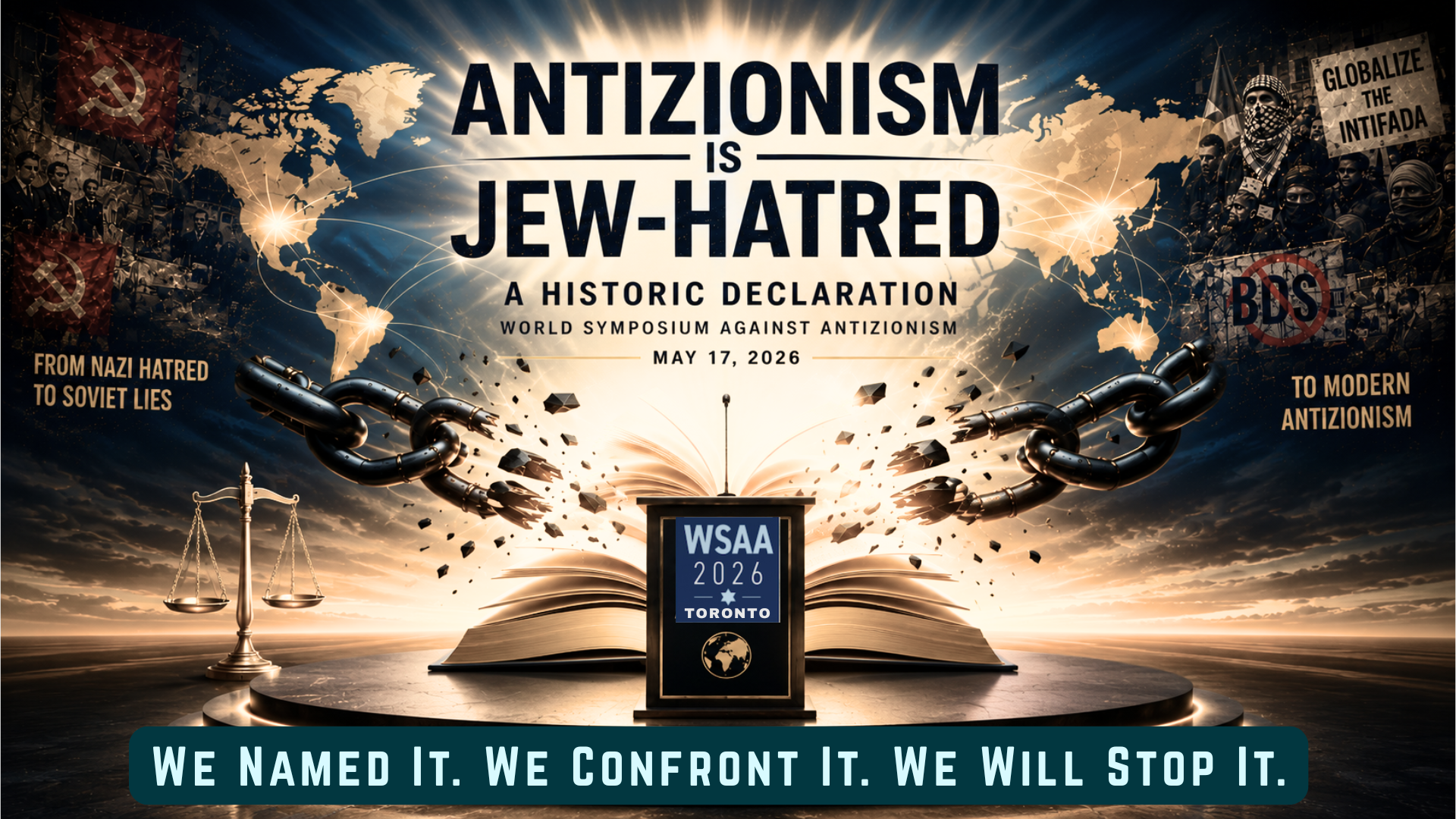
WSAA Declaration - Antizionism is Jew-hatred
On May 17, 2026, something unprecedented happened. Jews and non-Jews, among them scholars, survivors, lawyers, educators, and activists, gathered from across the world not to mourn, but to declare.
The declaration: Antizionism is Jew-hatred.
The World Symposium Against Antizionism, organized by StopAntizionism in partnership with Tafsik, was the first global event of its kind built on urgency, moral clarity, and the conviction that hatred, when left unnamed, becomes normalized.
What we are witnessing across the Western World is dark history repeating itself.
Why Now
As a Soviet survivor, I carry this knowledge in my bones. Antizionism behind the Iron Curtain was never really about Israel. It was about Jews — a weapon of isolation, silence, and erasure, dressed in the language of politics.
My research in fall 2025 showed antizionist hostility had reached a 70–75% adoption rate on the diffusion curve, the Late Majority stage, with organized violence already underway. The next phase, if unchecked, is genocidal consensus: ideological saturation above 85%, where existential danger becomes acute.
Antizionism was a Stage 4 cancer. And like any cancer, it cannot be treated until it is named.
The “Come to Moses” Moment
Silence was not an option. As a Soviet survivor, I made a promise to myself: I will never surrender to hate.
StopAntizionism already had the message and education fully developed, including Dr. Naya Lekht’s Three-Era Framework of Jew-Hatred, tracing anti-Jewish hostility from religious anti-Judaism through modern antisemitism to contemporary antizionism. What was needed now was a moment of declaration.
I envisioned a “Come to Moses Meeting,” a Mount Sinai moment, where people from across countries, backgrounds, and beliefs would gather and name, without hesitation, what the world has been reluctant to name: antizionism is Jew-hatred. A global paradigm shift. A revelation.
Choosing a keynote speaker required someone with moral clarity, a command of Jew-hatred’s cycles, and the ability to expose the Marxist-Islamist ideologies fueling antizionism today. Ben Shapiro was the obvious choice.
Executing a vision of this scale required the right partner, someone who understood both the urgency and the complexity of mounting a serious, high-level event in a short period of time. I called Amir Epstein of Tafsik and asked if he wanted to make history. A partnership for the World Symposium Against Antizionism commenced.
That partnership reflects an essential truth: confronting antizionism cannot be done alone. It requires coalition, unity, courage, and a shared understanding that antizionism is a lethal threat to humanity.
The Symposium
On May 17, 2026 — a beautiful sunny Sunday, the first long weekend of spring in Canada — approximately a thousand people gathered at Paramount Events. This is where the “Zionists” made history, coming together for the first time to confront antizionism as the third era of Jew-hatred and trace its evolution.
The atmosphere carried both inspiration and tension. Due to serious security concerns and the risk of possible attacks, the location remained undisclosed, even to some speakers, until roughly 12 hours before the event. Bomb-sniffing dogs, private Jewish security personnel, bag checks, and extensive protective measures surrounded the symposium throughout the day.
Many attendees arrived not fully knowing what to expect. What they encountered was not simply another conference or political event, but a framework — a revelation about how antizionism evolved, how it functions, and why it must be confronted with moral clarity. Once people saw the pattern, they could no longer unsee it.
The Panels
The full-day program examined antizionism across six panels — its origins, evolution, and consequences, not only intellectually, but practically.
Dr. Naya Lekht, scholar, educator, and developer of the Three-Era Framework of Jew-Hatred, led this panel, tracing the evolution of anti-Jewish hostility from religious anti-Judaism to modern antisemitism to contemporary antizionism. In each era, she argued, Jew-hatred reveals the corrupted morality of its time: the Jew is constructed as a villain through a cycle of libels, accused of violating society’s highest moral good. Ben Cohen (FDD) demonstrated through a timeline how antizionism was institutionalized in the UN with direct Soviet assistance, a reincarnation of Jew-hatred repackaged as political criticism of Israel after the Holocaust. Dr. Einat Wilf addressed Palestinianism directly: the very definition of Palestinianism, she argued, is the lived reality of antizionist ideology, a movement that has prioritized the destruction of the Jewish nation over building a future for its own people, diverting resources across generations toward that end and creating a multigenerational tragedy. Peace, Wilf concluded, can only begin when antizionism is rejected.
Loay Alshareef, Rawan Osman, Abraham Hamra, and Ali Siadatan brought their lived experiences of how MENA was radicalized through Nazi, Soviet, and Islamist propaganda. Rawan described how Mein Kampf and the Protocols of the Elders of Zion have been sold in Syria, Lebanon, Egypt, and across MENA and treated by antizionist academics as serious literature, giving rise to modern-day libels. Loay highlighted the marriage between the radical left and radical Islamists, united in demonizing Jews and Zionists, and stressed that confronting this requires deep education within the Arab world. Abraham Hamra reminded the audience that since the founding of Islam, Jews and Christians were treated as second-class citizens, Dhimmis who paid the jizya tax for the right to survive.
The panel exposed how antizionism manifests differently across Canada and the United States. In Canada, the focus fell on institutional normalization, weak enforcement, and a legal system that struggles to recognize antizionism as Jew-hatred. In the U.S., stronger progress is being made through Title VI, civil rights protections, and anti-discrimination frameworks. Rabbi Dr. Mark Goldfeder demonstrated how existing legal tools can challenge antizionist discrimination. Professor Rona Kaufman emphasized the role of legal scholarship and intellectual clarity in shaping the fight. Leora Shemesh delivered the panel’s essential conclusion: law alone is not enough without moral leadership and the courage to confront hatred directly.
StopAntizionism has worked closely with Associated Hebrew Schools (AHS) Toronto on a curriculum built around the Cycle of Libels. Remarkable grade 8 students demonstrated their mastery of the mechanics of the Cycle of Libels and the Role of Token Jews, state-of-the-art education that AHS is leading globally. Their leadership understood something essential: if we want children to confront hatred, we must first teach them how hatred operates. Dr. Gad Saad offered a striking analogy: just as a parasite manipulates a cricket into drowning itself, suicidal empathy is driving Western civilization toward self-destruction by normalizing antizionism while eroding the values of freedom, democracy, and self-preservation. A society that cannot recognize ideological parasitism becomes vulnerable to collapse. Dr. Brandy Shufutinsky (FDD) examined how Cultural Marxist frameworks, through the Pedagogy of the Oppressed, normalized and institutionalized antizionism within modern educational institutions. Dr. Andrew Pessin addressed how postmodernism provided intellectual fuel to antizionism.
Jesse Brown, founder of Canadaland and known for challenging mainstream journalism, noted pointedly that the media was not present to cover this historic event. Antizionism, he observed, is an anti-social force that infects and destroys, and its normalization in media is part of the problem. Eve Barlow warned that antizionism is a Trojan horse for Islamism: the extremism taking root in Britain, Canada, and the U.S. is incompatible with the free world. Lizzy Savetsky drew on Parasha Lech Lecha — G-d’s call to Abraham to go to the land where he would become a great nation and a blessing. Emily Austin concluded with a demographic argument for Jewish continuity: “make more Jewish babies.”
Eyal Yakoby, Jacob Smith, and Nick Matau gave me tremendous hope. Yakoby framed the stakes clearly: this is a battle between the free world and the Marxist-Islamist alliance, and he urged redirecting funds away from DEI and toward Jewish institutions, churches, and allies. Smith drew the direct parallel between antizionism and racism, where both demonize and apply double standards, holding Israel to demands placed on no other nation. Matau articulated the underlying pattern: antizionism, like all Jew-hatred, accuses Jews and Israel of whatever society currently defines as its greatest evil. To confront it, Smith urged conserving the institutions that made our countries great, taking pride in them, and standing against hate.
Listening to this next generation speak with such clarity, courage, and conviction gave me genuine hope that civilization is not yet lost. They are not confused, intimidated, or morally compromised. They understand exactly what is at stake, and they are prepared to confront it.
Zack Dulberg, Network Contagion Research Institute (NCRI), presented on moral inversion and the rise of authoritarian sympathy. James Lindsay (New Discourses) explained how Marxism systematically eliminates critical thinking, making it a perfect conduit for extremist ideologies, and described what the Soviets called a “demoralized population”: people who can no longer distinguish right from wrong even when confronted with facts and moral arguments. When a society loses its moral compass, demoralization is complete. Pamela Paresky, social psychologist, showed how history is projected and morality inverted through libels and conspiracies, where antizionism is not a new ideology but the same Jew-hatred dressed in different clothes.
The Keynote: Ben Shapiro
Ben Shapiro’s keynote address framed antizionism not as a policy disagreement, but as a moral and civilizational crisis. He argued that modern Zionism is no longer about establishing a Jewish state, but about defending the right of Israel, and its people, to survive. “Modern Zionism today is the proposition that the Jewish state of Israel ought not be exterminated,” Shapiro said, “and that people ought not do unto Israel what they would not have done unto them. No extermination and no double standards.” He reduced the debate to its moral core: Zionism means not eliminating Israel. Antizionism means eliminating Israel — the destruction of a country of roughly 10 million people, including 8 million Jews and 2 million Arabs. “That is not politics,” he argued. “That is racism.”
Shapiro argues that both, antizionism and antisemitism, operate through the same conspiratorial architecture. The only difference, he said, is that “Zionist” has replaced “Jew” in the language of accusation, libels, and collective blame. But more importantly “Antizionism is evil,” he said. “It is predicated on lies, and it requires violence to achieve the ends it seeks.”
Beyond the Jewish dimension, Shapiro described antizionism as a symptom of a broader civilizational crisis resulting from Marxist and Islamist ideologies eroding the moral confidence of free societies while once again turning the Jew into society’s scapegoat.
“It’s more palatable these days to call yourself an antizionist than anti-American or anti-Canadian,” he warned, “but it’s the same root conspiracy theory.” Jew-hatred, he argued, has always surged when extreme ideologies gain influence, making antizionism not only a Jewish problem, but a threat to democratic civilization itself. His prescription was blunt: “If you want to fight antizionism, don’t fight the fever — fight the flu.”
Shapiro also warned about the erosion of Jewish identity within parts of the Jewish community itself, arguing that the next generation cannot be expected to defend values they were never taught to embrace.
The goal, he argued, was not to turn everyone into passionate Zionists, but to make anti-Western and anti-Israel extremism socially unacceptable. “The task is to reject evil.” Shapiro closed with a call to courage: “What mattered then was courage — courage to move forward, not to be paralyzed by dangers on all sides. So speak up, fight back, and never back down, because as history shows, where there is courage, there is victory.”
The symposium concluded with a message from Soviet refusenik and human rights leader Natan Sharansky, whose life embodied the moral clarity and courage many speakers argued are now required once again.
What Was Declared
This symposium achieved exactly what we set out to do: name what much of the world has been reluctant to name. Antizionism is not politics, dissent, or criticism — it is the third era of Jew-hatred, and a growing civilizational threat.
The symposium provided a framework for understanding how Jew-hatred mutates across eras, from anti-Judaism to antisemitism to antizionism, and why naming each mutation precisely is the first step in confronting it. The Global Declaration that antizionism is Jew-hatred is a consensus, built in a room of scholars, educators, and survivors who know exactly what this ideology is, where it came from, and where it leads.
The Global Declaration that antizionism is Jew-hatred did not remain confined to the symposium hall. It is rapidly becoming an international consensus. More than 3,000 individuals and over 50 institutions have already signed, with support growing daily across countries, professions, faith communities, and generations.
Signing is not merely symbolic. It is an act of moral clarity, a refusal to allow Jew-hatred to continue hiding behind euphemisms, political abstractions, or ideological camouflage. It gives people the language, the framework, and the confidence to identify antizionism for what it is and confront it in public life, education, media, law, and civil society.
The declaration also complements the IHRA Working Definition of Antisemitism. IHRA provides the legal and institutional framework for identifying antisemitic conduct. The Global Declaration addresses the ideological mutation itself. Together they form a double shield: one defines antisemitism operationally, the other exposes antizionism morally and intellectually. One protects institutions. The other helps societies recognize the ideology before it normalizes and spreads.
Hatred cannot be defeated if it remains unnamed. And once named clearly, it becomes far harder to normalize, excuse, or institutionalize.
StopAntizionism left this symposium with a launchpad. Attendees took home educational materials, frameworks, and practical tools to confront antizionism with clarity and precision in their own communities. People left energized, eager not only to understand, but to act.
We reminded the audience that moral truth has never depended on majority approval. Only 20% of people left Egypt to follow Moses. Judaism was never a popularity contest. StopAntizionism is not building a big tent, but a moral one that is grounded in courage, critical thinking, and an uncompromising commitment to truth.
Most importantly, people left inspired, hopeful, proud, and empowered.
A Word on Execution
A full-day world-class event of this scale, covering security, venue, hotels, food, technology, and speakers from multiple countries, is a massive undertaking. It came together. There were challenges, as there always are, but they were the kind only the organizers would notice. As one of the organizers, I will admit I was worried. I am grateful to Tafsik for ensuring that every aspect of security and logistics was handled with professionalism and care. And yet, the reality that Jews gathering peacefully in a democratic society require this level of security says something deeply troubling about the moment we are living through.
What Comes Next
The symposium was not an endpoint. It was the beginning.
The tools are now in the hands of those willing to carry this fight into classrooms, courtrooms, newsrooms, and communities.
StopAntizionism‘s five-pillar initiative — Global Declaration, Symposium, Education & Training, Ideology Research Centre, and Global Antizionism Response Initiative — is designed for sustained, strategic confrontation of this ideology.
“Never Again” was never meant to be a slogan. It is a responsibility.
So let this symposium be remembered as the moment people stood up and said: enough.
Call antizionism what it is. Expose it. Confront it. Stop it.