
Taking Netanyahu at Face Value: The Response Reveals His Gaza Doctrine
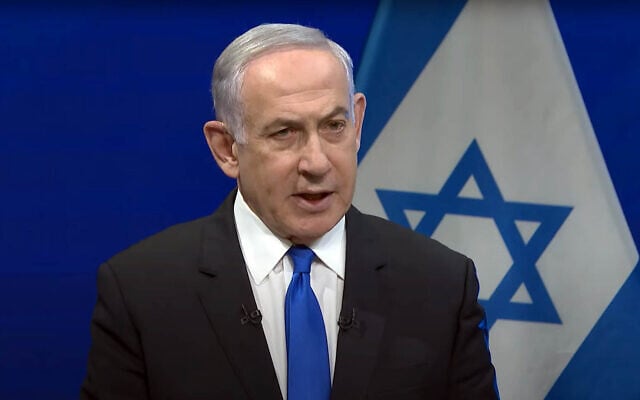
Last Thursday, Benjamin Netanyahu released to the public the official response he gave to the State Comptroller as part of the ombudsman’s investigation into the October 7, 2023, Hamas-led atrocities.
Of course, this is being consumed the way Israeli politics is often consumed: as a highlight reel of quotable fragments, protocol excerpts, and opposition figures dragged in for rhetorical effect. That is the easy read—the gossip-program read. The harder read is more consequential. If you take Netanyahu at face value, assume his citations reflect what was actually said, and treat his chronology as sincere, the document functions as something close to a doctrine memo. It tells you what he believes Israel’s Gaza policy was—and, indirectly, what he believes it should have been.
Start with what Netanyahu is clearly trying to establish: his doctrine was not “containment” as passivity. He explicitly rejects the language of “containment” and “quiet for quiet,” insisting those terms were never part of his directives. The vocabulary he wants attached to his name is different: deterrence, weakening, and controlled coercion. In his account, Hamas is managed through periodic blows that restore the price of aggression—what Israelis have long called “mowing the grass.” Deterrence is not a byproduct; it is the stated objective. When deterrence is harmed, he frames the moment as an opportunity to “correct it,” not as a reason to rewrite the entire strategy.
The second pillar is defined as much by what he doesn’t choose as by what he does. In multiple protocol moments, “full conquest” or “reoccupation” of Gaza appears as the obvious alternative—then is pushed aside. Sometimes it is described as lacking political support; sometimes it is treated as strategically wrong; sometimes it is simply not brought to a vote. Either way, the pattern matters. If a state repeatedly treats occupation as the option that cannot be taken, then deterrence-management is no longer a temporary tactic. It becomes the doctrine—because the “decisive” option is excluded by design.
That exclusion forces a third pillar: targeted force as a substitute for regime change. Netanyahu’s preferred instruments, in his own telling, are capability degradation and decapitation: striking infrastructure, pursuing leadership targets, and sustaining pressure without crossing into a war of governance. In one exchange, he tests the classic question—if you eliminate the top leadership, does the organization collapse? When told “no,” he doesn’t abandon the approach; he doubles down: then eliminate them anyway. This is not a theory of “day after” political architecture. It is a theory of repeated attrition.
So far, the doctrine looks coherent: no occupation, no attempt to “solve” Gaza, but constant management through deterrence, weakening, and selective force—calibrated to avoid a full-scale war that would require Israel to take responsibility for two million Palestinians.
Then comes the Qatari money, which supplies the doctrine’s economic engine.
In Netanyahu’s defense, Qatari funding is framed as a stabilizer: money is not “financing terror,” but preventing escalation, avoiding humanitarian collapse, and maintaining regional stability. That framing clashes sharply with a report by Nir Cohen for Yediot Ahronot in 2024, in which he reveals Netanyahu’s letter to Qatar in 2018.
In that account, a “top secret” letter allegedly sent from Jerusalem and signed by Netanyahu urges Doha to keep the pipeline open when Qatar considered closing it. The report says Netanyahu also mobilized the United States—through Treasury Secretary Steven Mnuchin—to provide assurances that the funding would not be treated as terror financing. The mechanism becomes institutional: roughly $30 million monthly, structured as fuel, salaries, and cash assistance. The article’s punchline is not only that the money flowed, but that it helped Hamas evolve into a more formidable force—tunnels, battalions, and the firepower of a small army.
Read Netanyahu’s defense alongside that reporting and a clear doctrinal assumption emerges: calm can be engineered. Deterrence is reinforced not only by strikes, but by “incentives” meant to reduce motivation for war, keep Hamas governing, and buy time. Both Netanyahu and the journalist would agree that this is where “the conception was born”: the belief that as Hamas accumulates assets and governing responsibilities, it will behave like a rational quasi-state actor.
Now contrast Netanyahu’s doctrine with the IDF’s own investigation into the “Gaza conception,” and the overlap becomes unmistakable. The IDF inquiry argues that for more than a decade Israel internalized a belief that toppling Hamas was not the goal; Hamas should remain the “address” in Gaza, deterred but intact. It describes how “quiet until the next escalation” became the measure of success, how Hamas’s invasion plan (“Jericho Wall”) was dismissed, and how reliance on the barrier, sensors, and routine led to diluted defenses and strategic complacency. It also cites an explicit direction from summer 2023: prioritize Iran, Hezbollah, and the West Bank; keep Gaza as calm as possible with Qatari aid and humanitarian easing. The army admits it did not challenge this.
Here is the key: Netanyahu’s document does not truly refute the IDF’s “conception.” It reframes it. He rejects the branding—“containment,” “quiet for quiet”—but not the substance: deterrence as regulator, Hamas as an address, economic stabilization as a tool, and avoidance of reoccupation as a governing premise. He even acknowledges failures that mirror what critics attribute to him—misread incentives, overconfidence in systems, and a strategy that treated Hamas’s restraint as durable. What he does not acknowledge is the political conclusion: responsibility. The failure is described as intelligence, as operational misreading, as others’ assessments—rarely as the predictable collapse of a doctrine built to postpone the hardest decision.
If we take Netanyahu at his word, the tragedy is not that Israel had no Gaza doctrine. It is that it had one—and when it failed catastrophically, its architect tried to defend it as if it were merely a broken alarm, not a strategic wager that finally came due.