Making Taboos Taboo Again
Tal Becker Gets It Half-Right
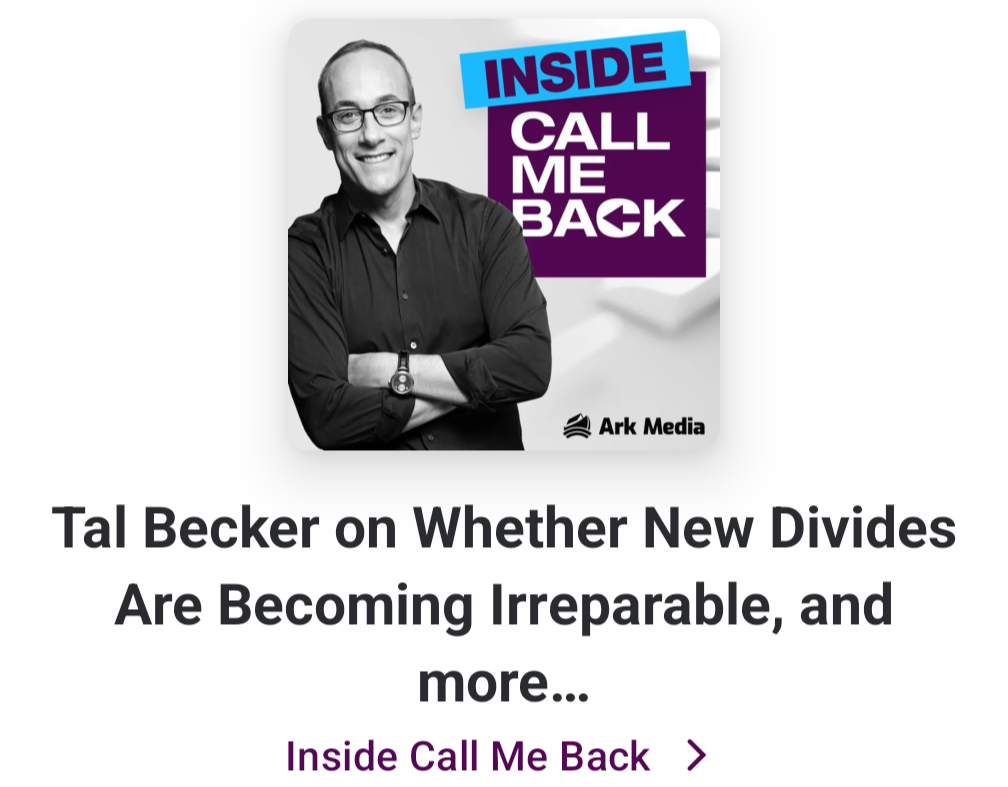
Tal Becker on Inside Call Me Back podcast
Solidarity alone cannot sustain the taboo against hateful bigotry. We need our leaders to enforce the social and institutional penalties that keep the illiberal, immoral, and violent fringe on the absolute margins.
There are few moral leaders I admire more than Tal Becker, whose insights I have intently listened to and learned from these past few years. That’s why I was grateful to have him answer my question on a recent episode of the Inside Call Me Back podcast, where I asked how we can make overt eliminationist bigotry and the endorsement of violence socially taboo again.
Becker’s answer focused on the necessity of moral courage and solidarity, particularly from non-Jews. He shared a powerful anecdote of encouraging a European politician to place a mezuzah on his door after a constituent’s house was defaced with a swastika. This is a vital message of solidarity, even though that politician ultimately declined to act. However, it only addresses one half of the equation—and misses what is arguably the more critical mechanics of how taboos are actually maintained.
Anonymous acts of hateful vandalism create permission structures for hate when left unmonitored, but open, overt expressions of bigotry by recognizable public actors are infinitely more dangerous. When somebody publicly espouses or sanitizes eliminationist rhetoric without facing professional, social, or institutional consequences, it sends a powerful signal that the hate is socially tolerated.
Solidarity alone cannot sustain a taboo, especially when there are strong ideologies and incentives in place to violate those taboos. We must pair positive messages of liberal equality with principled, consistent ostracism against those who violate those boundaries. This is how civil society has historically maintained its guardrails.
The challenge we face is not that the American majority has suddenly embraced extremism. Recent polling indicates that less than 5% of Americans across the political spectrum support political violence. The vast majority still instinctively reject raw bigotry and discrimination. The breakdown happens when partisan and tribal narratives cloud that judgment, carving out rationalized exceptions for “our side.” When we allow political tribalism to excuse the inexcusable, we engage in the exact moral hypocrisy that erodes universal taboos.
Moreover, relying on the fact that these beliefs remain “fringe” understates the compounding danger of their normalization. Extremist beliefs do not need to capture a majority to cause civilizational damage; they merely need to capture institutions. When institutional leaders fail to enforce social penalties, radical ideologies are normalized with astonishing speed, shifting the boundaries of acceptable discourse from the top down.
History shows that a society does not need to descend into widespread civil conflict to be unraveled by extremism. Even if a normalized fringe never triggers a broad, immediate violent backlash, it takes only one radicalized actor, empowered by a broken taboo, to commit a catastrophic act of mass violence. The damage of such an event to our social fabric, our sense of safety, and our democratic trust is immense and enduring.
We cannot afford to treat the erosion of universal taboos as a minor political drift. We do not just need our leaders to stand in solidarity with victims after the fact; we need them to courageously enforce the social and institutional penalties that keep the hateful and illiberal fringe where it belongs—on the absolute margins of society. That is how we make taboos taboo again.
Related Topics
Related Posts