
A voice from Morocco
Tamim’s Mustache Is Real—So Is His Agenda
The Network That Gave Bin Laden a Fanbase.
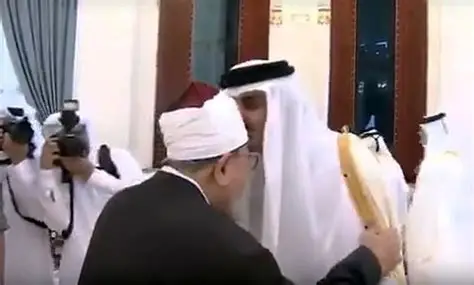
I watched with bewilderment as two of America’s most seasoned diplomats—Hillary Clinton and Condoleezza Rice—appeared on CBS News to commend Qatar’s role in brokering the latest phase of the Gaza peace deal. Their praise was measured, cautious even, but unmistakable: Qatar, they suggested, had emerged as a stabilizing force in a region torn by war.
But what exactly are we stabilizing?
The Emir of Qatar, Sheikh Tamim bin Hamad Al Thani, is no neutral broker. He is the political heir of a Wahhabi dynasty and the ideological son of Yusuf al-Qaradawi, the spiritual leader of the Muslim Brotherhood and a man who openly endorsed suicide bombings by Hamas. This is not a footnote—it is the foundation. For Tamim, Qaradawi is not just a mentor; he is a founding father. As Jefferson and Madison are to Americans, or Ben-Gurion and Golda Meir are to Israelis, Qaradawi is to Tamim: the architect of a vision, the moral compass of a movement, the voice that shaped his worldview. And that worldview is anything but peaceful.
To entrust post-war Gaza to such a figure is not just naïve—it is dangerous.
Qatar has no standing army worth mentioning. Its true military investment since the late 1990s has been Hamas. Through financial lifelines and diplomatic shielding, Doha has nurtured the group into a regional actor. And without the propaganda machine of Al Jazeera—Qatar’s most potent export—Hamas would be a shadow of itself. The network’s editorial line has long blurred the line between journalism and ideological mobilization, amplifying narratives that legitimize armed terrorism while cloaking it in the language of resistance.
So, when Clinton and Rice speak of “Arab leadership” and “regional commitment,” we must ask: leadership toward what end? Commitment to which vision?
Qatar was a geopolitical footnote until it struck gas in the mid-1990s. That moment—when the North Field began to yield its riches—marked the turning point. With newfound wealth and no legacy to defend, Doha chose not to build a conventional army or invest in regional stability. Instead, it built a media empire and an ideological arsenal.
Al Jazeera, launched in 1996, was not merely a news network—it was a calculated instrument of influence. Draped in the language of free speech and reform, it became the most sophisticated propaganda machine in the Arab world, amplifying voices that other regimes had silenced. Chief among them: the Muslim Brotherhood.
As Saudi Arabia and the Emirates began to purge the Brotherhood from their institutions, Qatar offered sanctuary. It granted citizenship to Yusuf al-Qaradawi and transformed Doha into the movement’s de facto headquarters. This was not a humanitarian gesture—it was a strategic alignment. By absorbing the Brotherhood, Qatar positioned itself as the ideological capital of Sunni political Islam.
But Doha’s ambitions didn’t stop there. It understood that by courting the remnants of pan-Arabism and Nasserist nostalgia—those still yearning for a unified Arab front—it could weave a broader coalition of grievance. The Brotherhood’s populist appeal, fused with the emotional residue of Arab nationalism, gave Qatar a potent ideological cocktail. One that could be exported, weaponized, and monetized.
Tamim’s ambitions stretch far beyond Gaza. His disdain for the United States—particularly for President Trump—is not merely political, it is visceral. He envisions a future where Arab zealots flood Israeli territory, committing acts so barbaric they would make history recoil. This is not hyperbole—it is the ideological arc of a man groomed by Qaradawi and emboldened by Western deference. Tamim is not just a sponsor of Hamas; he is the architect of a curse that now shadows Jewish communities worldwide, fueling antisemitic rhetoric under the guise of geopolitical grievance.
And the legacy runs deeper. Tamim’s father, Hamad bin Khalifa Al Thani, was a known sympathizer of Osama bin Laden. After 9/11, Al Jazeera’s studios were reportedly adorned with portraits of bin Laden, and the network played a central role in launching him to global notoriety. The infamous video tapes—sent directly to Al Jazeera—were not just news items; they were ideological broadcasts. When bin Laden was finally isolated in his Pakistani villa, he clung to relevance by watching his own face on Al Jazeera.
To imagine Al Jazeera voluntarily reforming its malign antisemitism is like waiting for Hitler to instruct Goebbels to turn his propaganda ministry into a peace-loving choir. Tamim mocks American diplomacy with the same theatrical contempt Hitler once reserved for FDR’s pleas not to invade neighboring countries. He plays the statesman while plotting the storm.
The optics of diplomacy often obscure its undercurrents. Qatar’s mediation is not a gesture of peace—it is a strategic maneuver to preserve influence, rehabilitate Hamas, and shape the post-war order in Gaza. The West’s embrace of Doha as a peacemaker risks laundering decades of ideological sponsorship and geopolitical manipulation.
Tamim may wear the tailored suit of a modern statesman, but his legacy is stitched with the threads of radical mentorship and ideological grooming. To dismiss his individual actions as regional eccentricities is to ignore a growing global threat. Qatar’s propaganda—once confined to the Arab world—has long breached its comfort zone. It now echoes through European capitals, American campuses, and digital platforms worldwide, shaping narratives, fueling grievance, and laundering extremism under the guise of diplomacy. This is no longer a question for polite panels or cautious engagement. Qatar is a dossier that demands urgent attention—one best opened not in Washington, but at a very special desk in Tel Aviv.
Related Topics
Related Posts