


Historian, Librarian, Educator, and Artist
Taylor Swift, Israel, and the Politics of Presence
What the backlash to a Taylor Swift documentary reveals about Jewish visibility and antisemitism in popular culture
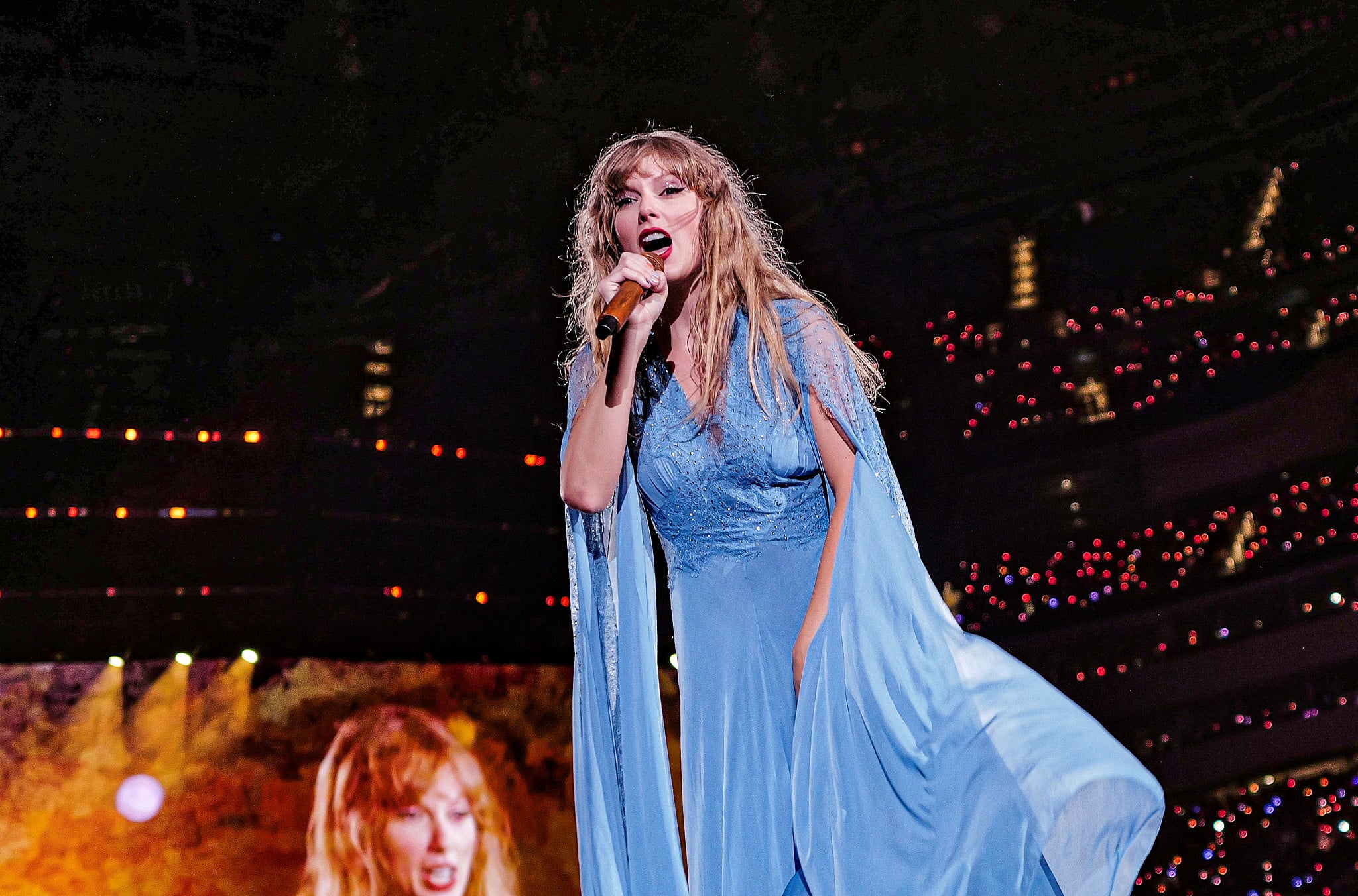
Taylor Swift onstage during the Eras Tour, later documented in Taylor Swift: The End of an Era. Brief references to Israel in the film have sparked an outsized backlash, highlighting the growing politicization of cultural visibility. (Source: Wikipedia Commons)
When Taylor Swift: The End of an Era premiered on Disney+ in December 2025, it was meant to serve as a reflective conclusion to the most successful concert tour in modern music history. Instead, the documentary became an unexpected cultural flashpoint, not because of anything Swift said about Israel or Gaza, but because Israel was visible at all.
Twice in the series, Israel appears briefly and without commentary. In one scene filmed outside Wembley Stadium, fans waiting to enter the concert mention they have met fellow Swifties from “Scotland, England, and Israel.” In another, archival CNN footage covering the cancellation of Swift’s Vienna concerts due to a terror threat shows a reporter broadcasting from Tel Aviv. Swift herself never utters the word Israel, offers no political framing, and makes no statement about the ongoing war.
However, those fleeting references were enough to trigger a wave of online outrage. Social media users accused Swift of being a “Zionist,” of deliberately including Israel in her documentary, and of “humanizing genocide” simply by allowing Israel to remain present. As reported by Ynet and The Jerusalem Post, critics argued that the mentions could have been edited out and that Swift’s failure to remove them amounted to a political statement.
The reaction shows something disturbing about the current cultural moment: some people see Israel’s presence as a provocation, and being neutral is seen as a moral failure.
From Vienna to Retrospect
The controversy around The End of an Era is connected to the fear that the Vienna terror plot in August 2024 caused. At that time, Taylor Swift called off three sold-out Eras Tour concerts because Austrian officials found a credible plan for an attack that would kill a lot of people.
Investigators arrested several suspects, including young men radicalized online and influenced by Islamist extremist ideology. Authorities recovered weapons, explosive materials, and detonators and warned that tens of thousands of concertgoers could have been targeted at Ernst Happel Stadium and in surrounding areas. U.S. intelligence shared the initial warning with Austrian authorities and Europol.
At the time, Swift limited her public response to logistical announcements. She did not issue a political statement, comment on terrorism, or address broader geopolitical issues. In the documentary, however, she speaks candidly about the psychological impact of the threat. “We dodged a massacre situation,” she says, describing the sense of vulnerability that followed a series of violent and frightening incidents during the tour.
With hindsight, the Vienna plot reads less as a referendum on Swift’s political views than as a reminder that global pop culture itself has become a symbolic target. Swift did not need to endorse Israel—or Palestine—to be selected. Her concerts represented scale, visibility, and Western cultural power. That was enough.
The Demand for Alignment
Since October 7, 2023, the discourse surrounding Israel has become considerably more antagonistic. Nuance has disintegrated. Silence is beginning to be interpreted as agreement. Celebrities are now judged not only by what they say but also by what they don’t say and what they allow the public to see.
Taylor Swift is at the forefront of this shift not because she made a statement but rather because she declined to comply with public demands for ideological position. She has not signed ceasefire letters, publicly denounced Israel, or made pro-Palestinian remarks despite pressure from fans and activists. In 2024 and 2025, many fans urged her to use her platform to speak out by using hashtags like #SwiftiesForPalestine and #AllEyesOnRafah.”Blockout 2024” and other campaigns went after celebrities who stayed neutral, saying that silence was a moral failure. Swift did not respond.
For some fans, particularly in Israel, her restraint was welcome. For others, especially within activist circles, it was intolerable. What they demanded was not compassion, but declaration.
Documentary Editing and the Politics of Erasure
The outrage over The End of an Era is striking precisely because the references to Israel are so unremarkable. Israel appears not as an argument but as a fact of the world: fans come from there; news is reported from there.
One of the mentions of Israel is a CNN report from Tel Aviv by veteran anchor Wolf Blitzer. Blitzer is one of the most well-known people in American broadcast journalism, and his presence adds an unspoken biographical layer to the moment. He is Jewish and the son of Polish Jewish Holocaust survivors. He started his career covering Middle Eastern issues, working in Israel and as a correspondent for The Jerusalem Post before joining CNN.
The documentary did not have any editorial commentary from Blitzer; it just showed old news footage of the attempted attack in Vienna, with Blitzer reporting from Israel. But for critics who were already ready to read meaning into visibility, even this factual context was enough to make them angry. The strong reaction showed how, in today’s world, Jewish biography is becoming more and more linked to political views.
Indiatimes/PopRant reported that even non-religious commentators were surprised by how angry people got, with some wondering how a casual mention of Israel could make people so angry. Some people said that the controversy was being “twisted” on purpose, turning normal documentary material into a political test.
The demand to completely remove Israel shows a deeper issue: for some critics, Israel should not just be criticized; it should be erased. Its appearance, though incidental, is regarded as endorsement. Being close to Jews is seen as ideological guilt.
This logic extends beyond the documentary itself. As The Jerusalem Post reported, critics resurrected allegations surrounding Swift’s “Life of a Showgirl” merchandise, accusing a necklace design of evoking extremist symbolism—a claim Swift’s team responded to quietly by removing the item from her online store, without comment. The episode demonstrated how rapidly accusation replaces evidence in an atmosphere of moral absolutism.
Silence as Strategy
Swift’s refusal to comment on the Israel–Hamas war has been widely misread as indifference. In reality, it reflects a consistent pattern in her public life.
Swift has spoken forcefully on American domestic issues—abortion rights, LGBTQ protections, and voting—where she understands the political terrain and the likely consequences of her intervention. Israel and Gaza offer no such predictability. The conflict is global, historically dense, emotionally volatile, and resistant to celebrity simplification.
The End of an Era underscores Swift’s commitment to narrative control. She speaks publicly only when she believes the message can be shaped, contextualized, and understood largely on her own terms. In conflicts where framing is uncontrollable and misinterpretation guaranteed, she has chosen restraint.
That restraint has been reframed by critics as hostility.
Elizabeth Taylor, Jewish Identity, and the Problem of Cultural Inheritance
The reaction to The End of an Era also cannot be separated from a broader pattern that has emerged around Swift’s recent work—one that reveals how quickly Jewish identity, once it surfaces in popular culture, becomes freighted with political meaning whether or not that meaning was intended.
A telling example appears in the discussion surrounding Swift’s The Life of a Showgirl and the renewed attention it has drawn to the legacy of Elizabeth Taylor. As Unpacked.Media has noted, Swift’s artistic engagement with Elizabeth Taylor has led many viewers to rediscover a part of Taylor’s biography that is often glossed over: her Jewish identity.
Elizabeth Taylor did not merely convert to Judaism in name. She studied Hebrew, embraced Jewish ritual, and spoke openly and repeatedly about her commitment to Jewish life and to Israel. She raised funds for Israeli causes, visited the country, and refused to treat her Jewishness as a private eccentricity or a fashionable affectation. For Taylor, Judaism was not an aesthetic; it was a lived identity.
What is striking is how uncomfortable that history can make contemporary audiences. Swift’s invocation of Elizabeth Taylor is not a political gesture. It functions, at least on the surface, as a meditation on fame, reinvention, femininity, and the cost of spectacle. Yet once Elizabeth Taylor’s Jewish identity re-enters the conversation, the tone shifts. What might otherwise be read as homage to Hollywood mythology becomes suspect, overinterpreted, and politicized.
This mirrors the response to the documentary’s Israel references. In both cases, Swift is not making an argument. She is not instructing her audience how to think about Israel, Judaism, or geopolitics. Yet meaning is imposed nonetheless. Jewishness, once visible, is no longer allowed to remain neutral.
There is a longer cultural history at work here. Jewish figures in Western popular culture have often been celebrated only when their Jewish identity is muted, symbolic, or safely distant. When that identity is remembered in full—especially when it includes an unapologetic relationship to Israel—it becomes controversial after the fact. The discomfort is not new, but it has intensified.
Swift’s work has inadvertently reopened this tension. By drawing on a figure like Elizabeth Taylor without filtering her history to fit contemporary sensibilities, Swift exposes how fragile the boundaries of acceptable Jewish visibility have become. The problem, it seems, is not what Swift says, but what history carries with it once it is allowed back into view.
In that sense, the Elizabeth Taylor moment is not a detour from the documentary controversy. It belongs to the same pattern. Whether through geography, biography, or cultural lineage, Jewish presence is increasingly treated not as context, but as provocation. Even when Swift remains silent, the meanings surrounding Jewish identity speak loudly—and are judged accordingly.
Terror, Proximity, and Human Limits
The documentary also includes moments that complicate accusations of selective empathy. Swift breaks down after meeting with the families of three young girls—ages six, seven, and nine—who were murdered in 2024 at a Taylor Swift–themed event in Southport, England. The attacker possessed an al-Qaeda manual. Eight other children and two adults were injured.
“It was little kids,” Swift says through tears.
The scene is apolitical but devastating. It reinforces a theme running quietly through the documentary: Swift’s encounters with terror are personal, embodied, and frighteningly close. She does not abstract violence. She absorbs it.
One of Swift’s longtime bodyguards, as reported by The Jerusalem Post, is Israeli and returned home to fight following the October 7 Hamas massacre. Swift has never highlighted this publicly, but the fact underscores how Israel is present in her professional and personal world even as she refuses to make it the centerpiece of her public identity.
Israel, Fandom, and Visibility
Swift has never performed in Israel; however, her Israeli fan base is substantial. When the Eras Tour concert film premiered in Israeli theaters in November 2023—just weeks after October 7—fans showed up despite the war, wearing tour T-shirts and glitter in a subdued but unmistakable display of continuity. For many, Swift’s music offered temporary solace amid national trauma.
That reality sits uneasily alongside a digital culture increasingly hostile to Jewish presence in any form. The backlash to The End of an Era demonstrates how quickly Israel’s visibility—even as a neutral geographic reference—is framed as moral offense.
In this environment, representation is no longer neutral. Mentioning Israel is treated as taking sides. Silence is interpreted as betrayal.
The Cost of Refusal
Most Swift fans remain enthusiastic. As The Jerusalem Post notes, the majority of viewers have embraced the documentary, uninterested in ideological litmus tests. For them, the Eras Tour remains a celebration of music, community, and endurance.
Yet the controversy matters. It reveals how rapidly cultural spaces are being conscripted into ideological battles and how unforgiving those battles have become. Artists are no longer permitted to opt out. Refusal itself is punished.
Taylor Swift has neither condemned Israel nor celebrated it. She has neither amplified Palestinian activism nor repudiated it. Instead, she has drawn a line—quietly and consistently—between art and enforced alignment.
That choice has angered some fans and reassured others. It has exposed the fragility of celebrity politics and the danger of outsourcing moral authority to pop culture figures. And it has illuminated a troubling reality of our moment: in an age of ideological coercion, neutrality itself has become suspect.
Swift’s silence is not empty. It is deliberate. In a world where even acknowledging Israel’s existence provokes outrage, Swift’s deliberateness may be the most revealing statement of all.
Sources
Bartov, Shira Li. “Taylor Swift mentions Israel in her documentary and fans are furious.” Ynet, December 14, 2025. https://www.ynetnews.com/culture/article/rjwusghmzl
Brown, Hannah. “Taylor Swift condemned over mention of Israel in new documentary series.” The Jerusalem Post, December 13, 2025. https://www.jpost.com
“Talyor Swift documentary stirs controversy after Israel mention sparks debate as netizens argue ‘How was this approved?’ and ‘Stop twisting it.’” PopRant, Indiatimes, December 2025.
https://poprant.indiatimes.com/trending/taylor-swift-documentary-stirs-controversy-after-israel-mention-sparks-debate-as-netizens-argue-how-was-this-approved-and-stop-twisting-it-677164.html
CNN. CNN News coverage of the cancellation of Taylor Swift’s Vienna Eras Tour concerts due to terror threats, August 2024. Archival footage referenced in Taylor Swift: The End of an Era. https://www.cnn.com
Disney+. Taylor Swift: The End of an Era. Documentary series, Disney+, 2025.
“Talyor Swift’s ‘The Life of a Showgirl’ puts Elizabeth Taylor and her Jewish identity back in the spotlight.” Unpacked.Media, 2025.
“ANERA: American Near East Refugee Aid.” NGO Monitor organizational analysis. https://www.ngo-monitor.org
“Swifties in Vienna Cry, Commiserate, and Try to Shake It Off.” The New York Times, August 2024. https://www.nytimes.com
CBC News. Coverage of fan reactions following the cancellation of Taylor Swift’s Vienna concerts, August 2024. https://www.cbc.ca/news
Reuters. Reporting on the Vienna terror plot, arrests, and security concerns surrounding large public gatherings in Europe, 2024–2025. https://www.reuters.com