
Teach the Holocaust. Lose the Label
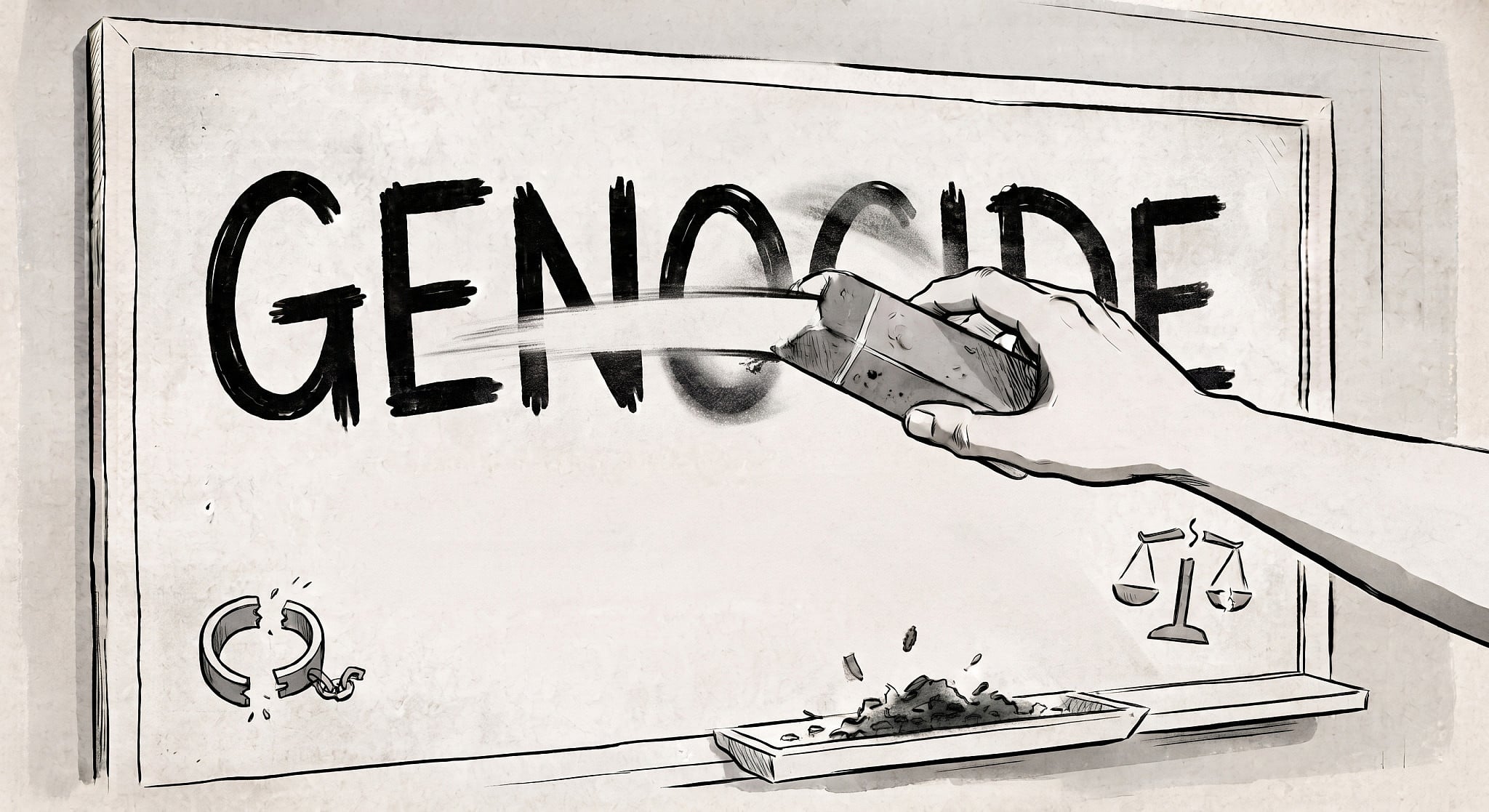
The word “genocide” was supposed to make evil unmistakable. Today, it does the opposite.
Raphael Lemkin coined the term in to name the unthinkable—the Nazi extermination of European Jewry. Holocaust educators adopted it almost immediately as its organizing category, using it aggressively ever since. It sits on museum wall text, in the names of “genocide prevention” institutes and their funding streams and in state laws: many “Holocaust education” mandates in American states are, in truth, genocide education mandates. Legislators may find that framing unobjectionable. Holocaust educators should not — because the word they use casually has stopped meaning what it meant in 1944.
As a concept, genocide has collapsed—politicized, overused, inconsistently applied, and reduced to a technical legal classification adjudicated by courts whose compulsory jurisdiction neither the United States nor Israel acceptsand whose record invites shame. Once a term of moral clarity, it has been invoked so liberally, so casually, and so cynically that it now clarifies nothing.
In academic and activist culture — and especially where the two meet — moral authority runs on claims of victimhood. Genocide became its currency. Cultural appropriation is genocide. Gentrification is genocide. Closing an ethnic studies program is genocide. When everything is genocide, nothing is.
Nowhere has the word been weaponized more cynically than against the Jewish state. Since Hamas murdered 1,200 Israelis in a single day — the largest mass killing of Jews since the Holocaust — students marinating in social media have absorbed a badly distorted picture. Trending hashtags and viral verdicts rush to brand Israel guilty of genocide. Trending hashtags and viral verdicts rush to brand Israel guilty of genocide. Gaza’s population has tripled since 1967 — grown faster under “occupation” than the United States or any country in the EU. Inconvenient arithmetic for a genocide allegation. The Holocaust killed an estimated two-thirds of European Jewry. The Rwandan genocide killed three-quarters of the Tutsi.
After October 7, allegations of Israeli genocide spread with dizzying, disorienting speed. The Lemkin Institute for Genocide Prevention issued a “genocide alert” against Israel within weeks — before any investigation, before any evidence. Activists parading as scholars rushed to supply expert testimony. Meanwhile, actual ongoing atrocities — the Uyghurs in China, the Rohingya in Myanmar, civilians in Sudan — draw little to no attention at all.
Should Holocaust centers stay the course, and work to set the record straight? No. Ask a man “Did you beat your child today?” and watch him try to answer — the question is unanswerable by design. That’s what a false genocide charge does to even careful, expert refutation. It makes rebuttal structurally impossible. Holocaust educators should not promote it as a category worth mastering.
Holocaust educators shouldn’t lend legitimacy to a term hollowed out by the internet — yet they keep doing exactly that, unreflectively. Students arrive pre-primed by social media and cable news with a debased understanding of the word. A workshop or exhibit that keeps “genocide” flattens history and dilutes moral clarity.
Jewish memory teaches the opposite lesson: specificity beats abstraction. For millennia, Jews told stories of destruction, survival, covenant, and responsibility without ever needing the word “genocide.” The Holocaust is not an example of genocide. The Holocaust was the Holocaust. A proper noun carries more truth, more history, and more moral weight than any abstract category ever could.
Individuals and institutions committed to Holocaust education should act on that. Rewrite curricula. Retrain docents. Disentangle from “genocide prevention” frameworks. Decline invitations to classify current events. Retire the term for good.
Replace it with language precise enough to resist political manipulation—language rooted in the history itself (the Nuremberg Laws, Aryanization, ghettos, Einsatzgruppen, deportations, selections, gas chambers, the “Final Solution”). Such specificity forces students to confront what happened rather than file it under a category broad enough to absorb every atrocity and dignify none.
A student fluent in the vocabulary of “genocide” but ignorant of the Holocaust’s particular causes, machinery, horrors, and consequences has missed the history we are charged with preserving.
Teach the laws. Teach the ghettos. Teach the shootings, deportations, camps, collaborators, rescuers, resisters, and survivors. Teach the names of the murdered—and the worlds murdered with them.
A student fluent in the vocabulary of “genocide” but ignorant of the Holocaust’s particular causes, horrors, and lessons has learned nothing you set out to teach.
Teach the laws. Teach the ghettos. Teach the shootings, deportations, camps, collaborators, rescuers, resistance, and survivors. Teach the names of the murdered and the worlds destroyed with them.
Teach the Holocaust—not the label.