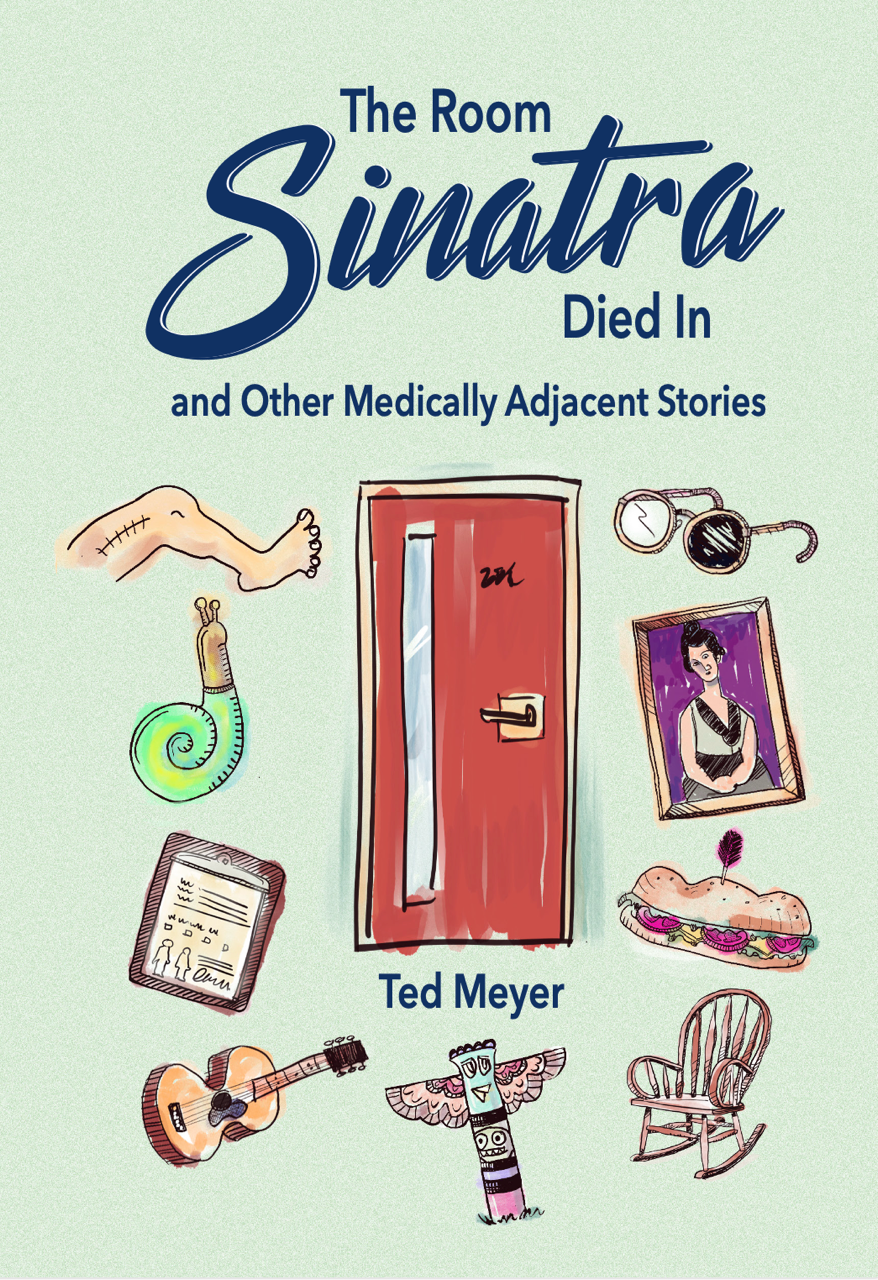
Ted Meyer – The Room Sinatra Died In

Ted Meyer’s The Room Sinatra Died In: and Other Medically Adjacent Stories, published by Art Your World (2024), is a beautifully written memoir that navigates the strange intersections of illness, family, art, and the oddities of fame with a voice that is at once wry, poignant, and deeply humane. Hospitalized and diagnosed with Gaucher disease at age seven, Meyer immerses the reader in a world both alien and intimate, where the body becomes a text for medical scrutiny. “I was a textbook made of skin and bones for every medical intern to read,” he writes. One attending physician, cigarette in hand, directs a dozen students to examine his enlarged spleen while enumerating a litany of complications: “Skeletal abnormalities . . . anemia . . . clotting problems . . . avascular necrosis . . . neurological complications . . . cancer and melanoma . . . THIS IS SO RARE!” Humor becomes a lifeline: “I felt like a melon at the supermarket.” Even claiming control over the hospital TV offers a sense of agency: “Control of the tethered remote was like being king of a country no one wanted to live in. My kingdom was a shithole with no functioning government, but I got to lord over that godforsaken territory anyway.”
Central to Meyer’s survival is his mother, Anne, whose life is defined by caregiving. She manages her own mother after brain surgery and shepherds Ted and his siblings through Gaucher disease. “She transformed lives by helping people with medical bills, home purchases, and other challenges,” he observes. In a system often cold and impersonal, Anne’s vigilance is sustaining—a reminder that love and attentiveness can make the difference between life and mere survival.
Family dynamics ripple outward. Doug, the “healthy” sibling, achieves fulfillment not through conventional success but by teaching disabled children. Meyer notes, “Illness affects the patient and the entire family in unpredictable ways.” Yet he cannot resist wryly observing Doug’s self-neglect: “Because he was the healthy brother, it upset me that he didn’t take better care of his body, especially his weight. The last time I saw him, he was so big he struggled to get into his car, holding on to the roof for support.”
Meyer’s narrative extends beyond bloodlines. On rehabilitation walks in San Diego, he meets Syd, a Holocaust survivor, and senses a silent bond of ancestry and shared history: “Had I not needed to rehab myself from a disease almost exclusive to descendants of Eastern European Jews, I would not have been out walking…This shared history of ghettoization, prejudice, isolation, and antagonism had found us on the same bench in sunny San Diego.” In these unspoken connections, Meyer captures the subtle ways trauma, memory, and survival intersect.
Humor and obsession are constant companions. Meyer lampoons Modigliani’s “tilted head” paintings: “Oh, Modigliani. All those women you painted with the broken necks. Was that really how you saw beauty? Did that obtuse angle equal glamour to you? Was a fair maiden with scoliosis a big turn on?” Childhood idols, like Milton Supman from Soupy Sales, provide ritual and comfort: “At five o’clock every day, rain or shine, I watched Soupy Sales… This daily habit was my security blanket; my parents, well-meaning though they were, had ripped that blanket from my little hands.” Meyer’s fascination with celebrity and the strange intersections of fame and illness even inspired a half-serious wish to occupy the same hospital room where Frank Sinatra had once stayed. Whether through a TV idol, a celebrated artist, or the aura surrounding Sinatra, these glimpses of fame provide touchstones of continuity, joy, and inspiration—a bridge between the extraordinary and the everyday.
Cats appear throughout as whimsical, grounding figures. Meyer’s “blah cat paintings” reflect midlife normalcy, commercial realities, and the absurdities of life itself. They remind the reader that amid suffering, small joys—companionship, humor, and simple creativity—remain vital.
The memoir is unflinching about mortality and privilege. Meyer’s friendship with Carol, a fellow Gaucher patient, and his TEDMED talk illuminate the tension between opportunity and survivor’s guilt: “I honestly don’t know how I ended up as one of the main-stage speakers…My illness gave me an amazing opportunity and something to talk about. My odd genetics led to my success. The same genetics killed my friend and my brother.” He crystallizes his philosophy: “I describe to med students all over the country how patient-artists might still have created art had they been healthy, but it would have been different, blander. Their work is unique, and, in my mind, better, because they are challenged by their difficult and sometimes life-threatening circumstances.”
Loss and chance underscore the memoir’s emotional weight. Richard’s decline under Parkinson-like illness, Anne’s sudden death—described as “otherwise completely whole”—and Meyer’s near-fatal leg infection, miraculously treated by a trauma surgeon who had purchased one of his paintings, intertwine mortality, serendipity, caregiving, and legacy: “I’m sure it saved my life, as well as thousands of dollars.” Meyer’s account reminds us that survival is never merely physical; it is relational, emotional, and creative.
The Room Sinatra Died In: and Other Medically Adjacent Stories is a memoir of resilience, wit, and unexpected beauty. Meyer’s reflections on family, illness, art, cats, and celebrity illuminate how adversity can sharpen insight, foster empathy, and inspire creativity. Above all, it is a story about living fully within extraordinary circumstances—a testament to humor, love, and human ingenuity. It is a must-read for anyone facing chronic illness or any condition that takes one out of the rhythms of ordinary life.
The Room Sinatra Died In: and Other Medically Adjacent Stories: Meyer, Ted: Amazon.fr: Books