

Tehilim: Nine Days, One Election
A verse a day
For nine days before this election, I have been posting one verse a day from the Book of Psalms (ספר תהילים), each time in a different chorus of the languages Israelis pray in. It was not a campaign. It was a prayer, and it began three years ago.
A few days after 7 October 2023, 22 Tishri 5784, after what we call the tevakh (טבח), the massacre, I began posting a verse from the Hebrew Psalms every evening, in Hebrew and in Yiddish. That day was a profound, existential shock to Israeli society. We must be precise about it: the massacre was aimed at an independent State of Israel, and its victims were the citizens and residents of the Hebrew state. They were Jews and non-Jews, Druze and Bedouin, Arabs and Christians, and foreign workers far from home.
I was not alone. At about the same time, a journalist from one of Israel’s major daily newspapers began posting one verse a day herself. Every evening she photographed a page of the Psalms and posted it as a prayer, an intercession. Her verses often spoke of the victims, the wounded, and the hostages. She kept at it, day after day.
I followed her lead, although we were hardly in direct contact. Each evening I posted the same verse she had chosen and added it in Yiddish. Yiddish is a language without a territory, or rather a language of every continent, and it seemed to me that it carried the verse outward, toward the whole world.
Tehilim, not tilim
In Yiddish we say tilim for תהילים, the Psalms. In Hebrew, טילים, tilim, are missiles. In those months missiles fell again on Tel Aviv and Jerusalem, and on the Arab towns of the Galilee. One word for what falls from the sky, and one for what rises toward it.
The Psalms are the breath of the soul that seeks God, and God does not hide. It is up to us to sense Him: to feel and understand what happens, what appears, disappears, and appears again. That is what a daily verse is for. It does not explain the war. It keeps the soul breathing through it.
The path was not easy. My colleague was often discouraged. Her verses were frequently for people she knew, many of whom I knew too, lying in hospital, often after amputations.
And there were the hostages. Every evening the cry was the same: they must be brought home. The Jewish tradition, and the Christian tradition after it, calls this pidyon shevuyim, the redemption of captives, and places it above almost every other duty. We prayed for them evening after evening, until the last of them came home in January 2026.
Unless I am mistaken or have overlooked someone, we were the only two to keep up this kind of dialogue: a tenacious, daily monologue, two voices that hardly spoke to each other and yet answered each other every evening. Prayer covered us both.
My colleague is Jewish. I am an Orthodox archpriest living in Israeli society, and I am expected to pray in Hebrew, in Church Slavonic, and, yes, in Yiddish too, one of my mother tongues. Some of the faithful find this odd, and so do certain well-meaning souls.
When it bothers them, I open my smartphone and pray in Aleut from Alaska, or in Pitjantjatjara from the Australian desert. I do it to remind them that our human story, however ancient and scattered, is one and the same.
There may seem to be something extravagant in this. But to live this unity in the Psalms is simple and obvious. The Psalms were the prayer book of the Temple before they belonged to any church or synagogue. Jews sing them, Christians chant them every day, and Muslims honor them as the Zabur given to David. They belong to all of us at once.
Roots and grafts
My family’s story is woven into this state. From Ukraine, my forebears worked for it from the time of the First Zionist Congress in Basel, in 1897. My whole family was murdered, many of them burned, in Ukraine and in Western Europe. Today I have no direct relatives left.
As a professor of Talmud and of the Christian traditions, I was shaken, but not surprised, by the blow of October, of Tishri. Our history knows it. The Scroll of Esther (3:13) tells of a decree “to destroy, to kill, and to annihilate” a whole people on a single day, and of a reversal no one expected. The pattern is old, and so is the answer.
That is why Esther speaks to us today, and why Jethro and Moses do too. Hope here is not naive. It is grafted, generation onto generation, as a young branch is grafted onto an old root, and it bears fruit again.
Nine days, many tongues
This autumn, nine days before the vote, my colleague posted a verse again: Psalm 61, “From the end of the earth I call to You.” This time I wanted to go further. An election divides us by design. Could a single verse a day be prayed by all the tribes of this country together?
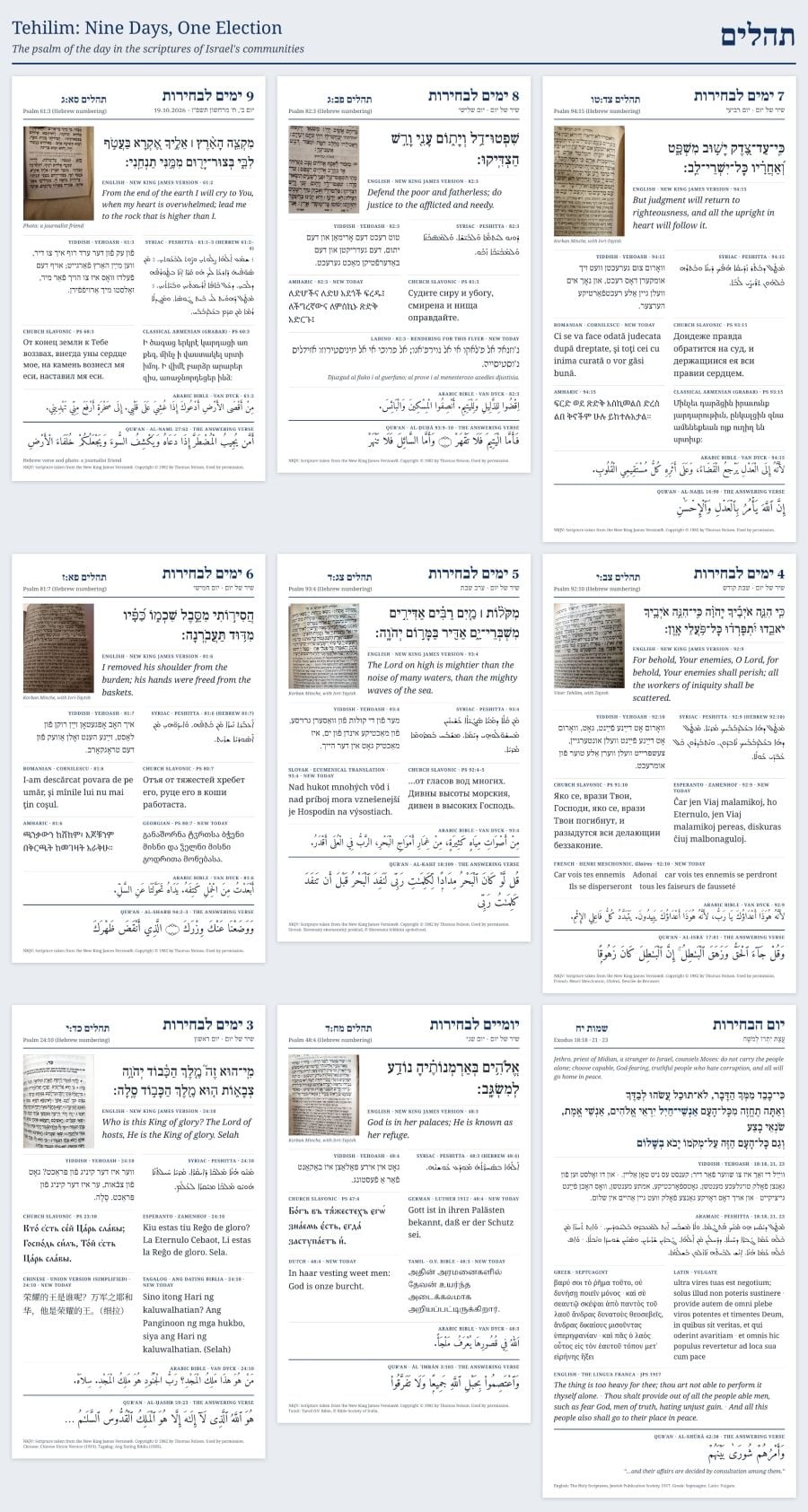
So from the next day I took the verse from the shir shel yom, the psalm of the day that the Levites sang in the Temple, and that is still said every morning. No party chose it, and neither did I. Each day I made a small flyer with a photograph of one of my old Psalters: a Hebrew Psalter printed in Antwerp, a worn Korban Minche with its Ivri-Taytsh, a Viner Tehilim.
Around the Hebrew verse stood the scriptures of the communities who live here:
- Yiddish, in Yehoash’s translation
- Syriac, from the Peshitta, the Bible of the Aramaic-speaking churches
- Church Slavonic, in its own letters and accents
- Arabic, from the Van Dyck Bible read by Arab Christians
- English, the lingua franca
- and each day one new voice: Ladino in Rashi script, Georgian, Amharic, Classical Armenian, Romanian, Slovak, Meschonnic’s rhythmic French, Zamenhof’s Esperanto, Chinese, Tagalog, German, Dutch, Tamil
Beneath each psalm I placed one verse from the Qur’an, chosen as an answer. In Psalm 82, “Defend the poor and fatherless,” the Qur’an answered: “As for the orphan, do not oppress him; as for the one who asks, do not repel him.” In Psalm 94, “Judgment will return to righteousness,” it answered: “God commands justice and kindness.” In Psalm 24, “Who is this King of glory?” it answered with God’s names: “the King, the Holy, the Peace.”
The languages did not quarrel. They leaned toward each other, as if each translation had been waiting for the others.
Election day: Jethro’s counsel
For election day itself, I have chosen to leave the Psalms for the Torah, for Exodus 18. Jethro, priest of Midian, a stranger to Israel, watches his son-in-law Moses judge the people alone from morning to evening, and tells him, “The thing is too heavy for thee; thou art not able to perform it thyself alone.”
Then comes his counsel: “Provide out of all the people able men, such as fear God, men of truth, hating unjust gain.” And his promise: “All these people also shall go to their place in peace.” The first lesson in shared government in the Bible comes from an outsider, and Moses has the humility to listen.
I have set these words in Hebrew, Greek, and Latin, the three languages written over the Cross (John 19:19–20), with the Aramaic of the Peshitta, Yiddish, and English. The Peshitta ends the passage beautifully: each one shall go to his home in peace.
Jethro’s “able men” are, in Hebrew, anshei chayil (אנשי חיל). The same word crowns the eshet chayil (אשת חיל), the woman of valor of Proverbs 31, in whom “the heart of her husband safely trusts.” Chayil is worth, strength and integrity, in men and women alike. The good counsellor, like the woman of valor, is trusted because they serve the life of the other, not their own. That is what we should ask of those we elect, and of those who advise them.
The answering verse from the Qur’an that day will be three words: wa-amruhum shura baynahum, “their affairs are decided by consultation among them.”
The morning after
We do not know who will win. I pray for something that does not depend on the result: that whoever governs will be surrounded by anshei chayil, people of worth who fear God, love truth, and hate corruption; that the weight will be shared; and that on the morning after, every citizen, whoever they voted for, will go to their place in peace.
This breath of the Psalms reaches toward a good and just destiny, a good mazl, for all who live in this land. It asks nothing of anyone but to listen. Tehilim, not tilim: words rising, not missiles falling.
The flyers, from Psalm 61 to Jethro’s counsel on election day, can be seen on my Facebook page.