
Telling The Roman Jewish Story at the Limmud Festival
In Judaism, Jews tell “the story over and over from the beginning to end, every year, every moment on earth.” This important tradition is one of the major reasons Jews have survived throughout the centuries and many persecutions they have faced.
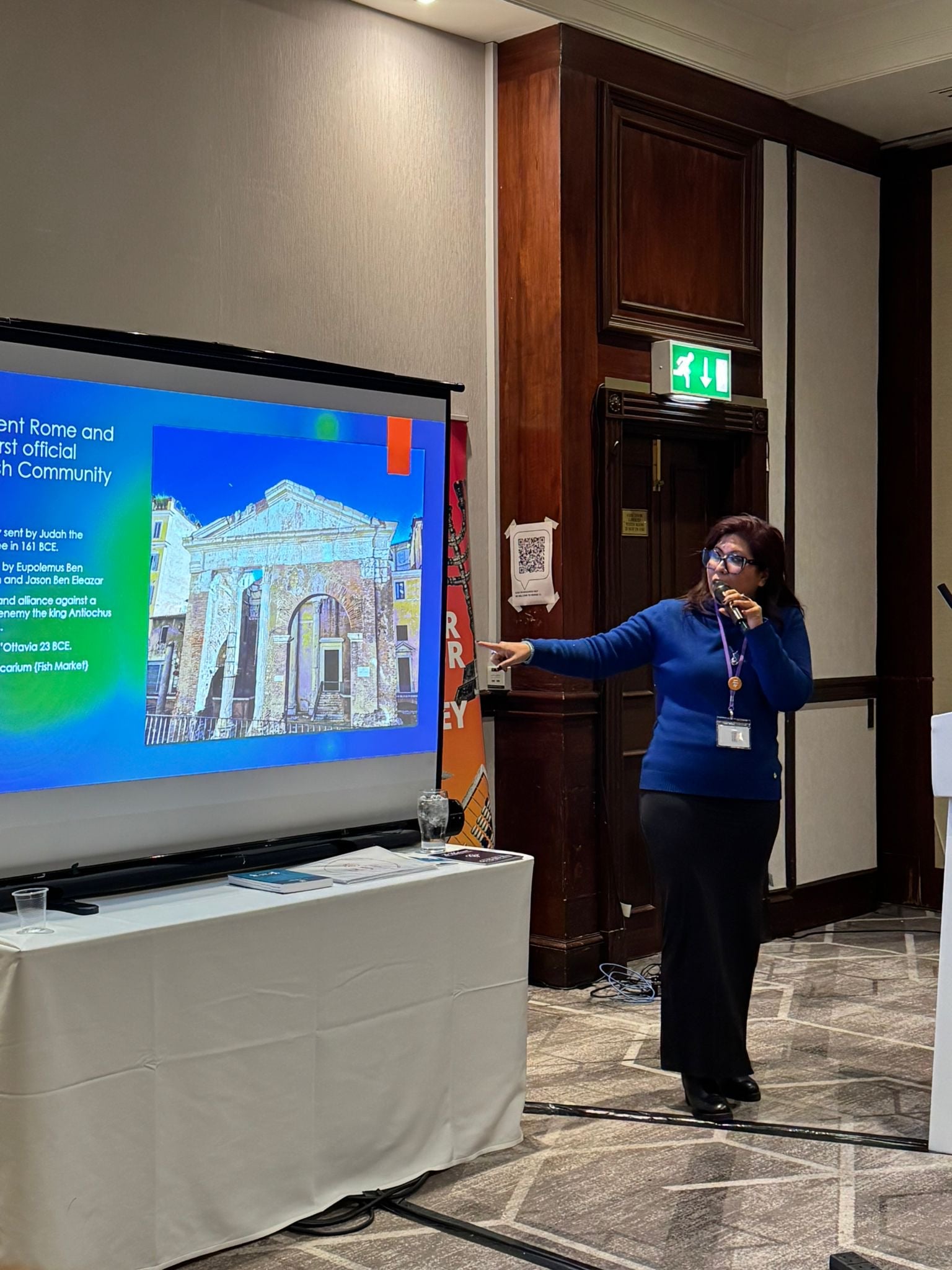
…Sara Terracina Tells the Roman Jewish Story at the Limmud Festival in Birmingham, England…
One of the licensed tour guides and historian from the Jewish community of Rome is Sara Terracina. She loves to passionately educates visitors about the amazing history of the Jews who have been living in Rome throughout the centuries.
Telling my Roman Jewish story, explains Sara, means I share my traditions, identity, and values focusing and explaining our 2,200 years of continuous history in the eternal city.
Telling a story is a core tradition of Judaism – as we do for Pesach , telling the story every year of the Exodus from Egypt. We can find this in Pesachim 116b (In every generation) the Talmud dictates that a person is obligated to see themselves as if they personally went out of Egypt.
The Haggadah, means “the telling”—we tell a story and the Haggadah is based on this principle, the telling of our story from a historical, personal, and experiential perspective explains Terracina.
The Jewish presence in Rome has always been a fundamental part of the Roman Empire. With their public synagogues, stone epitaphs and marble sarcophagi, they have refused to hide from sight or assimilate. Instead, throughout the eternal city’s history, the Roman Jews have openly expressed their refusal to be marginalized or forgotten—and in doing so, they have contributed to the essence and history of Rome.
This past December 28-31, 2025, Terracina shared stories about her culture and traditions at the Limmud Festival in Birmingham, England in three 50-minute PowerPoint presentations:
Roman Jews: a unique story of resistance
Terracina tells the story of the beginning of the Jewish presence in Rome: from the emissaries sent by Judah Maccabee to Rome in 161 BCE, to the destruction of the second temple in 70 CE that brought slaves and war captives, to how the Jewish presence continue to grow even after the destruction of the second Temple by Titus in 70 CE and finally concluding with how today’s Jews of Rome form a vibrant part of the city’s culture and life.
Jewish presence in the south of Italy: a less known history of Apulia and Calabria
Archaeological and literary evidence has shed light on the Jewish communities of Apulia and Calabria. Terracina discussed how the Jews flourished from antiquity up until the Middle Ages despite the expulsion and later emigration.
Discovering the Jewish catacombs of Italy
Highlighting the scholarship of Dr. Jessica Dello Russo, Terracinca presents important changes to the study of catacombs during the 19th century that led to the documentation of the Jewish catacombs of the ancient Roman Jews.
I like to thank my colleague Sara Terracina for sharing with me her in situ lectures that she presented at the Limmud Festival.
My compliments to Sara for going abroad to tell the story of the Jews of Rome.