They tried to destroy Temple Israel. Six months later, it stands tall
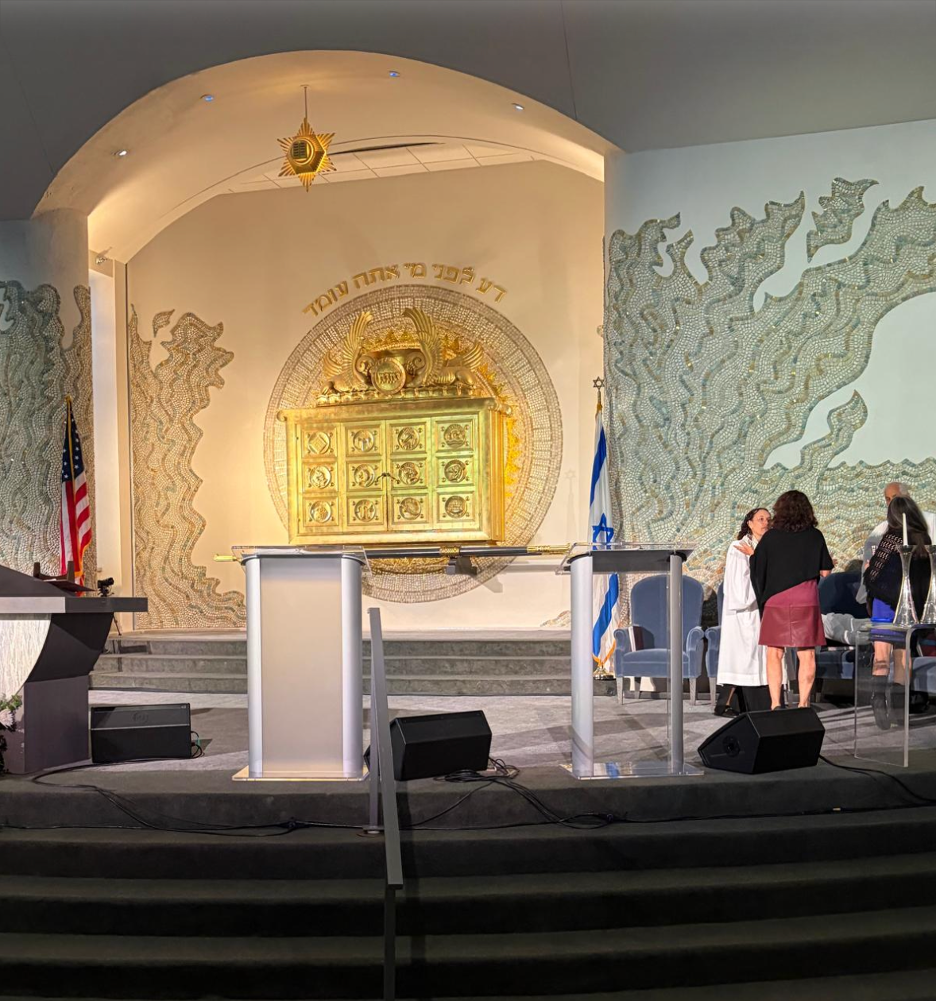
If I had to sum up the spirit of Temple Israel as the Jewish year 5787 begins, I would choose one word: resilience.
Temple Israel in West Bloomfield, Michigan, is enormous: some 3,500 families and more than 12,000 members make it the largest Reform congregation in America. And yet, before this year’s Kol Nidre service, as thousands of congregants streamed back into their restored synagogue, the scene felt remarkably intimate. Old friends embraced, families reunited, and joyous hugs seemed to be everywhere. For all its formidable size, Temple Israel somehow retains the warmth of a neighborhood shtiebel.
Founded in Detroit in 1941, it embodies the great liberal tradition of American Reform Judaism. In a state with roughly 100,000 Jews, more than one in ten is affiliated with the Temple. Its sheer size makes it a formidable presence in Michigan Jewish life.
This also made it a target.
On March 12, 2026, Ayman Ghazali rammed a truck loaded with gasoline and fireworks through the synagogue entrance and down a hallway beside its early-childhood center. Armed with a rifle, he exchanged fire with Temple security before dying, purportedly from a self-inflicted gunshot wound as the vehicle burned. A security guard was injured. More than 60 first responders were treated for smoke inhalation. Miraculously, the 140 children in the early-childhood center, along with the synagogue’s staff, escaped safely. Federal authorities later described the attack as Hezbollah-inspired terrorism.
The destruction was devastating. Hallways were blackened; photographs and religious materials scorched. The sanctuary: a total loss. And yet, the Torah scrolls survived. Even the sprinklers that soaked virtually everything else somehow spared them.
Then, Temple Israel went back to work.
Services resumed in borrowed spaces. The religious school and preschool resurfaced in temporary homes. Reform congregations across America sent supplies and support. Meanwhile, clergy, staff and lay leaders launched a mad race against the clock: somehow, the synagogue’s grand sanctuary had to be restored in time for the High Holy Days. Contractors, congregants and staff pushed ahead at breakneck speed. Six months later, with little time to spare, the Torah scrolls were carried back into their ark.
Temple Israel was home again.
So when my friend Larry August and his wife Julie, a former Temple president, invited me to join them for Yom Kippur during my brief stint teaching at Michigan State University, I didn’t hesitate. If there was ever a year to stand with this community, this was it.
I had never attended Reform Yom Kippur services and did not know what to expect. I was impressed. Temple Israel’s Cantor, Neil Michaels is blessed with a “once-in-a-generation voice”: a basso profundo of astonishing range, equally commanding in the depths and the heights. If any voice can pry open the Gates of Heaven, it would be his.
But the evening service became memorable for another reason.
The synagogue’s seven extremely talented rabbis seem to live quite happily in a non-hierarchical harmony. And so this year it was Rabbi Josh Bennett who stepped up to give the sermon: one that will be long remembered.
As there was a subtext throughout, one has to understand the political backdrop to fully appreciate Rabbi Bennett’s message.
Michigan’s Jewish community is confronting an unusually divisive Senate election. Abdul El-Sayed narrowly won the Democratic primary on August 4. A progressive on most domestic issues, he is also an uncompromising critic of Israel. Asked by CNN in July whether one could be both a progressive and a Zionist, he replied:“Every definition of a Jewish state ends up in some articulation of illiberal values, every single one.”
For Temple Israel, El-Sayed’s distaste for the Jewish state and those who support it is painfully personal.
After the March attack, El-Sayed paid lip service to condemning terror and antisemitism. But he then sought to place the attack in the context of Ghazali having lost family members in an Israeli airstrike in Lebanon. “I’ll never forget one of the simplest lessons I learned while on my psychiatry rotation in medical school,” El-Sayed said. “Hurt people hurt people.”
Many Michigan Jews heard those words as an attempt to rationalize an antisemitic terrorist attack. So did I. El-Sayed subsequently apologized, saying he had been trying to provide context but that perhaps it was the wrong moment to do so. Many Michigan Jews don’t buy it. Neither do I.
The alternative is Republican Mike Rogers, a former Michigan congressman closely aligned with much of President Trump’s agenda, including draconian immigration enforcement and shameless environmental deregulation.
For liberal Jewish voters, the collision of political principles is real… and painful.
Rabbi Bennett did not tell his congregants how to vote. Instead, he clearly and passionately laid out principles by which political candidates should be evaluated: Jews must be able to live openly and safely in America. Jews must be allowed to define their Jewish identity. They must be able to participate fully in American political life without their connection to Israel making them suspect. Israel’s continued existence as a Jewish state must be recognized. And political leaders should offer an affirmative vision for Israelis, Palestinians and the region – not simply opposition to Israel.
Then Bennett brought it home:
“Israel’s right to exist as a Jewish state is non-negotiable.”
“We are Zionists. Full stop.”
For a somber High Holiday service, the response was extraordinary: spontaneous applause.
The sermon was not an isolated phenomenon. The message was heard across the US: At New York’s Central Synagogue, Angela Buchdahl, perhaps the most venerated Rabbi in the US as of late, used her own Yom Kippur sermon, “Claiming Zionism,” to confront the same issue. “We cannot walk away from the most important sovereign project of the Jewish people,” she declared. “We must proudly claim the name ‘Zionist.’”
Sitting in Temple Israel, I felt my eyes fill with tears.
I thought how much easier another response would have been. After a terrorist drives an explosives-laden truck into your synagogue, after your toddlers flee their classrooms, after your community’s home burns to the ground and heavily armed security becomes part of the architecture of Jewish worship, it would be understandable to lower your voice. Keep your head down; shed the labels that have become so inconvenient; make Jewishness a little less conspicuous.
Temple Israel chose the opposite: it survived an attempt to blow up its building and its children. And six months later, the Torah was back in the ark, the sanctuary was full, and the congregation was on its feet. And it said, without apology: We are still here. And we are still Zionists.

Walking out after the final shofar blast: past the police, the SWAT team, the armored personnel carrier, the snipers on the roof of the synagogue, I felt something beyond admiration. I felt obligation.
The many American Jews who stand by Israel – especially when doing so carries such a steep social, political and emotional price – deserve an Israel worthy of that loyalty. For the past four years, our government has not made that easy. Those of us in Israel cannot simply demand solidarity from Diaspora Jews. We must earn it – by building a country that is democratic, decent, secure and faithful to the ideals and tradition for which so many Jews abroad are prepared to stand.
Temple Israel did more than rebuild its sanctuary. It reminded me what Jewish resilience looks like. As 5787 begins, it seems well to bring some of that spirit home to Israel. Because very soon we too have a chance to start rebuilding. And yes: this new year will be better.