
Writing on Jewish life, relationships, trauma, and resilience
Ten Key Points Netanyahu Wanted Americans to Hear in 60 Minutes Interview
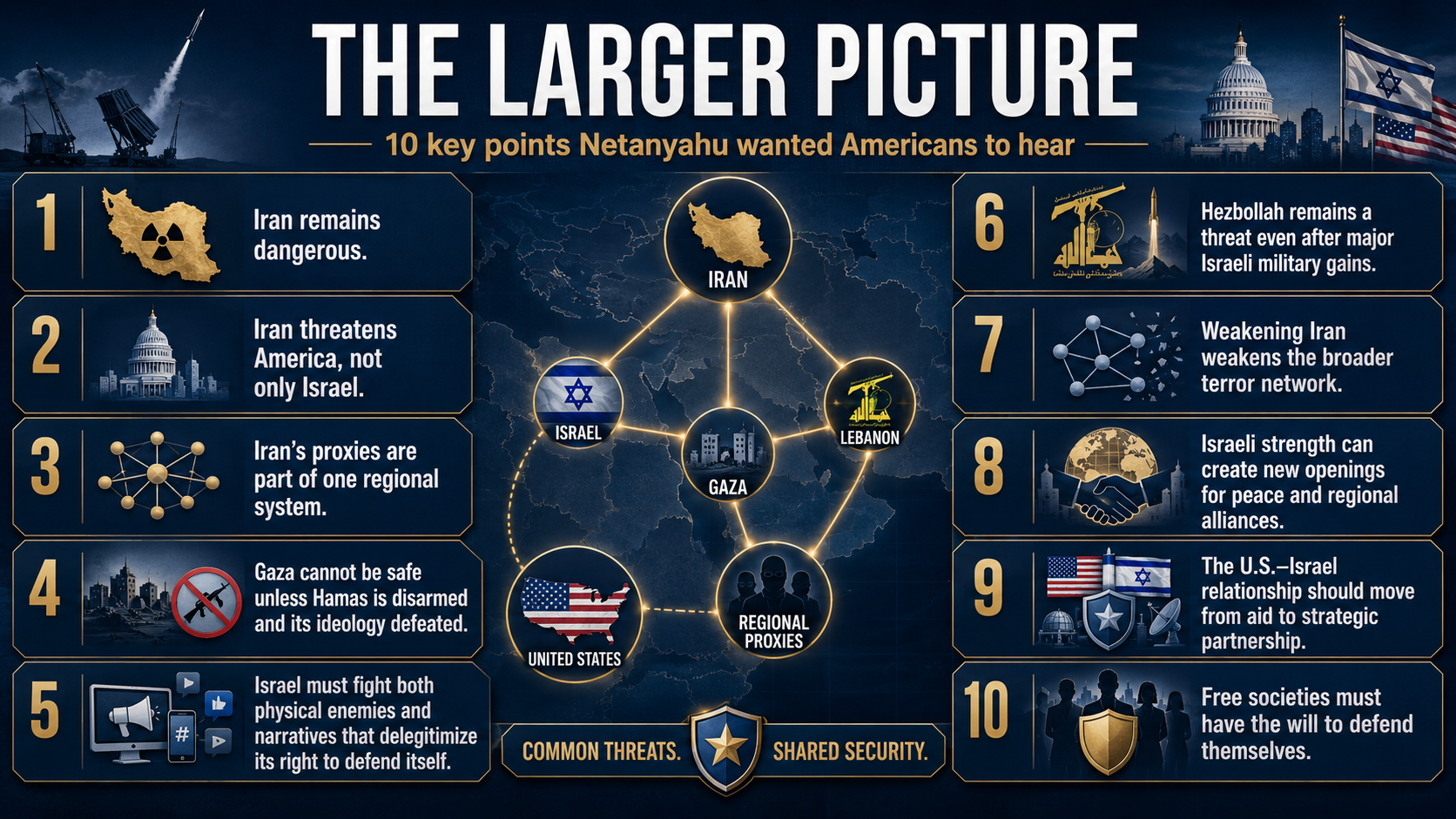
Infographic created by the author.
Much of Prime Minister Benjamin Netanyahu’s interview with Major Garrett that aired Sunday night did not make it into the televised 60 Minutes segment. That matters, because the full transcript reveals a broader and more direct message to Americans than a short broadcast could capture.
Netanyahu was not only defending Israel’s actions. He was making a case about America’s security, Iran’s ambitions, Hamas, Hezbollah, antisemitism, the US–Israel alliance, and the battle over truth itself.
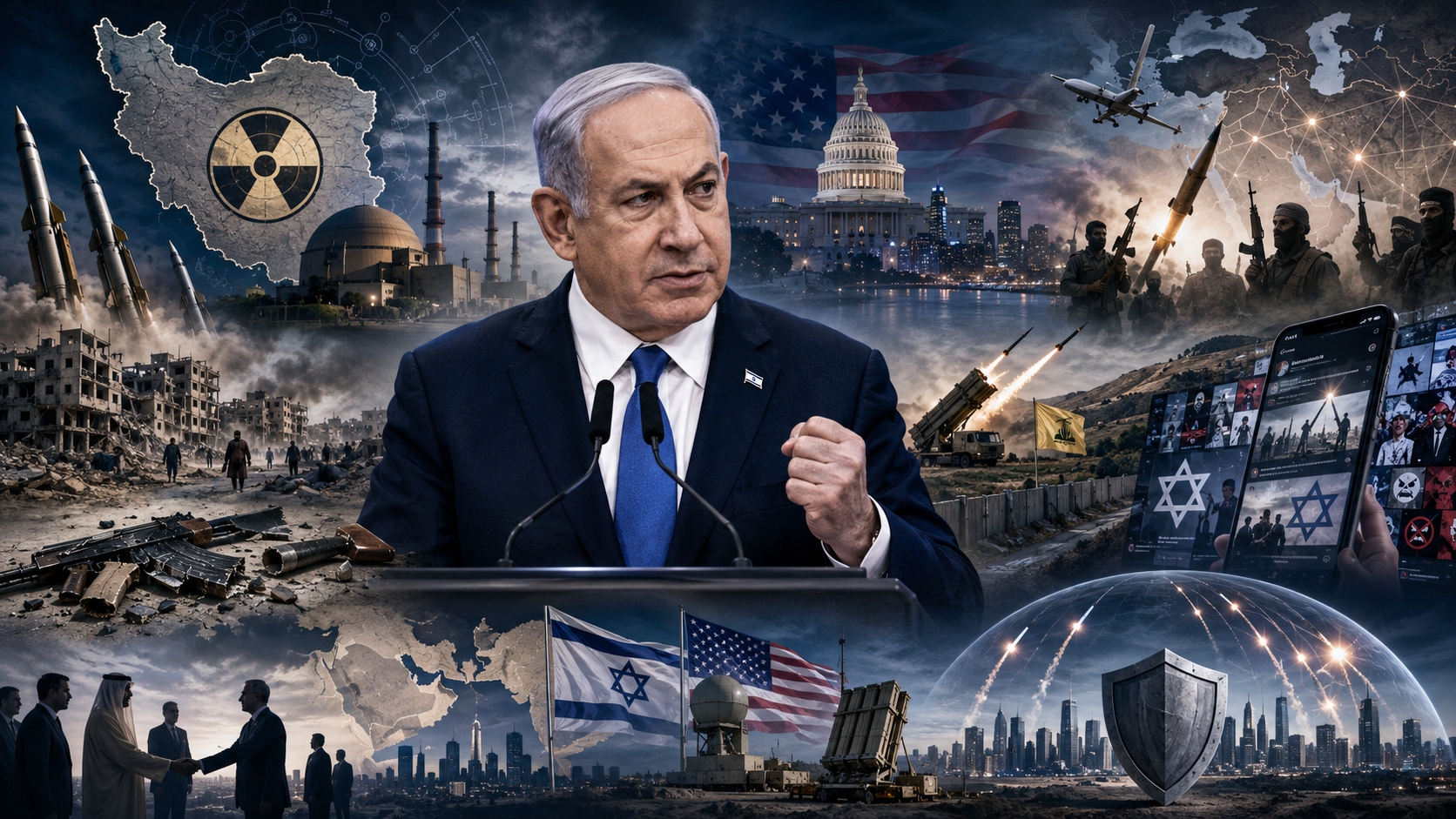
Here are ten critical points he emphasized.
1. The war with Iran is not over because the threat is not gone.
Garrett began with the question many Americans are asking: Is the war with Iran over?
Netanyahu’s answer was direct: no.
He said the war had “accomplished a great deal,” but stressed that enriched uranium remained in Iran, enrichment sites still needed to be dismantled, Iranian-backed proxies remained active, and Iran still wanted to produce ballistic missiles.
That distinction is central to Netanyahu’s message.
He is saying the world should not mistake a pause for an end, or damage for disarmament. If nuclear material remains, if enrichment can resume, if missiles can be rebuilt, and if proxies can continue operating, then the danger remains.
To Netanyahu, this is not merely a technical arms-control issue. It is the heart of the matter.
A hostile Iran with nuclear weapons would not simply be another difficult country in a difficult region. It would be, in his view, a regime with the ideology, infrastructure, and reach to threaten Israel, America, and the wider free world.
2. Iran is not only Israel’s problem. It is America’s problem, too.
Netanyahu repeatedly tried to move American viewers beyond the idea that Iran is a distant Middle Eastern problem.
He reminded Garrett that Iran’s regime does not only call for “death to Israel.” It also calls for “death to America.” He described Iran as a regime that wants to harm Americans, has killed and wounded Americans, and seeks nuclear weapons and missiles that could eventually put American cities at risk.
That was his clearest appeal to Americans: do not confuse geography with safety.
Israel may be Iran’s nearest democratic target, but Netanyahu argued that America is also in the regime’s ideological crosshairs. His “Little Satan” and “Big Satan” framing was meant to remind Americans that Iran’s hostility toward Israel and Iran’s hostility toward the United States come from the same source.
For Netanyahu, Israel is not asking America to care about someone else’s danger. Israel is warning America that the danger is shared.
That is a difficult argument for many Americans to hear after decades of Middle East wars. American families have paid heavily for military decisions made by leaders who promised more certainty than history delivered. Skepticism is understandable and responsible.
But Netanyahu’s counterpoint is blunt: the cost of acting must be weighed against the cost of waiting until Iran has nuclear weapons, longer-range missiles, and a stronger proxy network.
In plain language: the argument is not that war is good. War is never good. The argument is that a nuclear-armed Iran would be worse.
3. Hamas, Hezbollah, the Houthis, and other proxies are part of one Iranian-backed system.
A third point Netanyahu emphasized is that Israel is not fighting disconnected enemies.
In his telling, Hamas in Gaza, Hezbollah in Lebanon, the Houthis in Yemen, and other forces across the region are part of Iran’s broader strategy. They allow Tehran to attack, pressure, destabilize, and intimidate through proxies while maintaining a degree of distance from the consequences.
That matters because it changes the map.
If Hamas is seen only as a Gaza problem, Hezbollah only as a Lebanon problem, and the Houthis only as a Yemen problem, each conflict looks separate. Netanyahu wants Americans to see the scaffolding behind them: Iran’s money, weapons, training, ideology, and strategic ambition.
This is why he tied Iran’s nuclear program to its proxies in the opening exchange. He was not listing unrelated concerns. He was describing what he sees as one threat architecture: nuclear material, enrichment sites, missile production, and proxy forces.
In that framework, Israel’s fight is not only about defending its borders. It is about breaking the network that makes repeated attacks possible.
That also explains why Netanyahu frames the conflict as relevant to American interests. Proxy warfare threatens US allies, shipping lanes, energy markets, military personnel, and the credibility of American deterrence.
4. Gaza must be disarmed, demilitarized, and deradicalized.
On Gaza, Netanyahu’s formulation was stark: disarm, demilitarize, deradicalize.
He told Garrett that Hamas had promised to disarm as part of Trump’s 20-point deal but reneged. He said somebody must disarm Hamas and demilitarize Gaza, because Israel will not allow Hamas to threaten Israel again.
Those three words — disarm, demilitarize, deradicalize — are Netanyahu’s vision of what must happen before Gaza can have a different future.
Each word carries a different meaning.
Disarm means Hamas cannot retain the weapons it uses to control Gaza and threaten Israel.
Demilitarize means Gaza cannot remain a military platform with weapons factories, smuggling routes, tunnels, and rocket capacity.
Deradicalize means the next generation cannot be educated to glorify killing Jews or destroying Israel.
This is not a small agenda. It raises hard questions: Who governs Gaza? Who polices it? Who rebuilds it? Who educates children? Who prevents Hamas from rearming? Who protects civilians? Who verifies compliance?
Netanyahu’s answer was unsentimental. He asked Garrett to identify the countries willing to send troops into Gaza and tell Hamas killers to give up their arms. His point was that many governments may endorse the goal in theory, but few are willing to bear the cost in practice.
So Netanyahu’s message is: if the international community will not do it, Israel may have to, at a time and under circumstances it chooses.
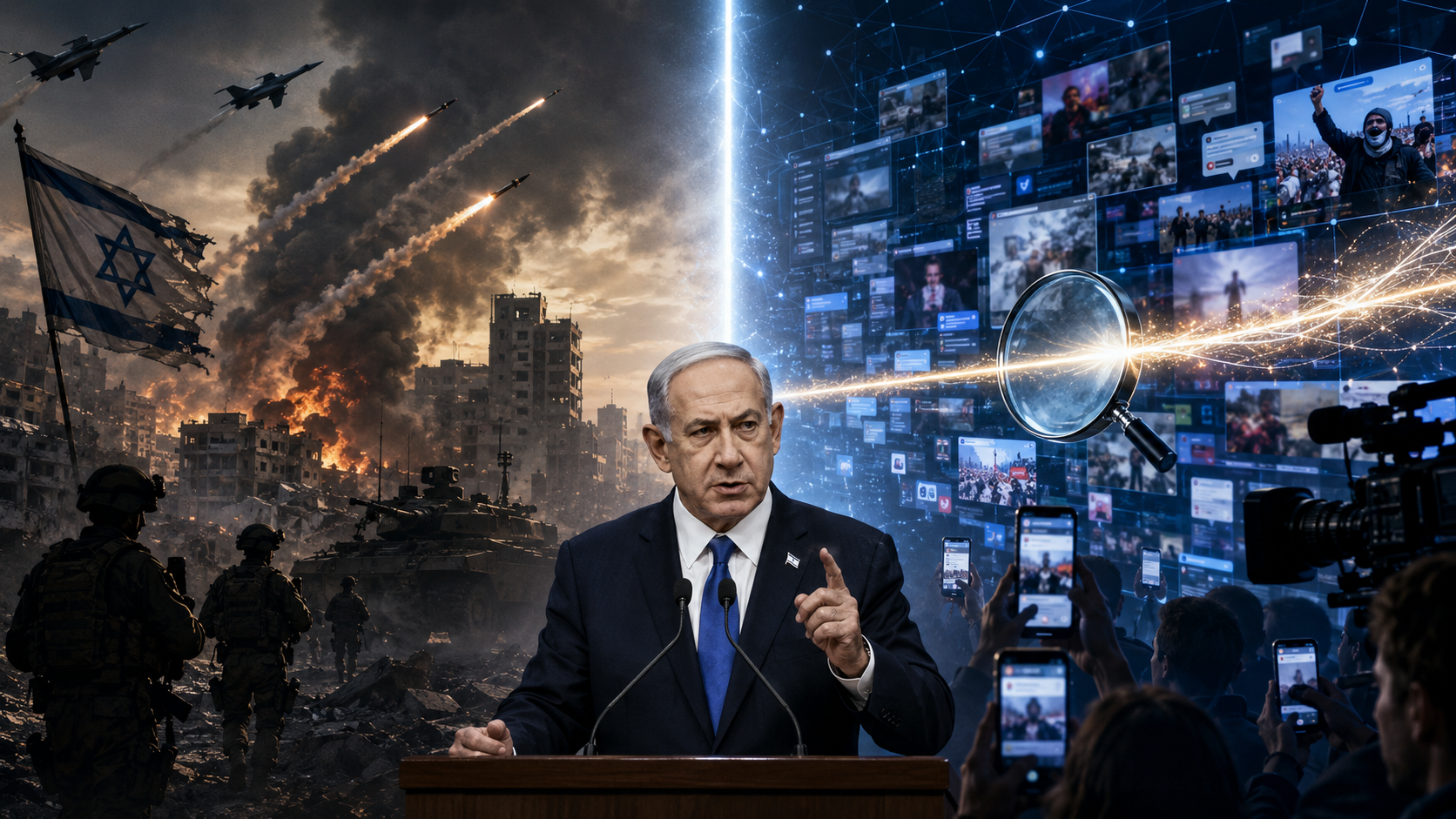
5. Israel is fighting a war of truth as well as a military war.
Another key theme was Netanyahu’s belief that Israel is struggling in the information war.
He argued that Israel’s enemies understand how to use images, civilian suffering, and viral narratives to turn public opinion against Israel. In his telling, Israel’s enemies embed themselves among civilians and then benefit when civilians die because the images create pressure on Israel.
That is one of his most important moral claims: for Israel, civilian deaths are a tragedy; for Hamas and similar enemies, civilian deaths are a strategy.
Whether someone accepts or challenges that claim, it is essential to understanding Netanyahu’s argument. He is saying modern war is fought not only with missiles and rifles, but with phones, posts, edited clips, slogans, and accusations repeated until they become accepted truth.
That concern connects directly to his comments about antisemitism. Netanyahu warned that before violence against Jews, history often brought vilification: slanders, lies, demonization, and dehumanization. In his view, today’s demonization of Israel risks becoming the newest expression of the oldest hatred.
This is where the interview moved from geopolitics to history.
Netanyahu was not saying Israel should be beyond criticism. No democracy should be. But he was warning that criticism becomes dangerous when it turns into demonization — when Israel is portrayed not as a flawed country fighting brutal enemies, but as uniquely evil, uniquely illegitimate, and uniquely undeserving of self-defense.
That kind of language does not stay neatly inside foreign-policy debates. It lands on Jewish students, synagogues, community centers, neighborhoods, and families.
Words do not always become violence. But violence is often preceded by words that make it easier to stop caring.
6. Hezbollah remains a major threat, even after severe losses.
Netanyahu told Garrett that Hezbollah had possessed 150,000 rockets and ballistic missiles before the war, describing it as the densest concentration of such projectiles on the planet. He said Israel destroyed more than 90 percent of that arsenal, but added that thousands of rockets and some ballistic missiles remain.
His point was that Hezbollah has been badly weakened, but not eliminated.
This matters because Netanyahu sees Hezbollah not as a Lebanese political problem, but as an Iranian proxy that has “hijacked” Lebanon and continues to threaten Israeli communities. He said Israel has no quarrel with Lebanon and would make peace with Lebanon, but that Hezbollah remains a foreign, Iranian-backed terrorist force embedded inside the country.
For Americans, Netanyahu used a vivid comparison: imagine a terrorist organization with missiles and drones sitting just across the municipal line from Washington, DC, declaring its intention to destroy the United States.
His argument was simple: no nation would accept that. Israel will not either.
7. Weakening Iran weakens the entire proxy network.
Netanyahu made a broader strategic point about Iran’s role in the region: if the Iranian regime is weakened, or possibly toppled, the entire network of proxies weakens with it.
He specifically mentioned Hezbollah, Hamas, and the Houthis, saying that “the whole scaffolding” of Iran’s terrorist proxy network could collapse if the Iranian regime collapses.
This does not mean he promised regime change or claimed it was guaranteed. In fact, Netanyahu repeatedly acknowledged uncertainty. He said regime collapse is possible, not guaranteed. He compared it to bankruptcy: it proceeds gradually, then suddenly.
Still, the logic is central to his worldview.
Iran is the source of funding, weapons, direction, and ideological energy behind much of the violence Israel faces. Remove or weaken that source, and the regional threat structure changes.
That is why Netanyahu framed pressure on Iran as not only a nuclear issue, but as the key to reshaping the security environment across the Middle East.
8. Israel’s strength, Netanyahu argues, can create new alliances and peace.
Netanyahu repeatedly returned to one of his long-standing beliefs: peace comes through strength.
He argued that Israel’s growing power has brought Arab countries closer, helped create the Abraham Accords, and may now open the door to deeper alliances with regional partners. He said Israel’s ability to stand up to Iran has increased respect for Israel among some Arab states.
This is a core Netanyahu idea: Israel is more likely to make peace when its enemies lose hope that it can be destroyed.
He told Garrett that Israel’s position had changed dramatically — from being “on the verge” of annihilation to becoming the most powerful country in the Middle East. In his view, that shift does not prevent peace; it makes peace more possible.
He also tied that strength to Israel’s economy and technology. Netanyahu described Israel as a small country with “gigantic talent,” especially in high-tech, energy, AI, quantum, intelligence, weapons, and missile defense.
His message was that Israel is not merely a military partner. It is a strategic, technological, and economic partner.
9. Netanyahu wants to move the US–Israel relationship from aid to partnership.
One of the more striking parts of the transcript is Netanyahu’s statement that he wants to draw down American financial support to Israel to zero over time.
He said Israel has “come of age” and should move from aid to partnership. His proposal is not to end the U.S.–Israel relationship, but to reshape it around joint projects in intelligence, weapons, missile defense, and technology.
This point is important because it speaks directly to American debates about foreign aid.
Netanyahu’s argument is that Israel appreciates American support deeply, but no longer wants the relationship defined by aid. He wants it defined by shared investment, shared innovation, and shared strategic benefit.
He described Israel as America’s “best ally,” citing intelligence, technology, pro-American public sentiment, and battlefield cooperation. He also referred to Israel as a “model ally” of the United States.
For American readers, this is one of the most newsworthy parts of the full transcript because it challenges a familiar political frame. Netanyahu is not asking for more aid. He is saying Israel should eventually stand financially on its own and work with America as a peer strategic partner.
10. Democracies must have the will to defend themselves.
A final major theme was Netanyahu’s warning that free societies cannot rely on hope alone.
He argued that freedom and survival are precious, but not guaranteed. They require “force of will” and, if necessary, “force of arms.” He quoted historian Will Durant’s lesson that good does not automatically triumph over evil unless good is willing to fight.
This is perhaps the deepest philosophical point in the interview.
Netanyahu was not only talking about Israel. He was talking about Western civilization, democratic fatigue, and the danger of losing the will to confront fanatical enemies.
He acknowledged the pain of war from personal experience: losing a fellow soldier, losing his brother in a hostage rescue operation, being wounded himself, and seeing families grieve. He said war is hell and that Israel tries to prevent civilian casualties. But he also warned that if free societies refuse to fight under any circumstances, they may later be forced to fight under the worst circumstances.
That is the moral tension he wanted Americans to understand: war is terrible, but surrendering the future to those who glorify violence is worse.
The Larger Message
The full transcript shows that Netanyahu’s interview was not just about explaining one war.
It was about persuading Americans to see ten connected realities:
Iran remains dangerous.
Iran threatens America, not only Israel.
Iran’s proxies are part of one regional system.
Gaza cannot be safe unless Hamas is disarmed and its ideology defeated.
Israel must fight both physical enemies and narratives that delegitimize its right to defend itself.
Hezbollah remains a threat even after major Israeli military gains.
Weakening Iran weakens the broader terror network.
Israeli strength can create new openings for peace and regional alliances.
The US–Israel relationship should move from aid to strategic partnership.
Free societies must have the will to defend themselves.
That is the interview many Americans did not see in full.
The televised segment gave viewers pieces. The transcript gives the architecture.
Netanyahu’s architecture is clear: Israel is on the front line of a wider struggle involving Iran, Islamist proxies, nuclear danger, terrorism, antisemitism, regional realignment, and the will of democracies to defend themselves.
Americans can debate his policies. They should. Democracies require debate, dissent, and accountability.
But before judging Netanyahu’s argument, Americans should understand it.
His message was not simply, “Stand with Israel.”
It was: Recognize the threat before it grows beyond Israel.
That is the warning he wanted Americans to hear.
Related Topics
Related Posts