


Middle East Forum Fellow/North Africa Risk Consultant
Termination of the Gadhafi Ghost: A Clean Slate for North Africa
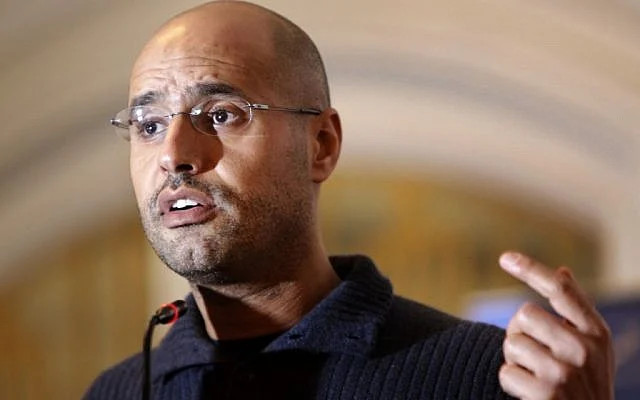
Saif al-Islam Gaddafi speaks to the media at a press conference in a hotel in Tripoli, Libya, in February 2011. (AP/Ben Curtis, file)
The current anarchy in Libya is a textbook indictment of a decade of misplaced Western idealism and “inclusive” diplomacy that prioritized the inclusion of bad actors over the assertion of order. For fifteen years, the specter of a Gadhafi restoration acted as a lead weight on the prospects of national stabilization. That weight has been violently and surgically removed. The assassination of Seif al-Islam Gadhafi in the western town of Zintan on February 3 marks more than just the end of a family dynasty; it represents the elimination of a primary “spoiler” who had successfully paralyzed the Libyan state’s path toward pro-Western consolidation. By terminating the Gadhafi “ghost,” the West now possesses a rare clean slate to enforce a unified authority capable of securing the Mediterranean’s southern flank.
The Zintan Operation: A Signature of Strategic Cleansing
The details of the operation in Zintan reveal a level of professional precision that transcends the typical militia skirmishes of the Tripoli suburbs. According to intelligence gathered from the scene, a four-man armed commando unit successfully infiltrated the 53-year-old heir apparent’s residence at noon on Tuesday. The assailants demonstrated advanced technical capabilities, systematically disabling the residence’s CCTV and security infrastructure before engaging Gadhafi in a direct confrontation.
The methodology—particularly the surgical neutralization of surveillance systems—bears a professional signature that suggests a political “cleansing” operation rather than a localized tribal vendetta. Coming exactly six days after a secret meeting in Paris between representatives of the Dbeibah and Haftar camps, the timing appears calculated to finalize a new Atlantic-led deal for the region. For the United States and its allies, the removal of a convicted war criminal wanted by the International Criminal Court (ICC) for crimes against humanity removes a legal and moral friction point that has served as a permanent veto on Libyan elections since 2021.
Ending the “Green Movement” Veto
Seif al-Islam Gadhafi occupied a singular, destructive role in the Libyan political machine. Though he often presented a Western-educated, “reformist” face to the world, he was the primary architect of the brutal 2011 crackdown, famously labeling his fellow citizens “rats”. Since his release from formal detention in 2017, he had lived in “obscurity and shadow” in Zintan, serving as a symbolic figurehead for the “Green Movement”—a coalition of former regime loyalists and disaffected tribes who leveraged his presence to destabilize any transition they did not control.
With Seif al-Islam gone, the “Gadhafi tribes”—primarily the Warfalla and Kadhafa—have lost their only credible rallying point. Deprived of leadership, these factions will now be forced to negotiate their integration into a new national military and administrative system from a position of profound weakness. This radically simplifies the Libyan political landscape, reducing the complex web of tribal rivalries into a manageable bipolarity between the Government of National Unity (GNU) and the forces of Khalifa Haftar, clearing the path for an official announcement of a unified government as early as April 2026.
Strategic Realism and the Mediterranean Firewall
The strategic necessity of this liquidation is underscored by the broader regional redesign. Under Italy’s expanded “Mattei Plan”—which has welcomed five new African nations into its security fold—Libya is designated as the primary firewall against illegal migration and Russian (Wagner) encroachment. The removal of Seif al-Islam ensures that Russian mercenaries in Cyrenaica cannot utilize the Gadhafi brand to incite populist unrest or tribal sabotage against Western energy assets.
A Libya freed from the “Gadhafi nostalgia” can now move toward an “authoritarian stabilization” model that prioritizes hard security and the containment of radical Islamism over the failed democratization efforts of the past decade. This aligns with the broader U.S. strategy of “maximum pressure” currently unfolding in the Persian Gulf. As the “Trump Armada” prepares for a final resolution of the Iranian threat, it requires a stable, pro-Western rear flank in North Africa that is not vulnerable to “spoiler” candidates or militia-cartel economics.
Victory Over the Past
The assassination in Zintan is a victory for the principle of “Strategic Realism.” For too long, the West allowed the fiction of a Gadhafi restoration to persist, providing cover for radical elements to maintain a foothold in the central Mediterranean. The current “Board of Peace” model—a stakeholder-driven transition that values security and demilitarization—is the only viable path for a post-Gadhafi Libya.
The West must now seize this “clean slate” to enforce a unified government and the total marginalization of radical Islamist militias. Victory in North Africa will not come through empty calls for “inclusive dialogue” with legacy dictators or their heirs. It will come through the surgical removal of spoilers, the assertion of Western interests, and the empowerment of partners who understand that stability is the only true foundation for peace. The ghost of Gadhafi is finally dead; it is time for the West to lead the living.