


Terrific Israeli Customer Service!

For those of you old enough to remember them, Monty Python sometimes introduced a new sketch by having a deep-voiced announcer intone, “And now for something completely different!”
So here is something completely different: a blog celebrating Israeli customer service. Complaints of course are more fun to read, but, as newspapermen used to say when newspapers were written by humans, “Sometimes men bite dogs.”
So as not to disappoint, I will close with a small complaint, though not about the service. Wait for it.
**********
We needed an appointment for a radiologic test. We obtained a hafnaya, a referral form, from the doctor who ordered it.
We then called our kupah, health plan. They had just introduced an AI robot to screen calls.
“Hello!” said the cheerful AI voice, “Sh’mi Aya!” (“My name is Aya—AI-A.” Get it??) “How can I help?”
“We need an appointment for an MSPCA,” I said. (Mipui (scan) of the Splenic Circumflex Armature—don’t look it up.)
“I cannot transfer your call for an MSPCA,” said Aya, sternly. “For that, contact Machon T’chol. They are on the internet.” Machon T’chol—not its real name—is owned by our health plan.
They have a dandy website. In a minute I had set up an appointment for 3 days later. In a different city, an hour-and-a-half away by bus. Nothing in Jerusalem, where we live.
The secretaries at our local clinic have been helpful at times for matters like these. I headed over the next morning.
There are usually two secretaries; today there was just one. She was attending to a woman with a complex issue. Each answer and proffered form was met with another question, another discussion, and another form.
I took a number and had a seat. I will call the secretary Mazi, short for mazkirah, secretary. Mazi smiled and stayed calm. Eventually the interview was done. Mazi waved me over, then took a call that had been on hold the whole time. She apologized, explaining that she was alone.
When she turned to me, I handed her the hafnaya. Mazi guessed at once what we needed: a test done locally.
“I’ll take care of this,” she said. “There is a different clinic that does this at Cinema City (a movieplex not far from our place.)”
Mazi clicked a few keystrokes. “I just faxed them the hafnaya,” she said. “Call them in an hour, when they open. I will call you later. When you tell me when your appointment is, I will arrange for your hitchayevut. (Prior Authorization, bane of the lives of many a doctor and patient in Israel and the US.)
Boom—it was done. In no time, and with a smile. “Yeyasher kochech,” I told her, “For being so efficient and calm when you’re all alone.”
“There is nothing better than a good mazkirah,” she said with a rueful smile.
“Last week I needed to go to a friend’s wedding,” she said. “On my lunch break, I called the bus company to try to figure out how to get there. Everybody I spoke to told me something different, then transferred me to somebody else.
“Finally, a man who was sitting near my desk came over and said. “Please hang up. Take such and such a bus to such and such a place and then take a cab.”
“This way I actually made it to the wedding.”
“Mazal Tov!” I said.
Delighted that we could do the MSPCA 10 minutes away by bus instead of somewhere in the center of the country, I went home, called the clinic, and set up the appointment for a week later. Chick-chock, as they say. My wife and I were elated. Maybe we could take in a movie after the test, or at least get popcorn.
Later, Mazi called, and I told her when the appointment was. She said the Prior Authorization would be ready in time.
“One more thing,” I said. “We are so pleased with your service that we want to write a letter to tell your boss.”
“Thank you,” she said. “That would be very important.”
“Our pleasure,” I replied. “Whom should we write to?”
That turned out to be a much tougher question than scheduling a nearby MSPCA.
**********
“Go to the aplikatzia, the app,” said Mazi. “At the bottom, one of the choices says, Kitvu lanu, “Write us.” Click on that. You will see 5 columns of options. Look at the fourth. Under it are 11 choices. Click on the 8th from the top, Pniot Tzibur.”
It was just as complicated as it sounded. When you click on “Write Us,” you get this:
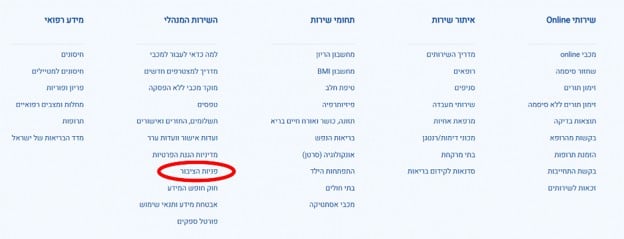
There are 5 columns, with 44 choices. The fourth column (from the right—this is Hebrew!) is headed “Administrative Services.” It has 11 choices. The first is “Why you should choose our Health Plan.” The 8th choice, sandwiched between “Privacy Policy” and “Freedom of Information Law” is “P’niat Tzibur,” Public Inquiries. Inquiries?
Without this guidance, what are the odds you would ever guess how to send a note praising an employee? What does that tell you about how much the Health Plan wants to learn about its workers?
**********
I returned to the clinic the next day just after 7 AM, when only the lab is open, and left an envelope on Mazi’s desk with her name on it.
In part, it read (translated into fluent, idiomatic Hebrew by AI, thank you very much):
We want to tell you how pleased we are with the customer service we received at your clinic. Your employee (we entered Mazi’s name) helped us obtain the test we needed here in Jerusalem, rather than undertake long and difficult travel. She did this with patience and good humor, despite the stress she was under from being alone at the front desk. We cannot praise her enough for her kind manner and first-rate professionalism.
Who knows if Public Inquiries will ever get back to her, but at least she knows what we had to say.
Yirbu kamoha B’Yisra’el! May there be many more like her in Israel.