
‘That’s How We Do Things Here’: When Tradition Becomes an Excuse

Parashat Vayetzei
There is perhaps no more convenient defense of injustice than the claim that things have always been done this way. It requires no moral reasoning, no accountability, and certainly no willingness to change. It simply invokes the authority of tradition, as though the passage of time could transform a questionable practice into a legitimate one.
In this week’s Torah portion, Vayetzei, we encounter a master of this argument: Laban.
After working seven years to marry Rachel, the woman he loves, Jacob discovers that his father-in-law has deceived him. Under the cover of darkness, Laban has substituted his older daughter, Leah, for Rachel. When Jacob confronts him, Laban offers a remarkably composed explanation:
It is not done in our place to give the younger before the firstborn (Genesis 29:26)
Notice what Laban does not say. He does not deny the deception, apologize, or acknowledge the suffering he has caused. Instead, he invokes local custom. This is simply how things are done here.
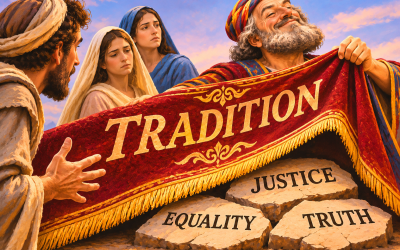
The irony is exquisite. Jacob, who deceived his father to receive the blessing intended for his older brother, now finds himself deceived through an appeal to the rights of the firstborn. Yet the deeper irony lies in Laban’s defense: tradition is employed not to protect moral order but to conceal its violation.
And that is where this ancient family drama becomes disturbingly contemporary.
How often do religious authorities defend discriminatory practices not by explaining why they are just, but by insisting that they are ancient? How often are women excluded from positions of authority, LGBTQ people denied recognition, or individuals deprived of religious freedom because “this is our tradition”? And how often do political institutions protect entrenched privileges under the respectable language of heritage and national identity?
Tradition matters. It carries collective memory, sustains identity, and connects generations. Judaism itself would be unimaginable without it. But reverence for tradition becomes dangerous when we confuse preserving our inheritance with granting every inherited practice moral immunity. Not everything that survives deserves to be preserved.
Indeed, Jewish tradition contains its own powerful mechanisms of moral criticism. Isaiah and Amos challenged religious practices divorced from justice, reminding us that ritual observance cannot compensate for exploitation or oppression. Their message was not to abandon religion, but to insist that religious legitimacy requires ethical responsibility.
There is another uncomfortable detail in Laban’s story. If the local custom was so sacred, why did he reveal it only after accepting seven years of Jacob’s labor? Tradition, it seems, becomes particularly useful when it protects those who control its interpretation.
In Israel, where debates over religious authority, gender equality, marriage, and personal freedom are inseparable from questions of Jewish identity, this distinction is especially urgent. But the problem extends far beyond religion. Governments, corporations, and communities everywhere have learned to dress power in the reassuring language of established norms.
The Torah does not demand that we abandon tradition. It challenges us to take responsibility for what we choose to carry forward, distinguishing between the inheritance that gives us roots and the practices we must have the courage to leave behind.
Because “that’s how we do things here” may explain a custom. It can never, by itself, justify an injustice.
May we never mistake what has always been done for what is right, and may we find the courage to change what tradition alone cannot justify.
Shabbat Shalom!