The 14th of Kislev – Part 2
Unbelievably, on the 14th of Kislev it will be five years since my wife, and I achieved my lifetimes ambition of making Aliyah. As the expression goes. “Better late than never.”
We look back on those five years, and they seem to have gone so very quickly.
I look out my bedroom window every morning and look at the beautiful street in which I live and thank Hashem for the blessing of living in Israel and being a citizen of our wonderful and amazing country.
For English speaking older Olim, there are areas to which Aliyah makes more sense to go to, in order to make the famed “soft landing” which is so important One of these places is Ramat Beit Shemesh Aleph. For us it was an easy choice, we had two children with their families already living here at the time.
Ulpan is free for ten years and there is a keenness for you to integrate into the country. Many people choose to work their way up the various levels. For those interested in learning and improving their Ivrit, (both here and abroad) I would commend the Nefesh B’Nefesh café oleh program with Jay on Mondays and Wednesdays. Ulpan is a wonderful way of meeting people, and I have made really good friends via Ulpan.
We have a profound sense of community, which is powered by the fact that so many of us are Olim. We may have diverse backgrounds, but the fact that we have all decided to pack up and come to live in Israel unites us.
One of my friends described living in Israel with the vast array of kosher food, as living in a country where there is so much stuff that you should not really eat. I do not go to the ice cream parlor every day or week, but it is nice to know that I have two of them locally.
Baruch Hashem, I had learnt a reasonable amount of Ivrit in my younger years, which has been a help. To help Olim, the Iriyah (local authority) has a department set up to help Anglos. I am always trying to improve my Ivrit. However, there are people who have lived here for over twenty years and get along simply fine never having learnt the language. Yes, there are lots of things to organize as an Oleh Chadash, but it is manageable. Having family support was of course an additional help for us.
Then, we have Meir. “Bli ayin hara”. He is over ninety years old and comes in on a regular basis to one of the local community centers to help olim generally, and in particular with Bituach Leumi, the social security system.
We are now living in the same country as our children and grandchildren. When we use WhatsApp for a chat, it is in real time, rather than having to think about the time difference between Israel and the UK. It means being able to talk to my younger grandchildren after school on video, who were in bed when I finish work.
When we used to come for a visit and then returned to the UK, we were collected by our Mechutan David, who also has family living in Israel. On our return from a visit he would aways say “I won’t ask how you are, because I know how you feel.” What a pleasure to get rid of that horrible sensation. PG, by him. I used to say that the best way to see Ben Gurion airport was in the rear-view mirror. Seeing it through the windscreen was the worst – it meant you were leaving Israel for Chutz La’aretz.
The situation for world Jewry living outside Israel is of great concern to us. From my own family history, my Booba (my Father’s z.l. mother) left the town of Stanislov with my Zaide and their children to go England. One of her brothers went to America but one stayed in Europe. There is not one survivor of the Shoah from that side of the family. Stanislov was originally in Poland but following the war it became part of Ukraine. They changed the name to Ivan Franko, i.e. there is no such place called Stanislov where the Jews were massacred.
I have said for many years that the UK is unlikely to become Nazi Germany, but it will become progressively more uncomfortable for Jews to live there. The lack of Jews in Parliament, the two-tier policing and judicial system, biased mainstream media such as the BBC and Sky, the weekly hate marches when nobody appears to be brought before the courts, and the situation in the universities are just some of the examples of what is going on. The list goes on, such as the recent Aston Villa Maccabi Tel Aviv football game and the disgrace at the Glastonbury festival.
We see a similar pattern across the world and the election of the NYC mayor should be serving as a wakeup call to American Jewry. With the high intermarriage rate, so many people born Jewish have lost their connection to Judaism and by extension Israel and support woke anti- Jewish causes.
I understand the difficulties of making aliya, jobs, family etc. but I am saying loud and clear, at least think about Aliyah, have a plan, before it is too late.
This is not a positive reason to make Aliyah, there are so many positive examples, Surveys consistently show Israel to be in the top ten happiest places in the world to live in.
So, back to the script of living in Israel. Everybody has their “only in Israel stories,” so permit me to share some of mine with you.
Having worked in the National l Health System in the UK, (a system which if it were any good, it would have been copied), I can only be greatly impressed by the health system here. My family doctor still operates a system whereby if you feel you need urgent treatment, you pitch up between 8.00 to 9.00 in the morning, and you will be seen. For blood tests, you go to the local centre, no having to make an appointment in the hospital as I had to do in England. The standard of care is excellent, and this is state medicine not private. Investigations are not dictated by financial considerations. For aiding diagnosis, the CT machine is part of the emergency room.
You get a warm feeling when random patients and staff members wish you a “Refuah Shleima” or “Targish Tov”. (Given we are supposedly living in an apartheid country, how come there are so many Arab doctors including heads of departments, staff members and patients in the hospitals that I have been in?).
Baruch Hashem, we have a growing population, but this brings a need for more hospitals.
If you are aware of anyone who wants to donate a hospital, or knows an oligarch who wants to set up, and finance it, just let me know.
Shabbat and Chagim are very real living in Ramat Beit Shemesh. I made Aliyah from Edgware in northwest London which has a high Jewish population. But the atmosphere is simply not comparable. You really feel Shabbat and Chagim, be it from the buzz starting on a Thursday to the aroma of the neighbors cooking in the block of flats (apartment building for those from the USA).
Yom Tov and Chol Hamoed mean a national holiday, with at least half the country on tiyulim (daytrips). As soon as you have put your Sukkah away, you will find the shops are selling doughnuts. In other words, we are moving into Chanukah mode. Therefore, unsurprisingly as soon as Chanukah finishes and out come the (fresh) hamantaschen.
The national days are so much more real and meaningful here.
People come out on their balconies to be with others for the siren during the morning on Yom HaShoah. You see the people stopping and standing still paying respects.
On Yom Hazikaron we have a local event (organized by one of the neighbors) outside the buildings. We live on a pedestrian precinct. The area has pictures and the biographies of local soldiers who have fallen in defense of the country. The ceremony is very personal due to the loss sustained by the organizer. At one point we have a live feed from the Kotel projected on a wall, and then you really feel the siren and the silence that follows it.
In the morning, prior to the siren, we gather together for prayers and recollections. I have been honored to speak for the previous two years. Again, the siren goes right through you. In the year of “aveilut” (mourning for my late Mother zl), I was asked to say the Kaddish. It was so difficult to get the words out because of the emotions involved.
We have an amazing neighbor who originates from Morocco. “Bli Ayin Hara”, he is a man in his nineties who still cooks. Most weeks we are given freshly made Matbucha, a dip made from slow-cooked tomatoes and other spices and vegetables. I have given him in return Ashkenazi chopped herring, potato latkes, and the traditional cakes and biscuits made at Pesach in the UK amongst other things.
It does not matter how religious you are, the seventh day of the week is called Shabbat.
I made Aliyah with a serious health issue. We are so fortunate to be supported and boosted by the amazing country in which we live. I am also lucky enough to have the advice of countless specialists – well actually none of them are qualified in medicine, but all are happy to tell me what I should be doing. Personally, I will stick with the specialist at Shaarei Zedek, who is a professor!!
Our Rabbi pops in virtually every week to check on us, and of course messages us in between.
Having friends who are constantly in touch and checking on us, and for whom nothing is too much to do. The offers of help are 100% genuine.
The friend from Ulpan who insisted on taking me to an appointment leaving at 7.00 in the morning and bringing us home at 10.00 in the evening.
Neighbors who insist on getting the shopping, and when they are away, deputizing another neighbor to do it.
The friend who read a previous Times of Israel Aliya blog of mine about the cousins who bought chocolate eclairs for an impromptu COVID restricted farewell party. He will turn up with eclairs.
Taxi drivers who daven for me on a regular basis and send me videos of the beginning of shiurim that are dedicated to my recovery.
Shops who put things aside for you when you cannot get there on the day, and the disability card that you get to save you waiting in queues.
Another driver who is a Cohen, who blessed me after bringing me home from the hospital.
My hope is to one day be well enough to participate in all the activities that go on, both religious (the Shiurim and classes) and the social including the concerts and other events.
The American comedian Elon Gold tells the story of the poor level of Ivrit he learnt as a youngster. I literally had the joke happen to me. Some teenage Americans stopped me on the way to school one Shabbat morning and asked me with great difficulty “Eiphoh Aish Shool”? I welcomed them to the district, spoke to them in English and having ascertained that they wanted the Aish Kodesh Shool sent them on their way.
We have had some very rainy weather recently. The second paragraph of the Shema talks about “Yoreh” which at Hebrew classes I learnt as “the former rain.” (One of the many things I could translate without having a clue as to what it really meant). It gives you a warm feeling when you learn that the first rain of the season is called “Yoreh.”
Having said that, summer is still continuing. One of the side effects of the drugs is insomnia. The upside is sitting on the balcony studying and watching the sun rise in our own country.
Many people take things in life for granted. As I have written in a previous blog, it was not always possible to pray at the Kotel. For those born after 1967, this is normal. As a relatively new Oleh, I still appreciate everything that we have. Every journey on the holy soil is special to me. If Waze advises that the main road to Shaare Zedek is congested, it takes you via the hills. The views are breathtaking.
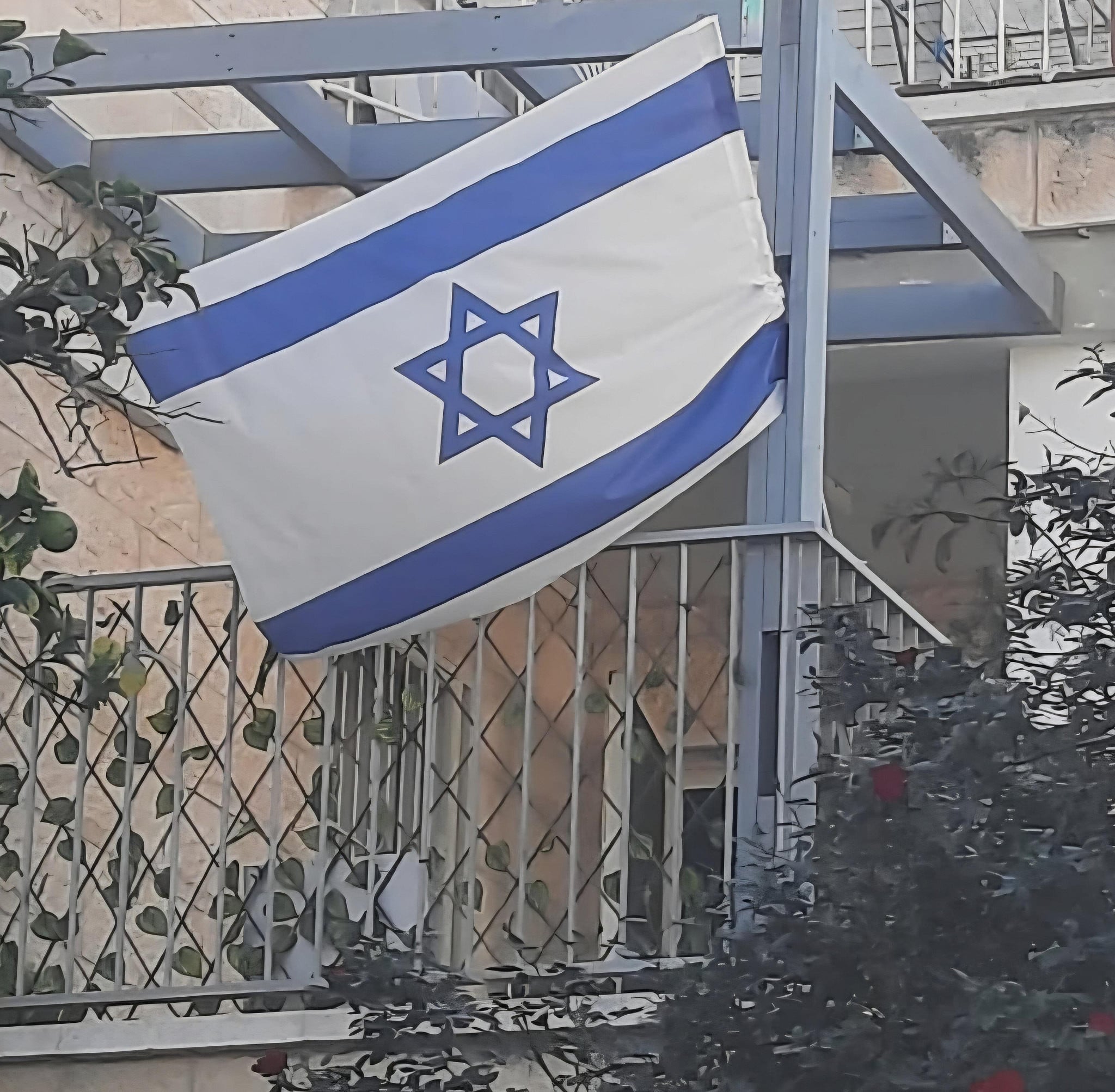
During the heavy rain that I just mentioned, I saw the large flag that we have on the balcony flying albeit soaked with rain. To me it symbolized the resilience of the country, flying ion the face of adversity.
Despite everything we have been through in the last two years, there is nowhere else I would rather be. It just feels special to live in Israel. With the help of Hashem, I look forward to having many more years of living in Israel with my family and friends.