


Shaping the Future by Remembering the Past
The 2,000-Year Journey – The Jewish Indian Heritage Trail
Jews and the Great Port of Bharuch
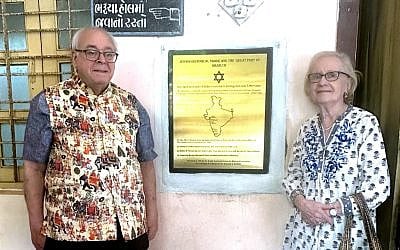
Dr. Kenneth X. Robbins and Dr. Joyce Robbins
Bharuch, Gujarat, India
February 12, 2026
Historical markers are windows into the past. The past molds our present and influences our common tomorrows.
A new and surprisingly rare event took place in Bharuch, Gujarat, India. A Jewish historical marker was publicly sited. The rarity of Jewish historical markers in India is changing because of an unusual three-legged partnership. A Jewish Indian heritage trail is emerging.
Dr. Kenneth X. Robbins is a Rockville, Maryland, physician. He is a psychiatrist for a living. For his second exuberant life, he is a world-renowned scholar, author, lecturer, and artifact collector of Jewish Indian history and culture.
Almost two years ago, Jerry Klinger, of the Jewish American Society for Historic Preservation, met with Dr. Robbins in his home. A shidduch (agreement) was formed around the idea of creating a historical marker system in India to tell the Jewish Indian story. Dr. Robbins knows the stories. JASHP has the funds and technical expertise to fabricate and deliver the markers. Relationships between Dr. Robbins and key people on the ground complete the necessary triangulation.
Jewish communities in India assert Jews have been part of Indian life for over two thousand years, dating from the time of King Solomon. Perhaps…what matters, as Dr. Robbins tempers, is “what can be proven.”
What can be proven through documentary evidence is that Jews have been centrally involved in Indian economic, social, political, and cultural life for at least 1,300 years across the Indian sub-continent. Jews have been, as expected, merchants. What is not expected, mainly because of Jewish Western cultural bias and arrogant ignorance, is that Indian Jews have been military leaders, Generals of armies, political influencers, and peace makers.
The Bharuch marker is sited, with honor and respect, on the front of the Raichand Deepchand Library in Bharuch. The prestigious library was established in 1858. It is one of the oldest libraries in Western India. The library has a collection of about 200,000 books and rare manuscripts.
Markers are by necessity short. If a marker’s text is too long, most people do not take the time to read it. They walk by. Getting a reader’s attention is the first challenge. The second challenge is to get the reader’s interest for another 30 seconds. The third challenge to historical markers is the hard part.
It is reminiscent of the famous story of a non-Jew who approached Rabbi Hillel. The man wanted to know about Judaism. The condition was that Rabbi Hillel was to impart the knowledge in the time that the man stood on one foot. A deliberately impossible requirement. The Rabbi agreed and gently told the man, “What is hateful to you, do not do to your fellow. The rest is commentary. Go and study.”
The man was intrigued. His curiosity piqued. The last three words made the difference. “Go and study.” Rabbi Hillel had created a verbal historical marker. Once engaged, the verbal historical marker said, if you want to know more, and there is more, much more, go and learn.
The Bharuch marker is the seventh marker in the nascent trail. The Baruch marker deliberately incorporates a Star of David and a map of modern India. The text is short, ~116 words. Short, yes, but pregnant with many, many ideas, thoughts, intriguing stories of life, death, hope, and dreams, to be read between the lines and a free mind’s imagination. The rest is commentary – go and learn.
The text reads:
Jewish Historical Trade and the Great Port of Bharuch
Jews have been part of India’s mercantile heritage for over 2,000 years.
Recently discovered 12th-century documentary evidence from the historical Cairo, Egyptian Synagogue, confirmed the centrality of the Port of Bharuch to Jewish International-Indian trade. [1] Abu Zikri Yehuda b. Yosef ha-Kohan al-Sijilmasi, a Moroccan Jew, took refuge in Bharuch after being attacked by pirates near Tana. [2] Yishaq al-Nafusi imported sorghum, iron, and textiles from Bharuch. [3] Halfon B. Netanel Ha-Levi sent textiles from Bharuch to Aden with Barakat B. Musa Al-Halabi. [4] Judah and Harun, the sons of Musa, perished on the route to Bharuch.
Presented in 2026 by the Jewish American Society for Historic Preservation (Jerry Klinger, President) and Dr. Kenneth X. Robbins.
Many more markers are in development. Many more stories are to be told.
Jerry Klinger is the President of the Jewish American Society for Historic Preservation