
Urban sociologist and geopolitical commentator
The 2026 BRICS Declaration: The Grammar of EMDE-Centrism
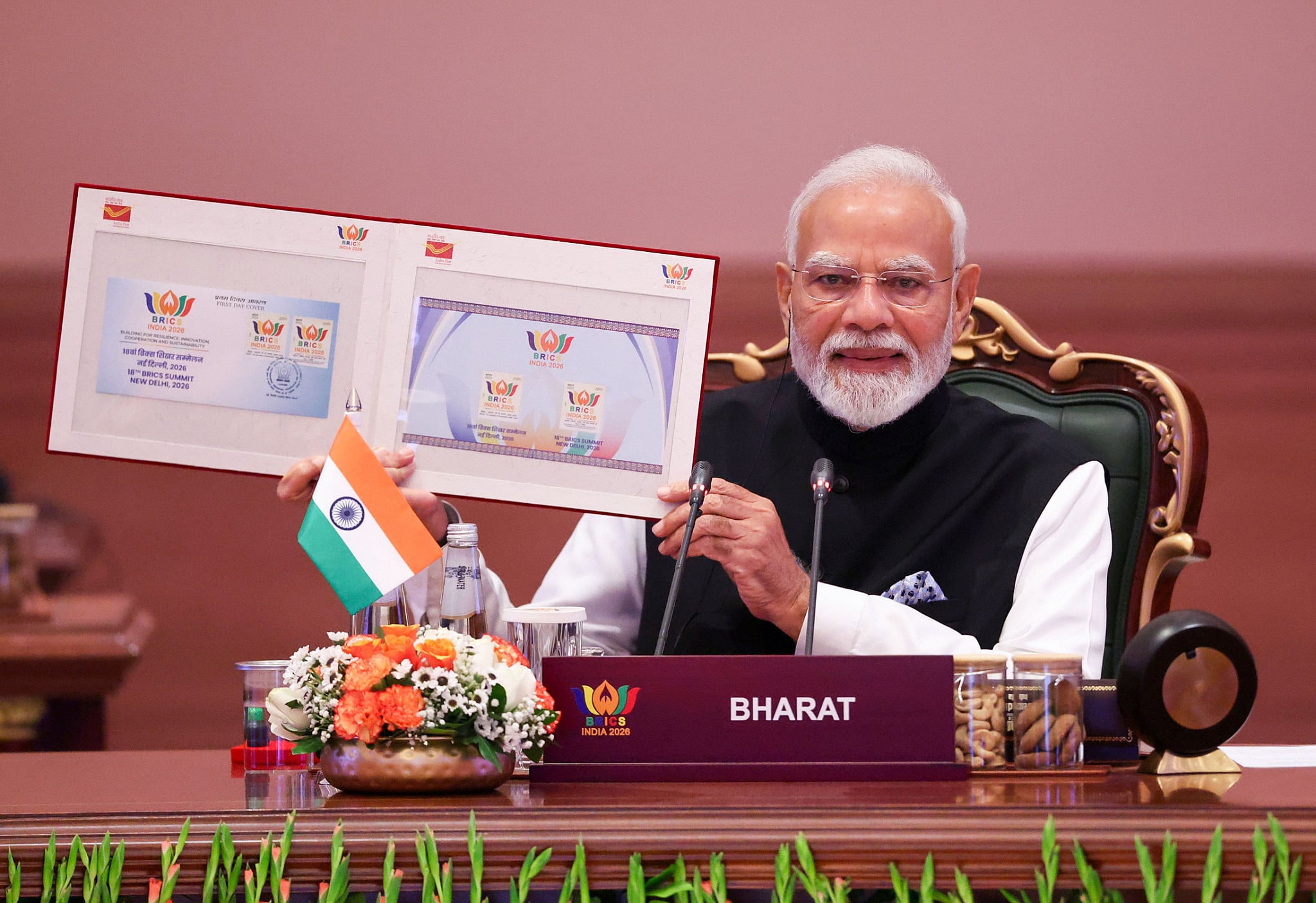
PM Narendra Modi at BRICS Summit Session on “Inclusive Global Governance and Strengthening Multilateralism” at Bharat Mandapam, in New Delhi on September 12, 2026. (Photo Credit: PIB/Govt. of India).
From a bureaucratic category to a language of collective leverage, the New Delhi Declaration shows how BRICS is weaving EMDEs into its claims over capital, representation, and the architecture of global economic governance.
On September 12, 2026, BRICS leaders unanimously adopted the 140-point New Delhi Declaration, closing the bloc’s 18th summit and, with it, India’s year-long chairship under the banner “Building for Resilience, Innovation, Cooperation and Sustainability.” The declaration’s language on “emerging markets and developing economies (EMDEs)” is by now familiar in cadence but new in reach: quota realignment, World Bank shareholding, artificial-intelligence governance, and development finance are all now explicitly routed through an EMDE frame that, a year ago, existed mainly as a foreign-ministry formula for AI policy. The interesting question is not whether this language is sincere. It is why a bloc of 11 states with its own summit calendar, bank, and acronym needs a second, far larger category layered on top of the first, and what that need tells us about how coalitions without formal authority try to extract concessions from those who hold it.
Two kinds of power, one bloc
International bargaining rests on a distinction rarely made explicit: the power to name a constituency and the power to fill that name with entitlements. Naming is unilateral. Any state or coalition can declare itself the voice of “the Global South” or “EMDEs” without anyone’s permission. Filling the name (a quota share, a voting weight, a leadership seat) requires the consent of whoever currently holds the thing being redistributed. BRICS possesses the first kind of power outright and only bargaining leverage, often thin, over the second. This asymmetry is not a flaw in the EMDE-centric turn; it is the condition the turn exists to manage, and it explains why the New Delhi Declaration reads so differently across its own sections.
Consider the declaration’s treatment of IMF and World Bank governance. Leaders urged entry into force of the 16th General Review of Quotas “with no further delay,” welcomed the Diriyah Guiding Principles, and called for work on a 17th review that would shift voting shares toward EMDEs while protecting the poorest members’ allocations (para. 18). This is nearly the same demand BRICS made at Yekaterinburg in 2009, repeated at Rio in 2025 under the “BRICS Rio de Janeiro Vision for IMF Quota and Governance Reform,” and now repeated again in 2026 with a new proper noun (Diriyah) attached. The pattern is not accidental. BRICS is a petitioner here, not a principal: the votes that would shift belong to the United States, Japan, and European shareholders whose relative weight would shrink, and those actors are under no institutional obligation to concede merely because 11 states, however populous, name themselves EMDE representatives and attach the request to a dated review cycle. Two decades of near-identical language should be read, soberly, as stagnation dressed in refreshed vocabulary: a conclusion the declaration’s own repetition of 2009-era grievances, this time with a “17th GRQ” instead of a “13th,” effectively confirms.
Contrast this with the New Development Bank and cross-border payment infrastructure, where the declaration is comparatively short but the underlying reality is different in kind (para. 115-116). When the NDB lends in members’ own currencies, or when domestically built payment rails are wired together, no external shareholder’s assent is required, because BRICS states are not petitioning anyone; they are the shareholders. The content-creation problem that stalls quota reform simply does not arise in the same form. This is why the financial-governance sections of BRICS communiqués have, since Rio 2025’s guarantee-mechanism announcement, sounded more concrete than the Bretton Woods sections, not because negotiators wrote them with more conviction, but because they describe a domain where the bloc can supply substance by its own decision.
The venue migration as evidence
What makes 2026 analytically distinct from prior BRICS cycles is not a new demand but a new routing. The EMDE-centric framing did not originate in a finance ministry. It was assembled across 2025 in foreign-policy venues: the Rio summit’s standalone AI governance declaration, grounded in data sovereignty and equitable compute access and pitched explicitly against OECD- and G7-led frameworks; the late-2025 foreign ministers’ call for AI that serves “good and for all.” The August 2026 Jaipur meeting of Finance Ministers and Central Bank Governors then moved this vocabulary into an institution that actually administers capital rather than issues ethical statements, folding AI, digital financial innovation, and cross-border payments into the same agenda as climate finance and quota reform. The September New Delhi Declaration completes the migration: Leaders now commit to implementing the BRICS Statement on the Global Governance of Artificial Intelligence as part of the same document that reaffirms the Rio quota vision and endorses the 2025 World Bank Shareholding Review.
This migration matters because it is the empirical signature of the category-versus-content distinction actually operating in real time, rather than a plausible theory imposed on the data after the fact. A coalition testing whether its naming power can be converted into content does not merely repeat a slogan; it moves the slogan into progressively more consequential institutional venues, from academic forum, to foreign ministry, to finance ministry, to leaders’ declaration, to see where it sticks. Whether the language survives contact with each venue’s actual decision authority is the test. On IMF quotas it has migrated everywhere and moved nothing. On AI governance it is moving into a domain, unlike Bretton Woods shares, where no incumbent yet holds the entitlement being contested, which is precisely why BRICS can behave as a first mover there rather than a petitioner, seeding a data-sovereignty vocabulary before an OECD-centered standard hardens into the default reference point by inertia.
Heterogeneity as the price of consensus
The New Delhi Declaration’s own drafting history illustrates the second constraint on EMDE-centrism: the bloc’s radical internal asymmetry. A May 2026 foreign ministers’ meeting in New Delhi ended without even a joint statement, split by disagreement over West Asia. That the leaders nonetheless reached unanimous consensus four months later, on a declaration condemning the Pahalgam attack, demanding an immediate Gaza ceasefire and full Palestinian UN membership, and criticizing unilateral tariffs and non-compliant carbon border measures, while naming no country on any of these points, is not evidence of deepening unity. It is evidence that the EMDE category functions as a coalition-maintenance device precisely because it is elastic enough to let a Gulf financial hub (Saudi Arabia, the UAE), a war-constrained Russia, a technology superpower pair (China, India), and lower-income members like Ethiopia and Egypt sign the same 140 points without resolving their disagreements or sharing a common economic condition. “EMDE” here is a bargaining label, not a description of shared circumstance, and its capaciousness is the mechanism that makes consensus possible at all.
That capaciousness carries a distributional cost the declaration does not address. The states capable of actually supplying content (China and India in payments and NDB lending capacity, Gulf members in capital) will accumulate disproportionate authority over what “EMDE-centric” means in practice. The poorer members the category is rhetorically built to serve receive the designation without a proportionate hand in shaping it, a bifurcation the 1970s Group of 77 experience previewed: the New International Economic Order (NIEO) coalition of newly independent and developing states declared themselves a unified bloc, demanded structural change to commodity pricing, technology transfer, and voting power at the Bretton Woods institutions, and largely failed to move the underlying architecture of IMF quotas or World Bank shareholding, because that architecture’s incumbents were under no obligation to yield it. What the G77 did succeed in doing, over subsequent decades and through separate, slower negotiations, was institutionalize categories, “developing country” status at GATT and later the WTO, the Least Developed Country designation at the UN, that eventually acquired real legal content: special and differential treatment provisions, tariff preferences, technical assistance obligations.
The lesson is not that categorical politics is empty. It is that categories and content travel on different timelines, through different mechanisms and separate, slower negotiations entirely disconnected from the original bloc’s leverage, and the gap between them can persist for a generation.
What the New Delhi Declaration actually settles
Read against this framework, the 2026 summit settles less than its 140 points suggest and more than skeptics assume. It settles nothing on Bretton Woods redistribution, where BRICS remains a petitioner reciting a 17-year-old request under a new guiding-principles label. It plausibly deepens content on NDB lending and payment interoperability, where the bloc already holds the pen. And it stakes a genuine, still-unresolved claim in AI governance, where no incumbent yet owns the entitlement being contested. “EMDE-centric” is best read as a coalition-maintenance device that has, this cycle, been extended from AI governance into financial-ministry text into the New Delhi Declaration: a genuine institutional deepening compared to 2025’s foreign-ministry framing, but resting on a financial-reform agenda (quota realignment, NDB guarantees) that BRICS has pursued with limited success for over a decade.
The declaration’s unanimous adoption is best understood not as proof that EMDE-centrism has acquired substance, but as proof that the category remains supple enough to paper over the bloc’s irreducible heterogeneity, which was, all along, the only thing the category was ever asked to do. Whether it becomes more than that depends less on the phrase’s elegance than on whether the NDB actually lends, the payment systems actually interoperate, and the IMF actually reforms, none of which BRICS has yet managed to force in twenty years of asking.
Related Topics
Related Posts