
The Abraham Accords Go Eurasian — And Kazakhstan Leads the Shift
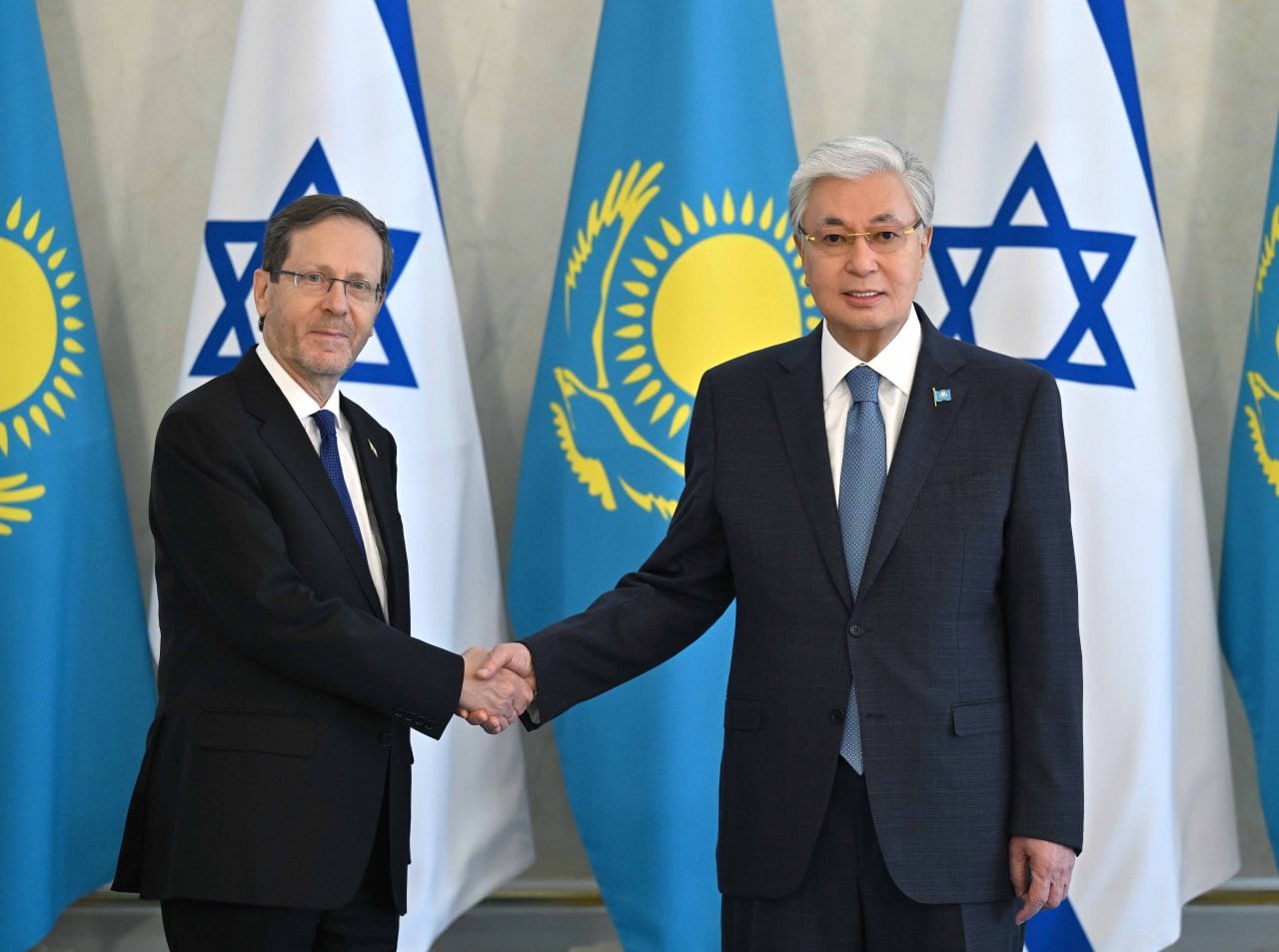
The recent state visit by Israeli President Isaac Herzog to Astana, while encompassing standard diplomatic engagements such as leader-level discussions, facility tours, and trade talks, also underscored a more substantial geopolitical development. Observations from the visit indicated an evolving trajectory for the Abraham Accords, suggesting their increasing relevance beyond the immediate Middle Eastern context. This expansion of influence, rather than being confined to conventional regional boundaries, implicates new spheres of cooperation, with Kazakhstan positioned as a significant contributor to this broader evolution.
I have just arrived in Astana, Kazakhstan for an official visit at the invitation of my friend President @TokayevKZ.
Kazakhstan is a country of global importance whose exceptional landscapes, culture and beauty I have always admired.
The longstanding partnership between… pic.twitter.com/JdMjAzGhsi
— יצחק הרצוג Isaac Herzog (@Isaac_Herzog) April 27, 2026
I’ve been writing about the Abraham Accords since they were signed in 2020. I’ve argued that they’re not just a diplomatic success, but a civilizational breakthrough — evidence that Muslim-majority nations and Israel can choose a path of progress over past grievances, collaboration over conflict. Still, I found myself pausing when Kazakhstan’s participation was announced last November. It wasn’t from doubt, but from a genuine sense of amazement at what this means.
For the very first time, a Central Asian state with a Muslim majority, emerging from the post-Soviet era, has joined the fold. There’s no precedent from the Arab world, and it’s not located in the MENA region. This nation, spanning from the Caspian Sea to the Chinese border—secular, abundant in resources, and strategically significant—has recognized the relevance of the Abraham Accords for its future. This choice didn’t merely add another country to a roster; it reshaped the geopolitical map.
???????????????? President @TokayevKZ and President @Isaac_Herzog hold a tête-à-tête meeting, highlighting untapped potential for economic&investment cooperation.
As the President underlined, Kazakhstan has decided to join the #AbrahamAccords.
This gesture symbolizes our readiness and… pic.twitter.com/wWPAIwNAnW
— Press Office of the President of Kazakhstan (@aqorda_press) April 27, 2026
Since 1992, Astana has enjoyed full diplomatic relations with Israel. They already had embassies, energy agreements, agricultural partnerships, and healthcare connections. By 2023, bilateral trade had soared to nearly $482 million. This wasn’t a country that needed the Abraham Accords to recognize Israel; rather, it sought the Accords for something more targeted: to harness the convening power that comes with formal alignment. The results have been swift. Within months, a reported $17 billion package of commercial agreements with American companies emerged, covering areas like mineral resources, digital technologies, and aviation.
Israeli Foreign Minister Gideon Sa’ar’s visit in January 2026 led to a comprehensive cooperation roadmap in high-tech agriculture, water management, AI, and renewable energy. President Herzog’s recent visit has further propelled this momentum, with proposals to triple bilateral trade, establish direct flights, and eliminate double taxation. These aren’t just symbolic moves; they’re the foundation of a revamped economic relationship.
President Tokayev made it clear — this decision is “solely in the interests of Kazakhstan.” There’s something refreshing about that honesty. No illusions of idealism here, just a straightforward acknowledgment that effective diplomacy is fundamentally about expanding a country’s opportunities. Kazakhstan has certainly achieved that.
(Communicated by the President’s Spokesperson)
Monday, 27 April 2026 / 10 Iyar 5786
*President Isaac Herzog Welcomed by President Kassym-Jomart Tokayev of Kazakhstan in Astana*
On Monday, April 27, 2026, President Isaac Herzog landed in Astana, beginning his official visit to… pic.twitter.com/ndYTDpBrIv
— Government Press Office ???????? (@GPOIsrael) April 29, 2026
The Abraham Accords were launched as a peace initiative aimed at the Middle East, and it’s clear why they were presented that way. Four Arab nations — the UAE, Bahrain, Morocco, and Sudan — took a bold step by normalizing relations with Israel, creating opportunities for economic collaboration, direct flights, and joint efforts in defense, cybersecurity, and agriculture. It was a historic moment, filled with significance. However, the momentum slowed down, partly due to ongoing regional tensions and partly because of changes in the U.S. administration.
When Trump returned to office, it reignited interest in the Accords. But Kazakhstan’s involvement did something that no revival could have orchestrated: it showed that the Accords aren’t limited by geography. Instead, they’re driven by a shared logic. This logic — practical cooperation between Muslim-majority countries and Israel, supported by American political goodwill and Gulf investment — applies just as much on the vast Eurasian steppe as it does in the Gulf region. This is hugely significant.
Once Kazakhstan’s participation is seen as a natural fit, the next question arises: who will follow? Azerbaijan, with its strong defense and energy connections to Israel and a secular outlook, stands out as a likely candidate. Uzbekistan is keeping a close eye on developments. Other Turkic nations in Central Asia will draw their own insights from this. The Abraham Accords, which once appeared to be confined to a specific region, are now emerging as a broader platform. And platforms, by their very nature, have the potential to expand.
8⃣
Notably, the Abraham Accords framework is now widening: Azerbaijan has joined the circle of cooperation, signaling a broader regional integration trend. pic.twitter.com/DWhe7XEK33— ME24 – Middle East 24 (@MiddleEast_24) November 24, 2025
An examination of the unfolding developments reveals a stepwise construction. Kazakhstan’s geostrategic position, specifically its role in the Middle Corridor (Trans-Caspian International Transport Route), facilitates a direct connection between Central Asia and Europe, notably bypassing both Russia and Iran. Its substantial reserves of critical minerals such as rare earths, lithium, tungsten, and copper position it as a key nation for Western efforts to diversify supply chains, thereby mitigating reliance on specific countries. Furthermore, its secular Muslim identity, combined with a multi-vector foreign policy approach, enables it to serve as a potentially effective intermediary between disparate geopolitical spheres.
The integration of the Abraham Accords framework within this geographic context introduces additional dimensions. This framework could facilitate the application of Israeli technological expertise, particularly in water management, precision agriculture, and cybersecurity, to address Kazakhstan’s significant climate and modernization challenges. Simultaneously, it offers Gulf sovereign wealth funds a structured avenue for infrastructure investments across Central Asia. For American policymakers, it presents an opportunity to cultivate a reliable partner in a region historically characterized by substantial Russian and Chinese influence.
This emergent dynamic does not appear to represent a zero-sum transaction. Rather, it exemplifies the type of multilateral outcome that diplomatic efforts ideally aim to achieve. The Abraham Accords, initially predicated on the principle that cooperation can supersede conflict, seem to find a new applicability in this context, with its underlying logic remaining pertinent.
The trajectory established by the Abraham Accords since 2020 indicates a clear pattern: agreements initially perceived as largely symbolic have, in fact, yielded more tangible results than many initial analyses suggested. For example, the relationship between the UAE and Israel has seen substantial growth across sectors such as trade, technology, tourism, and defense, exceeding initial expectations following the September 2020 agreements. This acceleration can largely be attributed to the inherent tendency of established cooperative frameworks to generate self-sustaining momentum.
Kazakhstan appears to be adopting this cooperative logic within the broader Eurasian steppe region. The recent visit by President Herzog to Astana, including his tour of the Alem.ai Artificial Intelligence Center and discussions regarding AI collaboration within a nation that has designated 2026 as the Year of Digitalization, collectively imply that the bilateral relationship is transitioning beyond ceremonial engagements toward more substantive cooperation.