
The accusations that Israel has committed genocide in Gaza are unfounded.
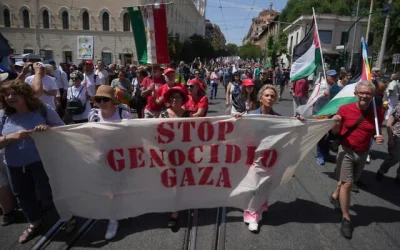 Anti-Israel protesters gather for a pro-Palestinian demonstration, in Rome, June 7, 2025. (AP Photo credit Alessandra Tarantino)
Just in the last month, there have been roughly 10 to 25 major protests against Israel in the United States in which protesters used the word “genocide”. This is nothing new; it has been going on for years.
What is new is that the anti-Israel position has caused a major shift in the support for Israel in the United States Senate. In April, 2026, 80% of the Democratic Senators opposed legislation authorizing certain weapons and bulldozers to be sold to Israel. The opposition failed to stop the sale.
In leading the opposition to the sale, Bernie Sanders accused Israel of “genocide”. That made me think again about what “genocide” means. Unfortunately, the term means different things to different people.
A little history clarifies this discrepancy. In the fall of 1947, local Arabs began a siege of Jerusalem, a siege which was not broken until the spring of 1948. The siege of Jerusalem was terrible for the people who lived in Jerusalem, many of whom lost huge amounts of weight because there was not enough food. See “Letters from Jerusalem 1947-48” (2015) by Zipporah Porath, an American Jew who lived in Jerusalem through that siege and sent letters home to her family describing that siege.
Sieges were nothing new in 1947. The Greeks besieged the Trojans in the 12th or 13th century BCE. Joan of Arc besieged the people of Orleans in the 15th century. As late as World War II, the Germans besieged St. Petersburg. Over one million civilians died as a result of that siege, mostly from starvation. In all of those sieges, civilians became victims. It did not matter. A siege was a siege and, at the time, considered an acceptable way to fight a war.
Today, opponents of Israel claim that Israel has committed “genocide” in Gaza, while Israel denies it. One reason for this difference is that Israel and its critics are using different definitions of “genocide”.
I begin with the Rome Statute, which defines “Genocide”. While there are numerous countries including Israel, Russia, the United States, India, and China which have refused to adopt the Rome Statute, the definition of “genocide” as set forth in the Rome Statute is now part of International Law .
Under the Rome Statute, the term “genocide” is defined:
” For the purpose of this Statute, genocide means any of the following acts committed WITH THE INTENT to destroy, in whole or in part, a national, ethnical, racial or religious GROUP, as such:
(a) Killing members of the GROUP;
(b) Causing serious bodily or mental harm to members of the GROUP;
(c) Deliberately inflicting on the GROUP conditions of life calculated to bring about its physical destruction in whole or in part;
(d) Imposing measures intended to prevent births within the GROUP;
(e) Forcibly transferring children of the Group to another GROUP” [CAPS MINE].
The definition of “Genocide”, had a history even before the Rome Statute was passed. The term was originally adopted during World War II as a response to the Nazis murdering millions of Jews because they were Jews. In 1948, the United Nations adopted the convention on the prevention and punishment of the crime of genocide (Genocide convention) which defines genocide as:
a. “Killing members of the group;
b. Causing serious bodily or mental harm to members of the group;
c. Deliberately inflicting on the group conditions of life calculated to bring about its physical destruction in whole or in part;
d. Imposing measures intended to prevent births within the group;
e. Forcibly transferring children of the group to another group.”
The date, 1948, of the adoption of the Genocide convention is significant. It was passed only three years after the end of World War II, when the whole world was horrified by the Nazi’s slaughter of six million Jews. It was passed two years after the Nuremberg trials. It was passed the same year that Israel became a country.
The definition of “Genocide” in the Genocide Convention was NOT intended to cover the unnecessary killing of civilians during a war, as some examples illustrate. In 1948, nobody thought Franklin Roosevelt to be guilty of genocide, even though on his watch, the United States firebombed Tokyo without any regard to how many civilians were killed. Nobody thought of Harry Truman as a war criminal in 1945, even though the bombing of Hiroshima and Nagasaki that year killed at least 160,000 people, most of whom were civilians Nobody considered Dwight Eisenhower a war criminal even though on his watch, the allies bombed Dresden, killing roughly 25,000 people, almost all of whom were civilians
Today, though, the definition of “genocide” as used by Israel’s critics has an entirely different meaning. Now, the definition used by Israel’s critics includes the unnecessary killing of civilians in a war.
Israel has two problems in dealing with the charges of genocide against it. First, the international community completely ignores the Rome Statute definition as well it needs to. Israel’s intent in the war was NOT to kill Palestinians as a group. Israel attacked Hamas who’s members had killed 1,200 people because they were Jews, raped countless Jewish women because they were Jews, and burned numerous people of all ages in their homes because they were Jews – the very group whose slaughter by the the Nazis caused the definition of “genocide” in the Rome Treaty to be drafted in the first place.
Israel did not kill anybody in Gaza because they were Palestinians . There are 2,000,000 Palestinians who are citizens of Israel. There were many Palestinians who served in the IDF in Gaza, some of whom died fighting there. At least one Palestinian has obtained the rank of General in the IDF.
Today’s critics of Israel do NOT feel bound by the Rome Treaty definition of “genocide.” To them, killing an unnecessary number of civilians, regardless of motive, constitutes “genocide”. Israel maintains that even under that definition , it has not committed genocide. It argues that the many civilian casualties in Gaza were caused by Hamas building a very elaborate set of tunnels which connected numerous regional headquarters which Hamas had built under hospitals and schools. Israel also emphasizes that it has gone to great lengths to minimize casualties in fighting the war.
Another comparison is illustrative. In 1967, after Egypt began a war against Israel, the IDF swept through Gaza, which was defended by one Egyptian battalion, in only one or two days. (Israel won the whole war in only six days.) Today, after years of fighting, Hamas is still operating in Gaza, armed, and grows stronger daily.
The bottom line is simple: under the definition of “genocide” which has become international law, Israel cannot be said to have committed genocide. Israel’s opponents don’t care. To them, the whole dispute between them and Israel is a matter of politics not law. Under international politics, regardless of the law, they find Israel guilty. What a shame.