


Mathematics Teaching Professor, Author
The Adams Street Shul: Over a Century of Jewish Life in Newton, Massachusetts
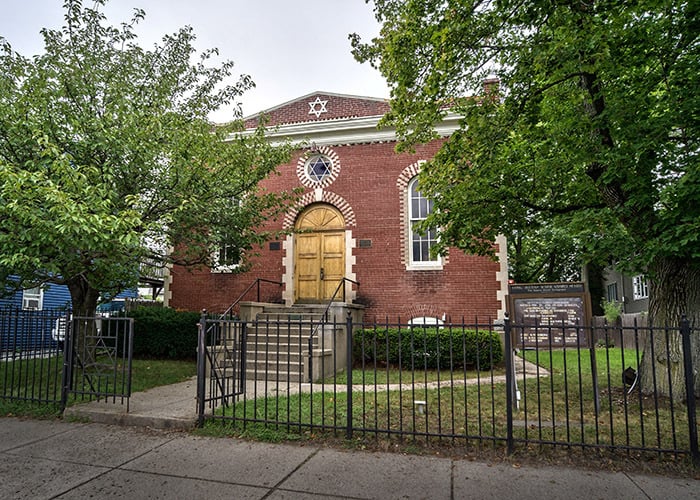
The Adams Street Shul (Source: The Adams Street Shul of Newton, MA)
The Adams Street Shul of Newton, Massachusetts, is an independent historic Modern Orthodox synagogue with a diverse congregation and a welcoming place in the broader community. For more than a century, the shul has provided a place for davening (prayer), learning, spiritual growth, and the celebration of Jewish holidays and life-cycle events. Originally established as Agudas Achim Anshei Sfard, the synagogue is now commonly known as the Adams Street Shul.
Known for its warm and caring community, the Adams Street Shul welcomes people from varying backgrounds and encourages participation and contributions to congregational life. Today, the shul continues the traditions established by its founders while connecting Newton’s rich Jewish past with the future.
I would like to thank Rabbi Mordechai Rackover and Mark Whittum, President of the Adam Street Shul for their guidance and support.
Synagogue
The Adams Street Shul, located on Adams Street near Watertown Street in Newton’s Nonantum Village, was built in 1912 by a Jewish congregation established the year before. A simple one-story brick building, it features round-arch windows and an entrance topped by an oculus containing a Star of David. The synagogue served as Newton’s only Jewish house of worship until Temple Emanuel opened in 1937.
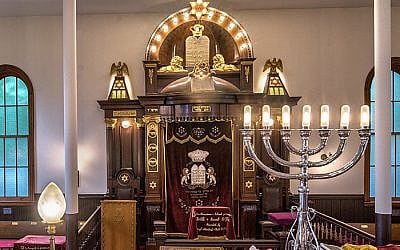
Much of the building was constructed with labor contributed by members of the congregation, many of whom were skilled craftsmen. In 1924, a Torah ark and bimah were added by Jewish-Ukrainian craftsman Samuel Katz, whose work is also represented at Boston’s Vilna Shul and the Museum of Fine Arts, Boston. Particularly notable is the synagogue’s central bimah, an arrangement more commonly associated with Sephardic tradition despite the congregation’s Ashkenazi origins. The historic interior remains largely intact, including benches later donated by Congregation Kehillath Israel of Brookline.
The Adams Street Shul’s ornate Aron Kodesh, commissioned by the women of the congregation, is an important surviving example of Katz’s work and one of only two historic synagogue arks still surviving in congregations in the Greater Boston area. The building’s architecture, artwork, and preserved interior provide a rare glimpse into Newton’s early Jewish community. The Adams Street Shul is listed on the National Register of Historic Places.
Religious Events
The Adams Street Shul has always welcomed Jews representing a wide range of beliefs and religious practices. Some members attend regularly, while others come for holidays or special occasions. This openness and strong sense of community have remained hallmarks of the congregation’s Modern Orthodox tradition.
For most of its history, the shul was led by its members rather than a rabbi. It remained a lay-led congregation until the 1990s, when it welcomed its first rabbi. Today, the Adams Street Shul continues to be a welcoming place for worship, learning, and community.
The congregation holds Shabbat and holiday services, as well as hosting a Sunday morning minyan. Its programming also includes weekly classes, Shabbat lunches and dinners, and celebrations of Chanukah and Purim. Through worship, education, and social gatherings, the Adams Street Shul continues its longstanding tradition of bringing people together and providing a home for Jewish life in Newton.
Historical Backgrounds
The Jewish presence in Massachusetts dates back to 1649, when Solomon Franco, a Sephardic merchant from Holland, arrived in Boston. The local Puritan court did not permit him to remain permanently and ultimately paid for his return trip.
Jews began arriving in Newton in significant numbers in the late nineteenth century, particularly in Nonantum, then known as North Village. Around 1890, Jewish immigrants from Ukraine began settling in the neighborhood, joined by a smaller number from Hungary. They became part of Nonantum’s diverse immigrant community, living alongside Irish, French Canadian, and Italian families rather than establishing an exclusively Jewish neighborhood. This offered a sharp contrast to the segregated villages and shtetls many had known in Europe.
Hungarian Jewish immigrants, often from families with experience in business and storekeeping, established shops along Watertown Street, the neighborhood’s main commercial thoroughfare. Many Russian and Ukrainian immigrants arrived with fewer financial resources and worked as peddlers, collecting paper, metal, textiles, and other materials and providing delivery services to local residents and businesses. Within a decade, many had achieved enough financial stability to purchase or build their own homes, often obtaining mortgages from local banks.
By 1901, at least half of Newton’s Jewish families lived in Nonantum, with many coming from Russia, Ukraine, and the Austro-Hungarian Empire. As the community grew, so did the need for a permanent place of worship. Before 1911, Jewish residents gathered for services in private homes or in a rented space on Dalby Street. In 1911, they established the congregation that would become the Adams Street Shul, Newton’s first synagogue, marking an important new chapter in the development of Jewish life in the city.
Which brings us to 1911.
In 1911, the United States was a nation of 46 states under President William Howard Taft. It was a period of rapid growth and significant change. In California, the Nestor Motion Picture Company established what became the first permanent movie studio in Hollywood, helping launch the area’s future role in the film industry. In New York City, the devastating Triangle Shirtwaist Factory fire killed 146 garment workers, most of them young women and immigrants, and sparked major changes in workplace safety and labor protections. That same year, on May 30, the first Indianapolis 500 was held at the Indianapolis Motor Speedway, beginning one of America’s most enduring sporting traditions.
In 1911, Massachusetts was a thriving industrial center, shaped by manufacturing, textiles, and a growing labor movement. Cities and towns across the state were home to factories, mills, and workshops that attracted workers from across the United States and abroad. The state was also at the forefront of progressive reform, with increasing attention to workers’ rights, workplace safety, and improved living conditions. Against this backdrop of industrial growth and immigration, Jewish communities were taking root in neighborhoods such as Nonantum in Newton, establishing businesses, homes, and religious institutions that would become an enduring part of the state’s history.
It was in that year, 1911, that the Adams Street Shul was founded in Nonantum, becoming the first synagogue in Newton. The congregation’s new building was dedicated during Chanukah in December 1912 and would become a lasting landmark of Newton’s Jewish community. Today, the Adams Street Shul is listed on the National Register of Historic Places and stands as a symbol of the longevity, resilience, and enduring spirit of Jewish life in Greater Boston.
The Adams Street Shul began with a small community of fewer than one hundred Jewish families. The congregation and its members soon prospered, and by 1920, many families had purchased their own homes and established businesses. The younger generation pursued higher education and went on to build new careers and businesses, helping strengthen the community for generations to come.
In its early years, the congregation could not afford the benches traditionally found in synagogues, so members brought chairs from their homes. Later, wooden desks with metal frames that could be secured to the floor were added, though they were not particularly comfortable for adults. The benches used today were donated by Congregation Kehillath Israel in Brookline when it renovated its sanctuary. Although they are from the appropriate period, they are not original to the Adams Street Shul.
As Newton’s only synagogue for many years, Adams Street became a home for Jews with a wide range of beliefs and levels of observance. Some members attended every week, while others came primarily for the holidays or only once a year. This tradition of welcoming Jews from across the spectrum of religious practice continues today, and the strong sense of community remains a defining characteristic of the congregation.
For more than a century, the Adams Street Shul has remained a vital part of Newton’s Jewish history. From its beginnings as a small congregation of immigrant families in Nonantum to its role as a welcoming home for generations of Jews, the shul reflects the resilience, traditions, and community spirit that shaped Jewish life in Newton. Its historic building, preserved ark, and enduring congregation connect the past with the present. More than a historic landmark, the Adams Street Shul continues to be a place where people gather to worship, learn, celebrate, and carry forward a living Jewish tradition.
Contact Information:
The Adams Street Shul of Newton MA, 168 Adams St, Newton, MA 02460
Phone: (617) 630-0226
Email: president@adamsstreet.org
Website: https://www.adamsstreet.org/