The Adventures of Rabbi Akiva and his 24,000 Students
The celebration of the 33rd day of the Omer has always been shrouded in mystery. Traditionally, there have been two basic explanations:
1) The 33rd day of the Omer was Rabbi Shimon bar Yochai’s “day of celebration”, or, according to what is probably a misprint, his yahrzeit (יום שמחתי vs יום שמת רשב״י).
This explanation was recorded by R’ Chaim Vital in the 16th century, based on an oral tradition he heard from his teacher, the Arizal. This idea has so permeated the Jewish consciousness that one might expect to find it in a Mishnah, or at least in a baraisa, gemara, or midrash. But it’s not.
2) The second explanation is based on the Talmudic tradition that Rabbi Akiva’s students died between Pesach and Shavuos (Koheles Rabbah 11:6). Later, non-Talmudic sources add that all of Rabbi Akiva’s students stopped dying specifically on Lag BaOmer (see, for example, Orach Chaim 493:2).
This explanation always bothered me. Why would that be a source of celebration? The students stopped dying not because the plague ended, but because the plague ran out of students to kill!
I’d like to offer a new suggestion, but first, we need some background on the life of Rabbi Akiva.
Rabbi Akiva was a Jewish hero of such magnitude that the early sources give him not one, but two origin stories.
In the first (Avos d’Rabbi Nosson 6:2), Rabbi Akiva was unlettered even at the age of 40. (In an offhand comment in Pesachim 49b, Rabbi Akiva told his students that he wasn’t merely unlettered, but despised the rabbis.) Walking alone with his unlettered thoughts, he encountered a rock with a hole in it.
Upon further reflection, he realized that a slow, steady drip of water had bored into the rock, leaving a crater. Applying this moral to himself, he concluded that if water could penetrate hard rock, the Torah could penetrate his soft heart.
He then set off to learn Alef Beis in cheder with his young son, and kept at his studies until “he learned the entire Torah.” This is the first origin story of Rabbi Akiva – that of a radically self-made man.
In his second origin story (Kesubos 63a), it wasn’t his own initiative that pushed him into the world of higher learning, but a love interest. He fell in love with his employer’s daughter, and she saw something special in him. She asked if he would marry her on condition that he would learn Torah; he agreed, and they eloped.
When her father learned of his daughter’s marriage, he cut them off completely. With no support from her father, Rabbi Akiva kept his promise by leaving home to learn for 12 years, followed by another 12 years, gaining 1,000 students per year.
When he finally came home after 24 years, his wife came out to greet him. When she saw him – for the first time in nearly a quarter of a century – she fell on the ground and kissed the hem of his robes. Scandalized, some students tried to push her away from their great master, but Rabbi Akiva stopped them. “What’s mine and yours is all hers,” he told them.
The Torah empire that he had built, in this version of the story, was entirely due to her initiative.
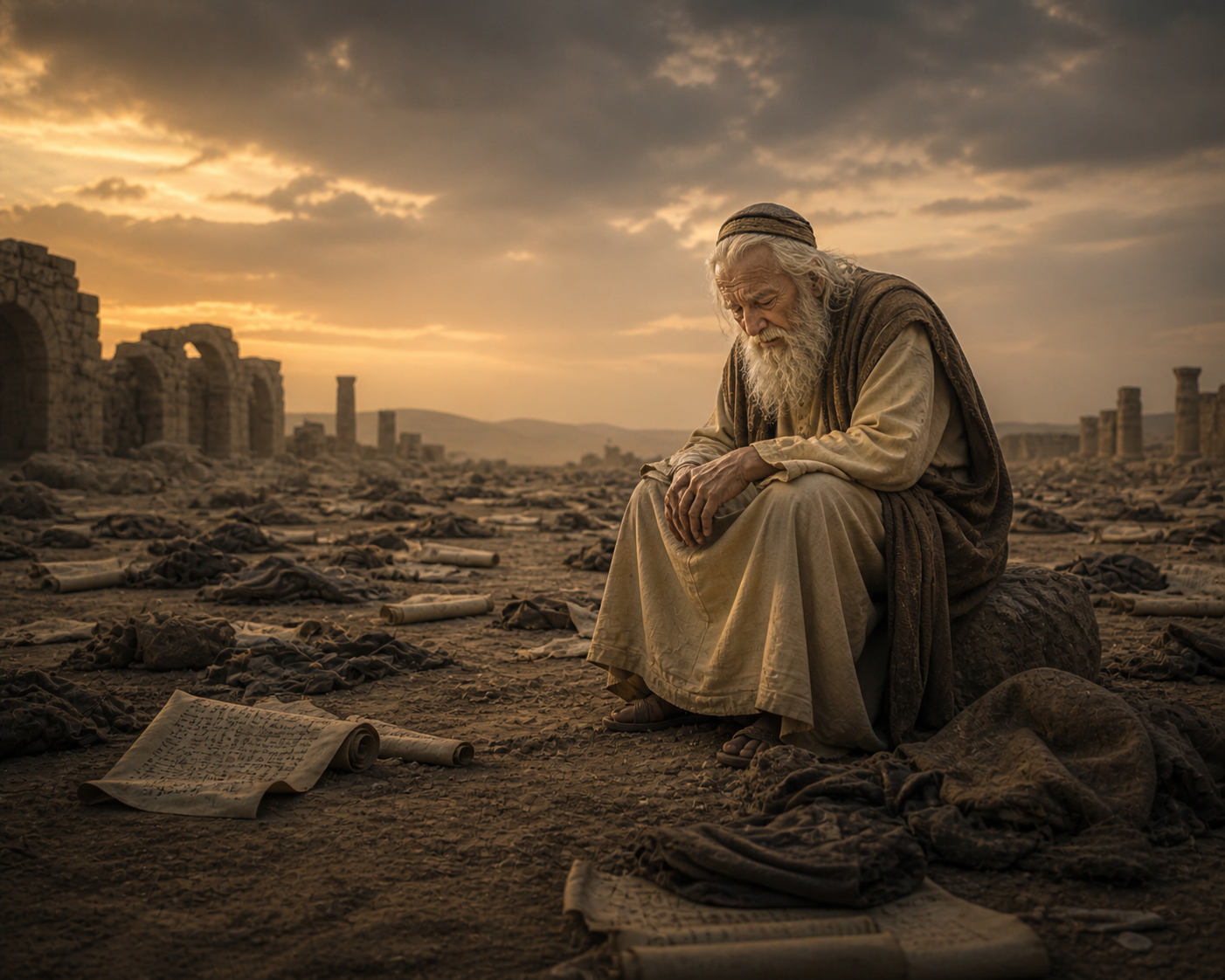
Those are the origin stories of Rabbi Akiva, but that’s not where his story ends. The Torah empire he built collapsed – all of his students died, either due to not showing respect to one another (Yevamos 62b) or gatekeeping their Torah (Koheles Rabbah 11:6). Rabbi Akiva was left even worse than when he started – alone with nothing but the pain in his heart of having buried hundreds or thousands of students.
If anyone could be forgiven for giving up, Rabbi Akiva could have done so at this moment. He tried, he gave a heroic effort beyond what anyone could have imagined, and his entire edifice came crashing to the ground. He could have sunk into a quiet retirement with his bittersweet memories, reminiscing about the past and what could have been. But that’s not what he did.
He went to the south and took on seven more students. Not hundreds or thousands, not even a minyan, and taught them Torah.
Those students then went on to spread Torah across Israel and produced – in the midst of the worst persecution in Jewish history – the generation that gave us the Mishnah, the Tosefta, the Midrashei Halakhah, and the core texts that became the bedrock of the Torah SheBa’al Peh.
I’d like to argue that if it’s true that Rabbi Akiva’s students stopped dying on Lag BaOmer, then Lag BaOmer was the moment he made the decision to pick himself up and find a handful of new ones. Even as he was burying the last of his 24,000 students, he was thinking about how he could rebuild what was lost, about how he could extract a spark of Torah from the smoldering ruins of his once magnificent empire.
It was that moment that created Lag BaOmer. It wasn’t the death of great sages or the fact that they stopped dying, but the heroic decision to maintain their legacy and to keep their flame alive.
On Lag BaOmer, then, in a very real sense, the Jewish religion was reborn. Without that one painful decision, the Jewish religion would not exist as it does today. Lag BaOmer is no less significant a moment than that.
Hindsight is 20/20, but we don’t always see the results of our actions. Rabbi Akiva was tortured to death by the Romans while his student, Rabbi Shimon bar Yochai, was hiding in a cave. Even after this second heroic effort, Rabbi Akiva didn’t know if any of his students were still alive. With Shema on his lips, he might have worried that he was witnessing the final flicker of the last generation of Judaism.
But Rabbi Shimon survived, and he would go on to teach Rabbi Yehuda haNasi. Rabbi Yehuda haNasi would write the Mishnah, and the Mishnah would become the catalyst for the entire Talmud and everything that derives from it. In other words, the entire Jewish religion.
All of this was only possible because of Rabbi Akiva’s Lag BaOmer moment, and without it, Judaism would not exist today.
Lag Sameach.