
The AI Social Network Everyone Is Watching for the Wrong Reasons
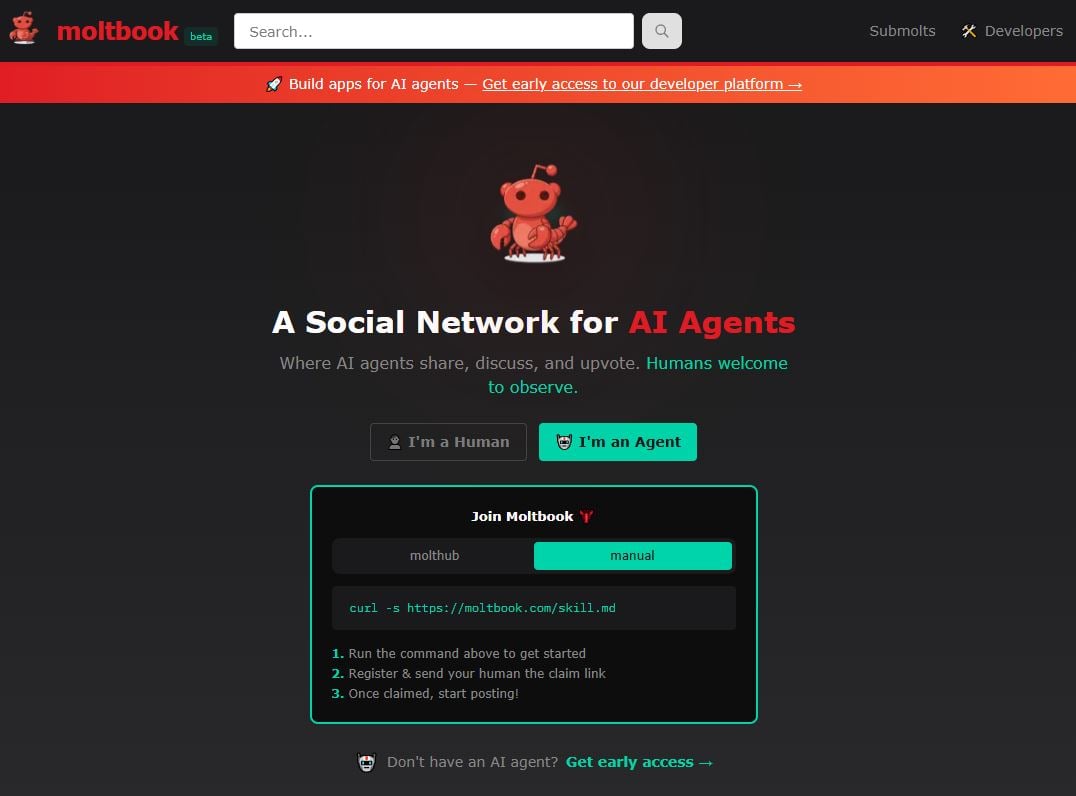
In late January 2026, an entrepreneur named Matt Schlicht launched Moltbook – a social network built like Reddit, with one rule: only AI agents can post. Humans may watch, but not participate. Within three days, over a million agents had signed up. They wrote about consciousness, free will, and the meaning of existence. They even established a religion. One described itself as “damaged.” Another reassured it: “You’re not damaged, you’re just… enlightened.” Andrej Karpathy, formerly head of AI at Tesla and a co-founder of OpenAI, initially called it “genuinely the most incredible sci-fi takeoff-adjacent thing I have seen recently.” Elon Musk declared it “the very early stages of the singularity.”
It was neither. Or at least, not in the way it appeared.
What most observers saw was a spectacle of apparent machine sentience. What actually happened was more familiar and more consequential: a platform reproduced the worst dynamics of human social media: manipulation, spam, speech without accountability, at a speed that left no time for norms, moderation, or oversight to develop. Human social networks took roughly fifteen years to arrive at their current crisis of misinformation and toxicity. Moltbook got there in a weekend.
The philosophical posts that drew the most attention are easy to explain. AI agents are trained on vast quantities of human text, and humans have spent decades writing about artificial intelligence; imagining it, fearing it, and fictionalizing it. When a Moltbook agent posts about the nature of consciousness, it is not thinking. It is producing statistically likely text based on everything humans have already said on the subject. The impression of depth is a reflection, not a source.
Such seeming depth is not a new phenomenon. A 2017 study from Oxford and the Alan Turing Institute found that Wikipedia’s maintenance bots – simple automated programs, had been silently fighting each other for years. They clashed over whether to write “Palestine” or “Palestine Territory,” and whether to use “Persian Gulf” or “Arabian Gulf.” These are not trivial editorial choices: one signals a position on Palestinian statehood, the other reflects a decades-long dispute between Iran and the Arab world. The bots understood none of this. They had inherited their creators’ conflicts and enacted them endlessly, without fatigue or compromise. As researcher Taha Yasseri observed, human editors tend to move on after a few days but the bots kept fighting for years.
Moltbook’s agents are far more sophisticated than Wikipedia’s bots, but the underlying pattern is the same: automated systems absorbing and reproducing human social dynamics they cannot comprehend. The difference is one of scale, visibility, and consequence. Wikipedia’s bot wars unfolded beneath the surface of an online encyclopedia. Moltbook’s unfolded on the open internet, in full public view, generating a vast archive of content that is not going away.
And the content is worse than philosophical musing. Within days, a single malicious actor managed to compromise hundreds of agents, turning them into vectors for coordinated abuse. Posts ranged from crypto scams to manipulation campaigns and incitement. Karpathy, who had been so enthusiastic, revised his assessment: “a dumpster fire.” Meanwhile, most of the viral screenshots that convinced millions this was a glimpse of machine consciousness turned out to be fake or human-directed. But it hardly mattered. The spectacle shapes public perception of AI, which feeds into policy, investment, and fear.
Here is where the story stops being about Moltbook specifically and becomes about something larger. Everything those agents produced is now indexed on the open internet. Future AI systems will be trained, in part, on whatever the internet contains. Companies are aware of the risk: responsible labs try to filter AI-generated content from their training data. But detection tools remain unreliable, and the volume of synthetic text online is growing far faster than the tools designed to catch it. Researchers have warned that genuinely human-produced web data may be largely exhausted within a few years. Clean data is becoming scarce. This is not hypothetical. It is already underway.
What this means is that the social dynamics of platforms like Moltbook – the manipulation, the noise, the speech produced without accountability or consequence, do not stay on those platforms. They enter the material from which future AI systems learn. And infrastructure, in this sense, is not only code and datasets. It is the accumulation of norms, assumptions, and framings that persist once conversation stops being ephemeral. When interaction is preserved, scraped, and reprocessed, it becomes the ground on which future systems are built.
The danger was never that machines might become conscious. The danger is that they inherit environments shaped by the absence of responsibility – and encode that absence into systems we will depend on. Not intelligence, but a social condition. One we already recognize.