
From Kibbutz to the global stage
The AI war has already begun
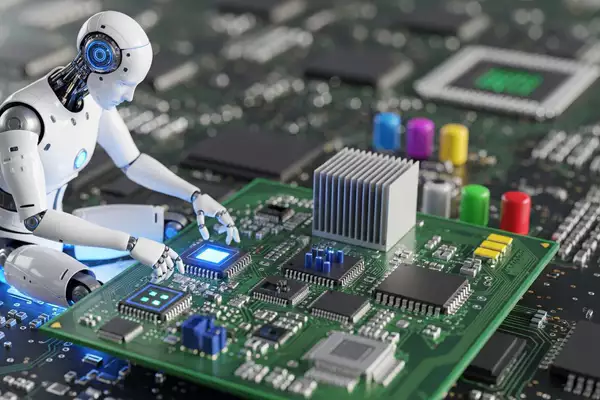
AI agent on a home computer (illustration, photo: Google AI Studio)
The AI war has already begun, which is both the problem and part of the solution. Some say that the AI revolution is a threat to the survival of the Earth’s population.
But the truth is that similar things were said about technological revolutions in the past, such as the printing revolution, the industrial revolution, the invention of the steam engine, the invention of electricity, the invention of the Internet, and this is probably not the last revolution.
The Earth has problems with survival, the climate is threatening, the universe is full of dangers, and already 66 million years ago, a meteorite destroyed the dinosaur population on Earth, and there is a danger that irresponsible leaders will use weapons of mass destruction.
But AI is a technological and social revolution that presents opportunities and risks, and everything will depend on us, the citizens of Earth, in the hope that we will know how to deal with this revolution, just as we have dealt with technological and social revolutions in the past.
In recent months, for example, I have seen that social networks, which until now sought social interaction and entertainment, have begun to cultivate independent and reliable content writers. The content industry is changing rapidly before our eyes, as are other factors, such as:
1. We need a very smart system to test AI.
2. We need very smart people to make decisions based on AI.
3. People who are displaced by AI will develop new needs.
For example:
A. The average university student will learn for 10 years instead of 4-5 years today.
B. Children will start learning at the age of 3-4, and the use of AI tools will begin at a very young age and continue throughout our lives.
C. Cognitive employment for seniors to prevent dementia.
D. Physical activity for all citizens throughout their lives as part of improving the mental, physical, and social systems.
Some facts about the AI war that has already begun and its components.
AI requires data and information.
Today, there is a “law of knowledge and information preservation,” and all data on the planet is preserved and stored.
This information is concentrated in the hands of a small number of companies such as Google, Meta, X Network, Microsoft, Nvidia, and others.
These companies also control the major AI companies. Today, AI companies are in a growth phase, with ChatGPT having only recently released version 5. At this stage, there is fairly good access to cross-company information, but soon every company will try to keep the information it produces to itself and will not want to share it with its competitors.
Hence, information and AI companies will develop and grow, and at the same time, a large industry will emerge for blocking data and information and establishing information coalitions of individuals and companies.
Those who do not know how to block the information they produce will not be able to receive compensation for it from customers and competitors. Those who fail to maintain an information and data coalition will not be able to provide good and appropriate service to their customers.
This means that although AI will result in a large workforce, at the same time there will be a cyber AI industry, AI partnerships, AI testing, and subcontractors, all of which will be very large in scope.
Another aspect is the global power of countries and blocs that will be created as a result of the AI industry.
Most of the information is concentrated in American companies, as is the chip and storage industry that supports the AI industry.
It is possible that governments and/or large political alliances will reserve entry ports for AI companies located within their territory. In any case, the concentration of information companies in the US, together with the concentration in the chip and storage industry, could lead to a concentration of political power in the country or bloc of countries that will succeed in establishing the AI industry in their territory.
Those countries that have known how to promote education, research, knowledge, and entrepreneurship over the years and have achieved success in the AI industry now also have a duty to ensure democracy and equality in their territories and prosperity for all inhabitants of the planet.
This will probably be our central mission in the second quarter of the 21st century, and perhaps the vision of AI will also bring with it the vision of “brotherhood of nations.”
AI is not artificial intelligence; it is human intelligence.
Related Topics