The Alibi Has Been Signed at Versailles
The op-ed I might have written last week — predicting that Donald Trump would eventually blame Benjamin Netanyahu for the shortcomings of his “victory” in Iran — has been overtaken by events. Trump did not wait for history’s verdict. He delivered the verdict himself, in real time, from the Palace of Versailles.
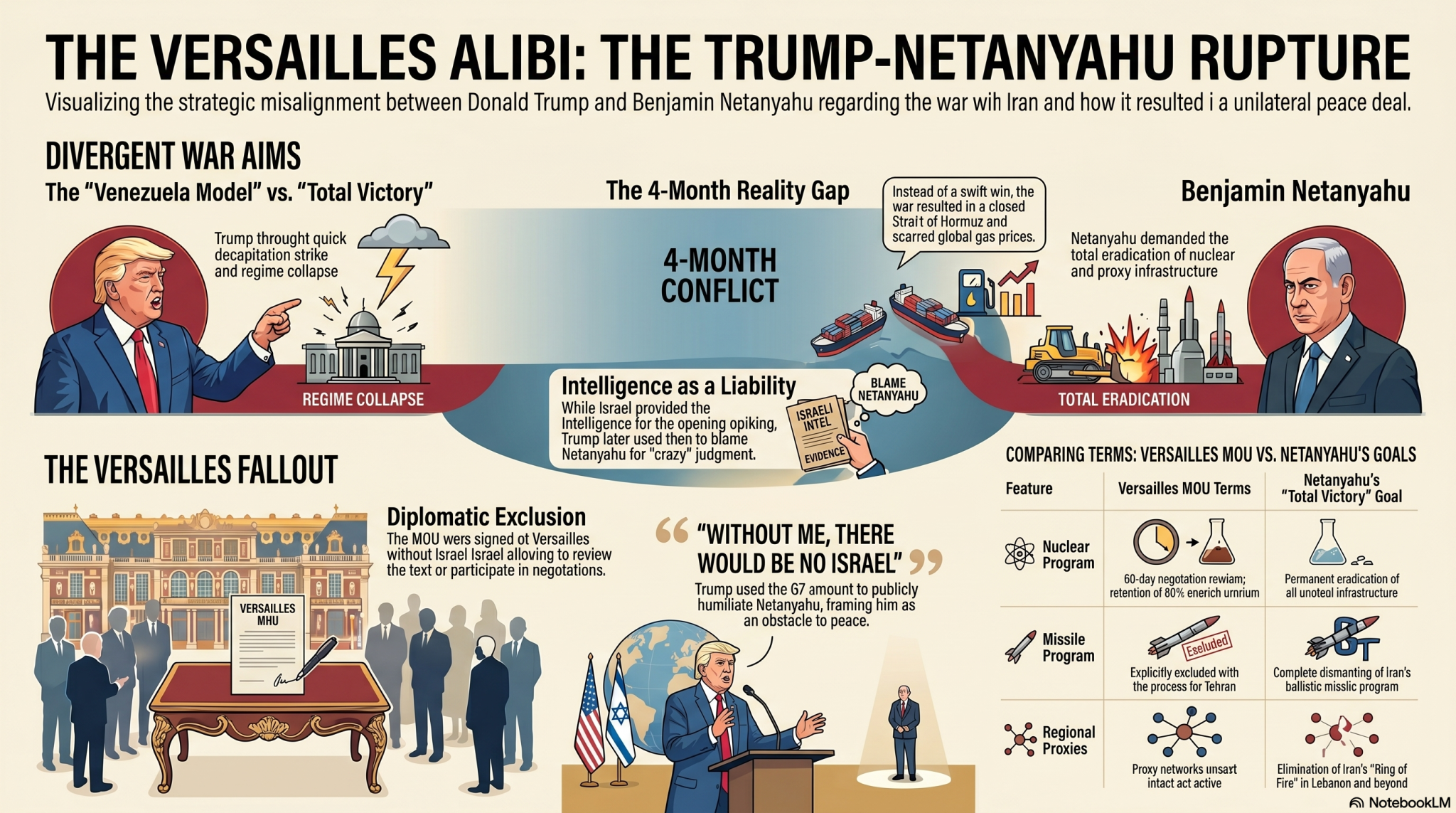
“Without me, there would be no Israel,” Trump told the G7 summit in France on Tuesday. He called Netanyahu “crazy.” He used an expletive to describe his judgment. He announced, with visible satisfaction, that he had signed a memorandum of understanding with Iran — at Versailles, of all places, a setting chosen by no accident — while Netanyahu was still publicly admitting he had not been permitted to read the document.
Let that land for a moment. The prime minister of Israel, the country that co-launched Operation Epic Fury on February 28, that provided the intelligence triggering the decapitation strike on Khamenei, that sent its air force into Iranian airspace — was not shown the text of the agreement ending the war his government helped start. Israeli officials claimed as recently as yesterday that Israel still hadn’t been allowed to review the MOU. Netanyahu, at his first press conference in three months, admitted he did not yet know what was written in the deal. He was not a party. He was an audience.
This is Trump’s alibi, fully constructed and formally executed.
The architecture of blame is now complete. Trump wanted a swift, clean war — the Venezuela model applied to Tehran. He got four months, a closed Strait of Hormuz, soaring gas prices, and a restless Republican base facing congressional elections in November. The “greatest military operation of the modern era” produced an Iran whose proxy network still survives and is still able to fire missiles into Israel, and a Tehran in a far stronger negotiating position than analysts expected. The quick knockout never came. So Trump did what Trump does: he went to Versailles, signed a deal on his own terms, and left Netanyahu to explain himself to the Israeli public alone.
The MOU itself tells the story. The 14-point framework lays out terms for ending the war, reopening the Strait of Hormuz, lifting sanctions on Iranian oil exports, and unfreezing Iranian assets, with 60 days of subsequent nuclear negotiations. Iran committed not to build a nuclear weapon — a commitment it has been making for fifty years — and agreed to further discuss the down-blending of highly enriched uranium, while retaining hundreds of pounds enriched to 60 percent. Iran’s missiles, per Tehran’s foreign ministry spokesman, “will not be discussed in any process or with any party.” The Hormuz closure, which Trump had cited as a casus belli, is resolved for sixty days pending a final deal that may or may not materialize.
Netanyahu, who promised the Israeli public “total victory,” got Trump’s memorandum of understanding — and, as a bonus, four months of public humiliation at the hands of the man he once called “the greatest friend Israel has ever had in the White House.”
Netanyahu stands alone internationally in his belief that the deal is a mistake and the war should have continued. Even the United Arab Emirates, the most hawkish of the Gulf states, joined the regional consensus in favor of the deal. In Washington, Netanyahu’s GOP allies and media supporters are reluctant to fully criticize an agreement that carries Trump’s imprimatur. There is no coalition for Netanyahu’s position. He is politically encircled, facing elections before the end of October, and cannot even attack the deal without attacking Trump — which would complete his isolation.
The trap was always structural. It was never purely about Netanyahu’s judgment or Trump’s vanity, though both were present in abundance. It was about the fundamental misalignment between two leaders who wanted different wars. Trump wanted a decapitation strike followed by regime collapse, popular uprising, and a Venezuela-style transition to an oil-rich government America could do business with. Netanyahu wanted to eradicate Iran’s nuclear infrastructure, its ballistic missile program, its proxy network in Lebanon, and the regime itself — and was prepared to fight as long as it took. It became clear early that Trump was seeking a quick win while Netanyahu wanted to vanquish Iran and its allies, even if it required an extended conflict. These were never the same war wearing the same uniform.
When Trump’s version failed to arrive on schedule, the political logic was inexorable: someone had to own the gap between the promise and the outcome. Netanyahu provided the intelligence that opened the window. Netanyahu’s military struck targets after Trump wanted restraint. Netanyahu told Trump the war should continue when Trump wanted his deal. And Netanyahu — unlike MBS, unlike Murdoch, unlike the GOP senators who cheered the opening barrage — has no domestic American constituency to protect him from the blame.
Trump told the G7 that “without me, there would be no Israel,” calling Netanyahu “crazy” in front of the assembled leaders of the democratic world. This is not the language of alliance. It is the language of a man who has decided, publicly and irrevocably, how the story will be told.
There is a bitter irony lodged at the center of this outcome. Netanyahu, in his press conference, was not entirely wrong about what the war achieved. He listed, with some justification, the destruction of nuclear facilities, the elimination of scientists and commanders, the degradation of Iran’s missile factories. “If we had not acted when we did,” he said, “Iran would already possess atomic bombs.” The claim is contestable, but not absurd. The problem is that in Trump’s telling, these achievements belong to Trump’s “historic partnership” when they serve as trophies, and to Netanyahu’s “crazy” judgment when they serve as liabilities.
Trump will claim the peace. He signed it at Versailles — a location that does not whisper, it announces. He will claim the credit for reopening Hormuz, for the oil waivers, for stopping the war before it became an unwinnable quagmire. He will call it one of the great diplomatic achievements in American history. And when the 60-day nuclear negotiation window produces something less than Iran’s complete denuclearization — which it will — he will note, for the record, that Israel complicated things.
Netanyahu promised total victory. Trump delivered a memorandum of understanding. Israel was not in the room.