
The Aliyah Tax Window Closes In Five Months
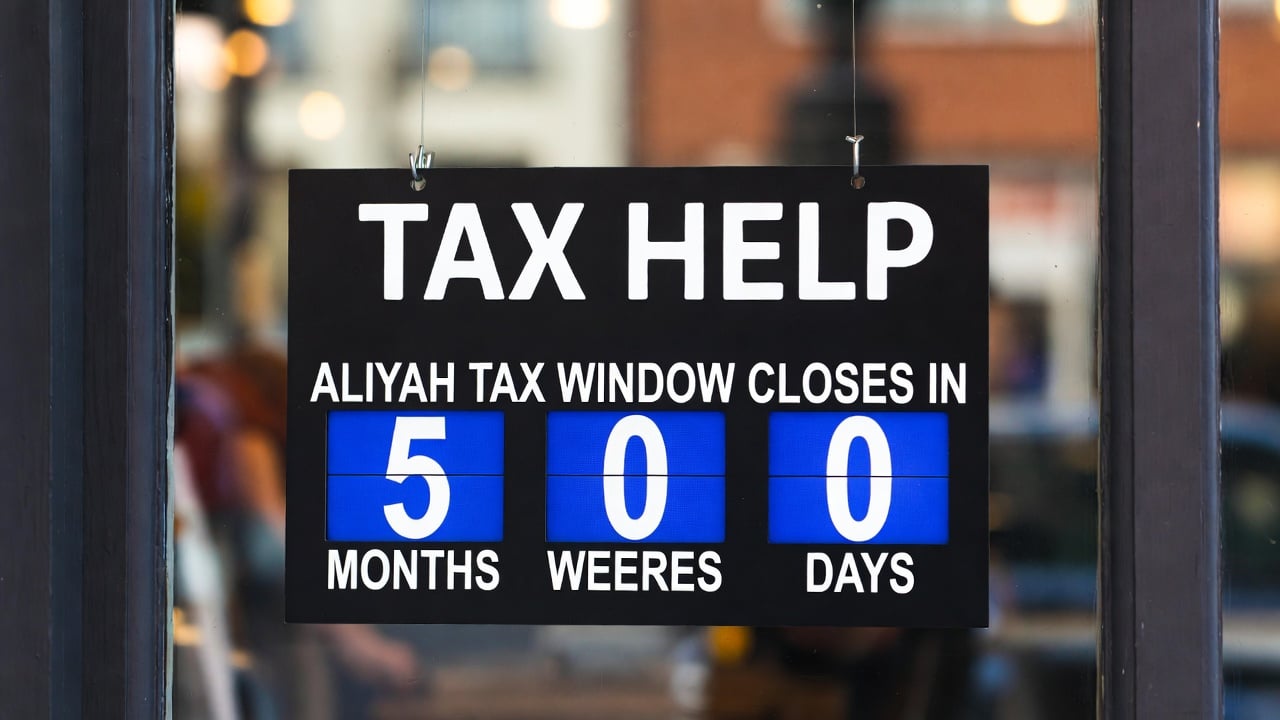
The Aliyah Tax Window Closes on December 31. Five Months Left.
Every few years, someone tells me the tax benefits are the reason they are finally making aliyah. I always push back. Tax is a bad reason to move countries, and a worse reason to move to this one. You move here because you want to live here.
But once you have decided to come, the timing of your arrival is a financial decision, and right now it is a very large one. There is a temporary exemption on Israeli income tax sitting on the books that closes to new arrivals on December 31, 2026. Most of the families I speak with have never heard of it. Some of them are quietly planning to land in early 2027, and they are about to leave a great deal of money in the Israeli treasury for no reason at all.
What actually changed
For nearly two decades, the headline benefit for olim has been the ten-year exemption on foreign-source income, introduced by Amendment 168 in 2008. It is genuinely generous — it replaced a five-year exemption — and it is intact. If you keep a rental property in Manchester, a portfolio in New York, or a business that operates entirely outside Israel, that income stays outside the Israeli tax net for ten years from the date you become a resident.
The problem was always the same. That benefit does nothing for the oleh who arrives, finds a job in Tel Aviv or opens a practice in Jerusalem, and earns Israeli shekels from Israeli clients. Israeli-source income was taxed in full, at rates that top out at fifty per cent once the three per cent surtax bites above roughly ₪720,000. The person who integrated fastest into the Israeli economy got the least help.
That is what the new law addresses. The Encouragement of Aliyah to Israel and Return Thereto Law (Temporary Order), 5786-2026 was passed at the end of March 2026 as part of the Economic Efficiency Law, and applies retroactively from January 1, 2026. It grants qualifying olim and veteran returning residents an exemption on Israeli-source income earned through personal effort — salary, self-employment income, business income, professional fees. Not rent, not dividends, not interest, not capital gains. Work.
The exemption is graduated across the tax years 2026 to 2030:
| Tax year | Exempt ceiling | Ceiling on income from a relative |
|---|---|---|
| 2026 | ₪600,000 | ₪140,000 |
| 2027 | ₪1,000,000 | ₪140,000 |
| 2028 | ₪1,000,000 | ₪140,000 |
| 2029 | ₪350,000 | ₪140,000 |
| 2030 | ₪150,000 | ₪150,000 |
Read those middle two lines again. For an oleh earning a professional Israeli salary, two consecutive years of income tax at zero is not a rounding error. It is a deposit on an apartment.
The part people are getting wrong
Here is the detail that keeps coming up in my conversations, and it is the reason I am writing this.
The eligibility window is not about which tax year you earn in. It is about when you become an Israeli resident. To qualify at all, you must have become an Israeli resident between November 5, 2025 and December 31, 2026. Miss that date and the entire five-year schedule is closed to you — including the two million shekels of exempt income sitting in 2027 and 2028.
And “become a resident” means the ordinary residency test — center of life — not the date stamped on your teudat oleh. You can hold the certificate and still not have crossed the line, and the law expressly disapplies the adjustment-year provision when fixing that date. If your arrival is going to be close to the wire, this is the single question worth putting to an accountant before you book flights.
This creates a slightly counterintuitive result. The 2026 ceiling of ₪600,000 is prorated for the portion of the year you were actually resident, so landing in November 2026 gives you very little of it. That does not matter much. What landing in November 2026 does give you is the key to 2027 and 2028 at their full ₪1 million ceilings. The prize is not this year. The prize is getting through the door before it shuts.
I have had people tell me they will come in March 2027 because the school year works better. That is a reasonable family decision, and it may cost them a six-figure sum in shekels. They are entitled to make that trade. They are not entitled to make it without knowing about it.
The conditions, plainly
This is not free money and it is not unconditional.
You need the paperwork. An oleh needs an oleh visa, a teudat oleh, or eligibility for sal klita. A veteran returning resident needs ten years of foreign residency and a certificate from the Ministry of Aliyah and Absorption. Landing is not enough on its own.
You must genuinely move. The legislation includes an anti-abuse mechanism aimed at people who arrive to collect the benefit and leave. If you cease to be an Israeli resident during 2028 or 2029 and spend fewer than 75 days in the country in one of those years, the exemption falls away retroactively from the beginning. Structure your life accordingly, or do not take the benefit.
It is income tax only — with one recent exception. Bituach Leumi is not touched by this law and remains payable on your earnings. Separately, however, the Knesset passed Amendment 262 to the National Insurance Law in February 2026, giving olim from the United States a five-year exemption from Israeli national insurance contributions on income for which they already pay US social security. It exists because there is still no Israel–US social security treaty. It is narrower than it sounds: health insurance contributions remain payable regardless, it falls away where the oleh has other income beyond the US-insured earnings, and it may also be available to olim already here for the balance of their first five years. Anyone modelling a net position on the income tax exemption alone will still be unpleasantly surprised by the first payslip.
Income from a relative is capped far lower, at ₪140,000 a year through 2029. Note that this is income received from a relative, not merely employment by one — the freelancer invoicing a family business is caught as surely as the salaried son. The definition reaches children, a spouse and their children, siblings and their children, and parents and their siblings.
Transparent entities are largely carved out. Income attributed to you from a partnership, LLC or similar transparent structure is generally outside the exemption, with a narrow exception for income attributed to a controlling shareholder of a wallet company. For Anglo professionals who trade through a US LLC or a partnership interest, this is a bigger practical obstacle than the relative cap, and it is the one I would check first.
There is a companion exemption for foreign companies. Where a foreign company’s business income is produced in Israel solely because of the personal effort of the oleh, that income can also be exempt for 2026 to 2030 — but not where the oleh holds ten per cent or more of the company. Relevant to remote workers and founders, and easy to fall the wrong side of.
The exemption is automatic, but you can decline it — in whole or in part. There are situations, particularly for American citizens, where the interaction with US foreign tax credits can turn a zero Israeli tax bill into a larger American one, in which taking it in full is the wrong move. The statute allows a partial election, which is a genuinely useful planning lever. It is also the single most important reason to model your position with a professional before you land rather than after.
The other change nobody mentions
While attention has been on the new exemption, a separate amendment passed in April 2024 took effect on January 1, 2026. Olim and veteran returning residents who become Israeli residents from that date forward have lost the reporting exemption that used to accompany the ten-year foreign income benefit.
To be precise about what this does and does not mean: the exemption from tax on foreign income has not changed. The exemption from telling the Israel Tax Authority about it has. New residents now file annual returns disclosing worldwide income from the first year, on income they will not pay a shekel of Israeli tax on. Foreign assets — accounts, portfolios, property, pensions, trusts — come into view through the capital declaration, which the assessor can demand, and the Authority also gained the power to request information from foreign companies managed from Israel by these individuals.
There is a trap here for people who think they beat the deadline. The Tax Authority’s published position is that someone who became a resident before January 1, 2026 but elected the adjustment year is treated as a foreign resident until after that date — and therefore falls into the new reporting regime after all.
For most families this is an administrative cost and a loss of privacy rather than a financial one. For families with complex structures abroad, it is a genuine planning matter, and it is not one to discover in year three.
What I tell people
If you were already going to come, and you were thinking of arriving in early 2027, get your file moving now. Aliyah files take months, not weeks, and the queue in the final quarter of the year will not be short.
If you are not sure you want to live in Israel, this changes nothing. A tax exemption is a poor foundation for a life here, and the anti-abuse provisions are designed precisely to catch people who treat it as one.
And whichever bracket you fall into, model your position with an Israeli accountant who understands your country of origin before you land. The window closes on December 31. The consequences of walking through it unadvised last considerably longer.
This post is general commentary and not tax or legal advice. Israeli tax treatment depends entirely on individual circumstances. Consult a qualified Israeli tax professional, and if you hold another citizenship, one who understands both systems.