The American Promise
Jonas Phillips was not born into privilege. Born in Germany around 1736, he arrived in the American colonies in 1756 as an indentured servant to Moses Lindo, a Jewish indigo merchant in Charleston, South Carolina. After completing his service, Phillips moved north — first to Albany, then New York, and eventually Philadelphia. He became a merchant, married Rebecca Mendes Machado, raised a huge family with 21 children, and became deeply involved in Jewish communal life, helping build Congregation Mikveh Israel in Philadelphia, one of the historic synagogues of early American Jewish life.
But Phillips was not only a Jew living in America. He was a Jew who believed in America.
He supported the Revolutionary cause, served in the Philadelphia militia, and identified with the patriots who sought independence from Great Britain. In 1776, he wrote a letter in Yiddish to a relative in Europe and enclosed news of the Declaration of Independence. The British intercepted it and, apparently unable to read Yiddish, thought it might be some kind of code.
In a way, it was. It was the code of Jewish survival, holding on to his parents’ language, his faith and people while engaging the world around him. Eleven years later, Phillips wrote a much more consequential letter. In 1787, Pennsylvania’s state constitution required public officeholders not only to affirm belief in God, but also to affirm that the Old and New Testaments were divinely inspired. For a believing Jew, that meant public service required a violation of conscience.
So, on September 7, 1787, Phillips addressed a letter to George Washington, then president of the Constitutional Convention, and to the members of the Convention. At the top of the letter, he wrote the Hebrew date: “24th Ellul 5547.” In the birth-pangs of the USA, a Jewish immigrant dated his plea for religious liberty by the Jewish calendar. His request was direct: remove the requirement that a public official affirm belief in the divine inspiration of the New Testament. If that language were removed, he wrote, “the Israelites” would be happy to live under a government where all religious societies stood on “an equal footing.”
There is no record that Phillips received a personal written reply from Washington or the Convention. But his concern was answered by the Constitution itself. Article VI of the US Constitution declares: “No religious Test shall ever be required as a Qualification to any Office or public Trust under the United States.” Jonas Phillips was asking America to allow him — and all Jews — to be fully Jewish and fully American.
That was revolutionary. In Europe, Jews were often tolerated at best, persecuted or expelled at worst. But America’s founding promise was different. Religious liberty did not mean that Jews would just be permitted to hide quietly in the corner. It meant we could enter the public square without surrendering our identity.
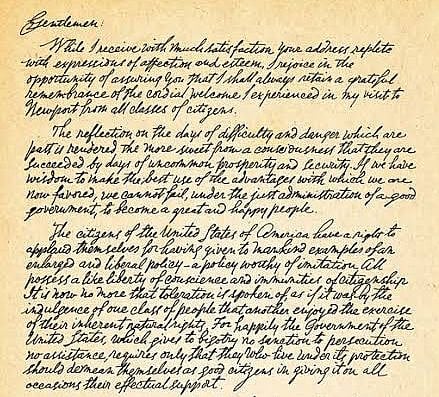
That promise was expressed most beautifully in 1790, when George Washington wrote to the Hebrew Congregation of Newport, Rhode Island. He declared that the Government of the United States “gives to bigotry no sanction, to persecution no assistance,” and prayed that everyone would sit safely “under his own vine and fig tree, and there shall be none to make him afraid.”
That sentence should still send chills down the spine of every American Jew. Washington was not granting Jews a favor. He was recognizing a right and as we celebrated America’s 250th anniversary, we Jews must express the appropriate hakarat hatov — gratitude. Halacha demands we say brachot before we eat, not because God needs our blessing, but because we need to become people who notice blessing. Gratitude is the spiritual discipline of refusing to take goodness for granted.
Of course, gratitude does not mean blindness. America has had painful failures, including overly restrictive immigration quotas in the 1930s and 1940s that kept desperate Jews in Nazi-occupied Europe from finding refuge when they needed it most. Love of country does not require denial. But Judaism also teaches us, in the fourth blessing of Birkat HaMazon (Grace After Meals) — “hatov v’hametiv” — to recognize good even in a world of imperfection.
For countless Jews fleeing persecution, America became a haven. Here we built shuls openly, educated our children, kept Shabbat, wore our names proudly, and participated in civic life without having to choose between loyalty to Torah and loyalty to America. Rav Moshe Feinstein tz”l, himself an immigrant, famously referred to America as a medinah shel chesed, a country of kindness. He understood that gratitude to America created a responsibility. He urged Jews to register and vote, because civic participation is one way a Jew says thank you.
That idea is deeply personal. My father, z”l, devoted his life to the practice of immigration law. He had his father’s Polish passport proudly framed in his office. As an attorney, he fought the US government many times but never became cynical about America. He believed that because America had given his family and so many others a chance, we had an obligation to strengthen it and be grateful to it.
No life captures that sentiment more dramatically than Tom Lantos, who was born into a Jewish family in Budapest. When the Nazi’s occupied Hungary in 1944, his teenage life was shattered. He was sent to a forced labor camp, escaped, and survived in a safe house established by the Swedish diplomat Raoul Wallenberg. Much of his family perished in the Holocaust. In 1947, at the age of 19, Tom Lantos arrived in the United States on a student scholarship with little more than a Hungarian English dictionary. In America, he found freedom. He earned a doctorate, became a professor, and in 1980 was elected to the United States House of Representatives, where he served for over three decades. He became the only Holocaust survivor ever to serve in Congress.
As we celebrate 250 years of the American experiment, the true measure of this country’s greatness is found not only in history books and monuments, but in actual lives transformed on these shores. It is found in Jonas Phillips, the indentured servant who demanded that a Jew be allowed to serve without betraying his faith. It is found in Washington’s promise that bigotry receives no sanction, and persecution no assistance, and it is found in Rav Moshe’s call to gratitude and responsibility.
That is why, even amid the alarming rise of antisemitism, and even as we remain devoted to building and defending Israel, we must never stop teaching our children to love this country. Because in America, Jews did not have to disappear to belong — and that is a blessing we must never take for granted.