


Mathematics Teaching Professor, Author
The Ancient Synagogue of Barcelona: 2,000 Years of History in One Place
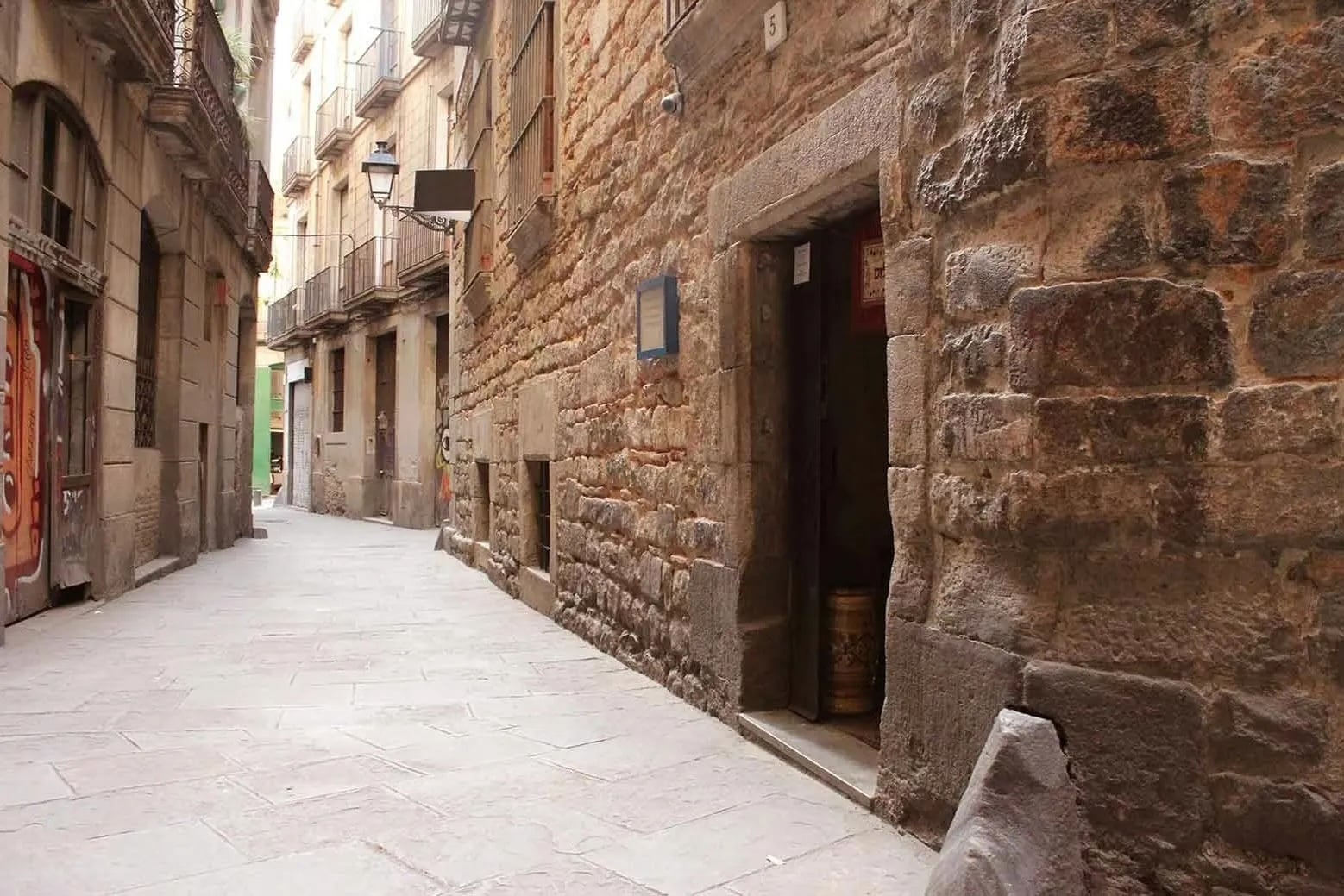
Carrer Marlet in the old Jewish quarter of Barcelona. The Ancient Synagogue is on the left. (Source: Ancient Synagogue of Barcelona)
The Ancient Synagogue of Barcelona is a unique historic site where Roman, medieval, and modern layers of the city’s Jewish heritage intersect. Located in the heart of the former Jewish Quarter (El Call), the building reflects centuries of transformation, from its earliest architectural traces in the Roman period to its major establishment as a synagogue in the 13th century and its later adaptations over time.
Today, it serves both as an archaeological space and a cultural center, preserving important artifacts, architectural remains, and ritual objects that illustrate the continuity and diversity of Jewish life in Barcelona.
Synagogue
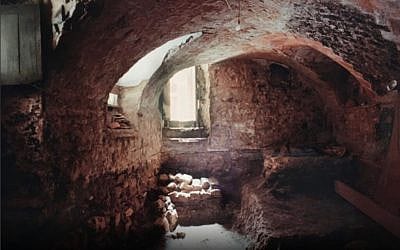
The Ancient Synagogue of Barcelona contains architectural and archaeological elements spanning several historical periods. Its foundations and walls include remains dating to the 3rd century from the Roman era, while the building was significantly renovated and expanded in the 13th century, when it functioned as a major synagogue. The Archaeological Room preserves the original floor level, located about two meters below today’s street level, illustrating the gradual rise of the city over time.
Among its key features is a section of Barcelona’s Roman wall dating to the 3rd to 4th century, built using the opus africanum technique, characterized by large vertical stone blocks (pillars) alternating with horizontal blocks. One stone bears the Roman numeral XIIX (18), which corresponds to the Hebrew word Chai, life, a detail some researchers interpret as suggesting earlier religious significance at the site.
Other significant objects include a seven branched Menorah created by Chueta artist Ferran Aguiló, representing the enduring heritage of Mallorca’s crypto-Jewish community. The Chuetas descended from part of medieval Jewish population whose ancestors were forcibly converted to Christianity and, only in some cases, continued practicing Judaism in secret. Also included is Miguel Iaffa’s personal Judaica collection, featuring Hanukkah lamps, Mezuzot, Torah pointers gathered across Europe and Israel.
A stained-glass window by Máximo Iaffa depicts the Twelve Tribes of Israel and symbolizes renewal through the joining of broken glass.
The collection also includes a 17th-century Torah scroll discovered in Morocco and donated by the Oller family; although incomplete, it is no longer considered kosher for liturgical use, as well as a Torah from XVI century.
Alex Neish Collection
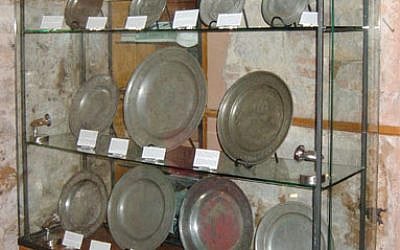
Alex Neish, a Scottish collector based in Barcelona, followed the restoration of the Ancient Synagogue of Barcelona from its early stages. As a leading collector of pewter artifacts, he assembled an extensive collection of Judaica over more than three decades, focused on Jewish ritual life, traditions, and faith.
Many of the objects were identified and documented with the help of Swiss expert Jan Gadd. Today, the collection is permanently displayed in the synagogue as part of its exhibition on Jewish heritage and history.
Bar and Bat Mitzvah Ceremony
The Ancient Synagogue of Barcelona offers the opportunity to celebrate a Bar or Bat Mitzvah in one of Europe’s oldest synagogues, located in the heart of Barcelona’s historic Jewish Quarter. Marking a young person’s transition into Jewish religious adulthood, this important milestone can be celebrated in a setting that reflects more than a thousand years of Jewish history and tradition.
The ceremony may include traditional elements such as the reading of the Torah, prayers, blessings, and family participation, according to the family’s customs and religious tradition. Celebrating a Bar or Bat Mitzvah in the Ancient Synagogue of Barcelona provides a meaningful connection to the city’s Jewish heritage while creating a memorable occasion for family and friends in a historic and spiritual setting.
Weddings
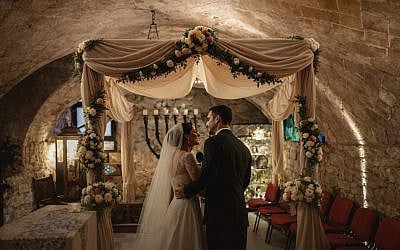
The Ancient Synagogue of Barcelona offers the possibility of holding a Jewish wedding ceremony (Chuppah) within one of Europe’s oldest synagogues, located in the city’s historic Jewish Quarter. Couples may choose to celebrate their marriage in this historic setting, where Jewish life has been present for centuries. The ceremony can incorporate traditional elements such as the Chuppah, the Ketubah which is a Jewish marriage contract, the Kiddush wine blessing, the Sheva Brachot, Seven Blessings, the exchange of rings, and the breaking of the glass, according to the couple’s preferences and religious tradition. The synagogue provides a unique setting for those seeking to celebrate their wedding while connecting with the history and heritage of Jewish Barcelona.
Tours
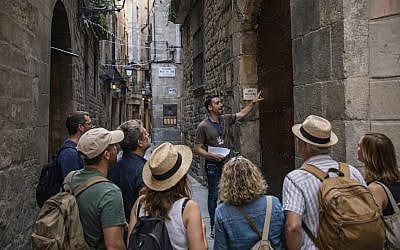
The Ancient Synagogue of Barcelona offers guided tours of Barcelona’s historic Jewish Quarter called the El Call, providing an introduction to the history, heritage, and legacy of one of the city’s oldest neighborhoods. Beginning at the synagogue, the tour explores the medieval streets of the Gothic Quarter, where visitors discover the places that once formed the center of Jewish life in Barcelona.
The medieval Jewish Quarter was divided into two main areas, Call Major and Call Minor. The word Call derives from the Hebrew kahal, meaning community, and was the term used in medieval Catalonia to designate Jewish neighborhoods. Through historical landmarks, hidden courtyards, and surviving traces of the former Jewish district, the tour offers insight into the community’s cultural, religious, and intellectual contributions to Barcelona before the expulsion of the Jews in 1492.
Historical Background
In 70 CE, Barcelona, then the Roman colony of Barcino and now is Barcelona, was a modest but growing administrative and economic center shaped by Roman infrastructure. In the aftermath of the Roman destruction of the Second Temple in Jerusalem, small groups of Jewish migrants are believed to have begun arriving in the region, seeking refuge within the Roman Empire.
Over time, these early communities established themselves in what would later become the medieval Jewish Quarter, El Call, laying the foundations for a continuous Jewish presence in Barcelona that developed further in the Middle Ages.
Over 200 years later, in the 3rd century, Barcino was a compact, fortified colony of just over 25 acres, centered around Mons Tàber, now called modern Plaça de Sant Jaume. It was a prosperous hub of wine production, crafts, and maritime trade, but during this period of instability at the end of the Pax Romana, the city was strengthened with double defensive walls and towers in response to Germanic raids, housing an estimated 3,500 to 5,000 inhabitants.
At this time, Jewish presence in 3rd-century Barcino was small but established, with Jews integrated into the Roman provincial economy as merchants, traders, and artisans living alongside pagan and early Christian communities. This period reflects an early stage of continuous settlement that would later develop into the medieval Jewish Quarter, El Call.
It is also within this Roman context that the earliest foundations of what is now known as the Ancient Synagogue of Barcelona are placed, with structural remains believed to be built over earlier Roman ruins. These foundations, attributed to the 3rd century, are considered among the oldest elements associated with a synagogue in Europe and indicate the early emergence of a localized Jewish gathering space within the evolving city.
In 1987, medievalist Jaume Riera i Sans made important progress in identifying the location of the Synagogue of Barcelona that existed until 1391. His research helped establish its position within what is now known as the Barcelona Jewish Quarter, contributing significantly to the historical understanding of the city’s medieval Jewish presence.
As mentioned, Jews have been present in Barcelona since at least Roman times, but the community reached its greatest prominence during the Middle Ages, particularly between the 12th and 14th centuries, when it made up an estimated 12% of the city’s population and played a key role in trade, intellectual life, and the urban economy.
As the community grew, the medieval Jewish Quarter, known as El Call, developed as its center. The earliest area, Call Major, was located between today’s Carrer de l’Arc de Sant Ramon del Call, Carrer del Call, Carrer del Bisbe, and Carrer de Sant Sever, within what is now the Gothic Quarter. By the mid-13th century, the community expanded into Call Minor, around present-day Plaça de Sant Jaume, forming the core of Jewish life in medieval Barcelona.
Beyond the city walls, the Jewish cemetery was established on the slopes of Montjuïc, and documentary sources also mention Jewish-owned vineyards used for producing kosher wine. Within the city, daily life in the 14th century was organized around key points in Call Major, including one of its main gates near today’s Carrer de Sant Domènec del Call, now called Carrer Solomon Ben Adret, as well as essential communal services such as the butcher, fish market, and water fountain that supported the neighborhood’s population.
Jews in medieval Barcelona paid taxes directly to the Crown rather than municipal authorities and were allowed a degree of self-government, including the administration of justice according to Jewish law. However, the Catholic Church imposed significant restrictions on the community, including regulations that Jewish religious buildings should not exceed the size or prominence of Christian ones, which helped shape the modest scale of the synagogue.
In the late 14th century, following the Black Death, a prominent clergyman accused the Jews of causing the plague, fueling widespread anti-Jewish sentiment and violence that began in southern Spain and spread to other parts of the Crown of Aragon. On 5 August 1391, the attack on Barcelona’s Call resulted in the murder of around 400 Jews, while many survivors were forced to convert to Christianity. Following these events, King John I of Aragon confiscated Jewish communal property and redistributed it to members of his court.
Many residents took refuge in the Castell Nou, located on today’s Carrer dels Banys Nous at the corner of Carrer del Call. Nearby stood the Synagogue of Barcelona, situated in the extension of the former Carrer de la Carnisseria, also known as Escola Major. The synagogue was a free-standing structure.
After the 1391 attacks, the Crown assumed control over much of the property belonging to the dissolved Jewish community. Some property was seized by the king, some reverted to the Crown because the aljama had ceased to exist, and some was granted or sold to nobles, courtiers, churches, or private individuals.
Between 1477 and 1487, part of the former synagogue was used as a family business by Jaume d’Arguens, a converso (a Jewish person living in Spain or Portugal who converted to Roman Catholicism) later accused by the Spanish Inquisition of secretly practicing Judaism in the building. After his prosecution and flight, the structure was repurposed for many uses over the centuries, including a prison, warehouses, shops, and residences, marking the complete loss of its original religious function.
Rediscovered in 1996 through research by Miguel Iaffa and Jaume Riera i Sans, the building was partially restored and opened in 2002 as a museum dedicated to Jewish history in Barcelona.
The Ancient Synagogue of Barcelona stands as a rare testament to the city’s long and complex Jewish history, preserving layers of Roman, medieval, and modern heritage within a single space. From its origins in the ancient urban fabric of Barcino to its role as a major synagogue in the Middle Ages and its later transformations, the site reflects both continuity and rupture in Jewish life in Barcelona.
Today, through its archaeological remains, historical artifacts, and ongoing cultural and religious use, the synagogue serves as a place of memory and preservation, offering insight into the enduring legacy of the city’s Jewish community.
Contact Information:
Ancient Synagogue of Barcelona, Carrer de Marlet, 5, Ciutat Vella, 08002, Barcelona, Spain
Phone: (+34) 933 17 07 90
Email: sinagogamayorbarcelona@gmail.com
Website: https://sinagogamajor.com/en/