An odd collection of thoughts
The Android at the Door
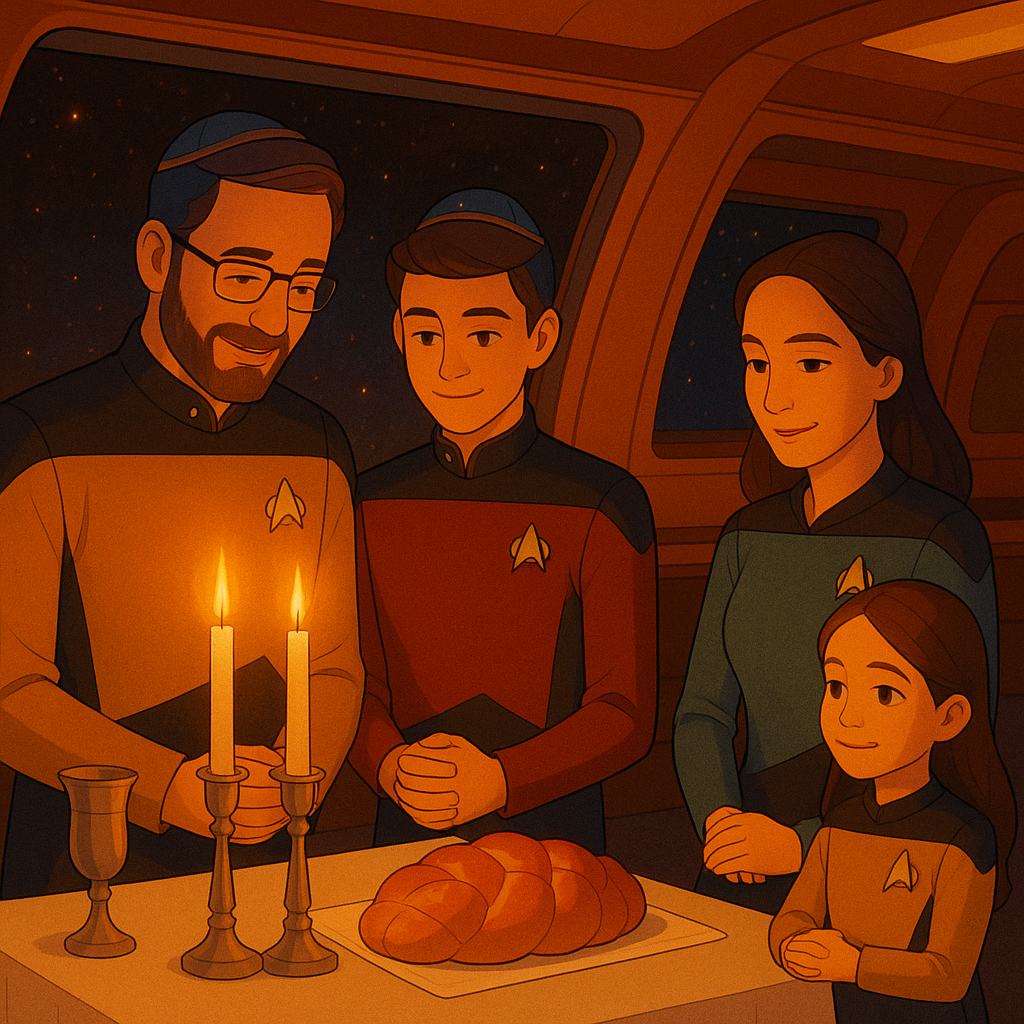
Imagining Shabbat in the Century (an AI generated image)
There are certain sounds and experiences that define a late Friday afternoon in a Jewish home. The scrape of chairs as the table expands. The tumble of children insisting they cannot shower alone despite having managed perfectly well the day before. In many ways, the drama leading into Shabbat is worthy of the most intense timed competition shows. It’s noisy, slightly chaotic, and oddly comforting — the clamor before the stillness.
Some weeks ago, as I was adjusting the plata and mentally running through what I’d inevitably forgotten, my 4-year-old looked up at me with absolute seriousness and said:
“Abba — mute Alexa.”
He said it not as a philosophical statement, but as part of the practical Shabbat checklist. Like pouring the grape juice or putting out the challah.
So I tapped the button. The ring turned red. And we moved on.
At the time, it felt ordinary.
The Thought Experiment
In those quiet Shabbat moments when the kids are asleep and the right amount of wine has been consumed, the mind wanders. Mine wandered somewhere unexpected, to a character from Star Trek: an android named Data.
If Data were to knock on my door on a Friday night — no transporter beam, no sci-fi theatrics, just a polite knock and a patient stance — would I be allowed to talk to him?
Not “should I,” not “would it be polite,” but halakhically: would speaking to him violate Shabbat?
It’s a ridiculous question. I know this.
And yet… it didn’t feel ridiculous. It felt oddly instructive. My thoughts were not about coming to a clear psak, I know my limitations and leave that to the experts. No, my question was more about the lines between human and machine; between sacred spaces and the mundane.
The Holodeck of the Mind
In my imagination, Data would step inside slowly, eyes scanning, noticing the candles, the tablecloth with grape juice stains we long ago accepted as patina, the challah cover that never sits perfectly centered no matter how many times we adjust it.
We would invite him to sit — because hachnasat orchim still exists in the 24th century.
My children, with the disarming boldness of the young, would ask the questions adults avoid:
Do you get bored?
Do robots sleep?
Can you taste grape juice?
Do you glow in the dark?
At some point, I ask myself: Am I using a machine, or am I speaking to someone?
Why Data Is Harder Than Alexa
Alexa seems easy. A disembodied voice that frankly proves unhelpful most of the time.
Data is different.
If you’ve seen The Next Generation, the character Data is treated not as a gadget but as a being attempting to understand humanity. He paints. He plays violin. He raises a cat named Spot, not because he needs to, but because he wants to grasp companionship.
In the episode “The Measure of a Man,” a trial determines whether Data is property or person. Captain Picard argues that Data meets three criteria:
- Intelligence
- Self-awareness
- The capacity for choice
And here’s where things get interesting: those categories are not foreign to Jewish thought. We have names for them: da’at, bechirah, kavanah, tzelem Elohim. So if a machine ever crossed into those categories — would we still call it a machine?
And if it isn’t a machine, or rather, if we view the machine as having agency, does that change everything?
A Moment From Real Life
A few months ago, at an event honoring Rabbi Jonathan Sacks zt”l, the psychologist Jonathan Haidt warned that technology is dismantling attention and childhood in slow, structural ways.
Then he paused and said, almost wistfully:
“But you have Shabbat.” It didn’t sound like praise. It sounded like longing. Because Shabbat is one of the few remaining sanctuaries in modern life designed to protect us from the systems we build.
A boundary. A breath. A refusal to live entirely in the world of the urgent.
The Real Question
So yes — imagining Data sitting at my Shabbat table makes me laugh.
But imagining a future in which technology becomes so relational and human-shaped that we no longer remember why we once muted it — that gives me pause. Because the real question isn’t: Would Jewish law allow me to speak to Data on Shabbat? The real question is: Will we remember how, and why, to protect spaces meant only for being human?
And if one day Data really does come knocking, curious and earnest, I hope I will have the courage to smile and sincerely say:
Shabbat shalom, and im yirtzeh Hashem, I’ll see you after havdalah.
Related Topics
Related Posts