London based entrepreneur, cybersecurity analyst doing a PhD in AI
The Angels of our nature.
One of the oldest questions humanity has ever asked is also one of the most personal.
Are human beings fundamentally good?
Or fundamentally violent?
Modern psychology has wrestled with this question for decades.
In The Better Angels of Our Nature, the psychologist Steven Pinker argues that although human beings possess deep capacities for violence, history also reveals an extraordinary expansion of empathy, cooperation and moral restraint. Across centuries, he argues, many forms of violence have declined as societies have developed stronger institutions, commerce, education and the rule of law.
Whether one agrees with every aspect of Pinker’s thesis is almost beside the point.
His central observation is profound.
Human beings possess competing moral instincts.
The question is not whether one exists.
The question is which one we cultivate.
Remarkably, this is almost precisely how the Qur’an introduces humanity.
The Angels’ Question
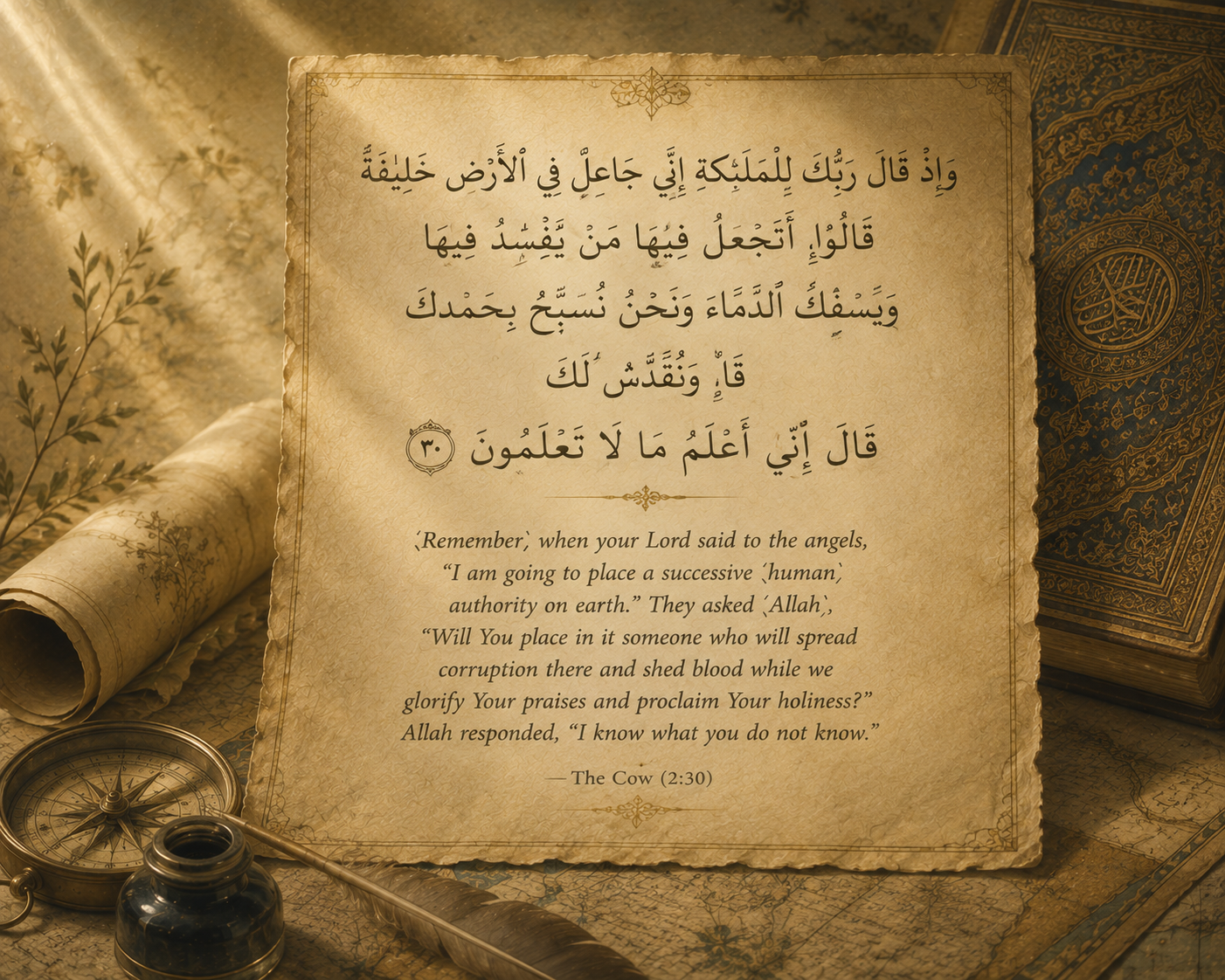
Before humanity is created, the angels ask God:
“Will You place upon it one who will spread corruption therein and shed blood, while we glorify You with praise and sanctify You?”
Qur’an 2:30
It is one of the most extraordinary conversations in Scripture.
The angels are not asking whether human beings will be intelligent.
Nor whether they will build cities.
Nor whether they will compose symphonies or discover mathematics.
Their first concern is violence.
Bloodshed.
Conflict.
Corruption.
From the very beginning, the Qur’an acknowledges something uncomfortable.
Human beings possess an extraordinary capacity for destruction.
History suggests the angels were not entirely wrong.
The twentieth century alone witnessed two world wars, the Holocaust, the Armenian genocide, the Rwandan genocide, Cambodia, Bosnia and countless other atrocities.
Modern technology magnified not only our ability to heal.
It magnified our ability to kill.
God’s answer is equally remarkable.
“Indeed, I know that which you do not know.”
Qur’an 2:30
The Qur’an never explicitly tells us what the angels did not know.
Adam (a.s) is taught the names of all things.
He taught Adam the names of all things, then He presented them to the angels and said, “Tell Me the names of these, if what you say is true?” (Quran 2:31)
Human beings receive knowledge.
They become capable of language.
Reason.
Discovery.
Stewardship.
The same creature capable of bloodshed is also capable of science.
Engineering.
Mercy.
Justice.
The problem is not humanity itself.
It is which part of humanity we choose to nourish.
The Qur’an continues this paradox elsewhere.
“Indeed, We created man in the best of forms.”
Qur’an 95:4
Then, immediately afterwards:
“Then We reduced him to the lowest of the low.”
Qur’an 95:5
Few verses capture human psychology more elegantly.
The same species capable of general relativity and quantum physics can build Auschwitz.
The same hands that cradle a newborn can pull a trigger.
The same intellect that discovers antibiotics can design chemical weapons.
Human beings are creatures of astonishing potential.
In both directions.
The Qur’an refuses simplistic optimism.
It also refuses despair.
It strikes a beautiful balance.
In The Better Angels of our nature, Pinker argues that civilisation succeeds when our better psychological tendencies gain the upper hand over our darker impulses.
The Hebrew Bible tells remarkably similar stories.
Cain and Abel.
Joseph forgiving his brothers.
Both stories are also part of Islam.
The prophets repeatedly call Israel away from power and towards justice.
Every civilisation is, ultimately, the sum of millions of these daily choices.
This brings me to the second point of this article – Psychology Is the Atom of Society.
Economists often speak of institutions.
Politicians speak of laws.
Military strategists speak of security.
The Abrahamic tradition begins somewhere deeper.
It begins with the human heart. The Soul, The Psyche.
A law cannot eliminate hatred.
A constitution cannot manufacture compassion.
No court can force someone to become merciful.
Every society is ultimately built from individual psychologies.
Psychology is to civilisation what atoms are to matter.
Change enough human hearts and societies change with them.
Corrupt enough hearts and no institution remains secure for long.
Perhaps this explains why the Qur’an says:
“Indeed, Allah does not change the condition of a people until they change what is within themselves.”
Qur’an 13:11
Notice the astonishing depth of this example. Society is formed of human psychology.
Daniel Kahneman, the famous psychologist, would later win the Nobel prize for his work on psychology and its implications on Economics and become a seminal figure of Behavioural Economics.
The transformation begins inside before it becomes visible outside.
The Choice Before Every Generation today is the same as it has always been.
In many ways, human psychology today is at a precipice of tribalism, greed, fear and eruption of violence not seen since World War 2 ended.
Steven Pinker’s optimism should not make us complacent.
The twentieth century demonstrated that progress is reversible.
Every generation decides whether it will rise towards its highest nature or descend towards its lowest.
The angels saw blood when humanity was created.
We see it everywhere around us today.
History has repeatedly shown what we are capable of.
The question has never been whether humanity possesses darkness.
The question is whether we possess the courage, wisdom and moral discipline to ensure that our better angels prevail.
That may be the deepest meeting point between modern psychology and the Abrahamic tradition.
Neither believes human beings are fixed.
Both believe we are always becoming.
And civilisation is simply the collective direction of that becoming.
Judaism observes :-
“The LORD saw that the wickedness of man was great in the earth, and that every inclination of the thoughts of his heart was only evil continually.”
(Genesis 6:5)
And after the Flood:
”…the inclination of the human heart is evil from youth.”
(Genesis 8:21)
Judaism generally does not interpret this as humanity being totally depraved.
Classical Jewish thought speaks of the yetzer hara(inclination towards evil) alongside the yetzer hatov (inclination towards good). Humans possess both and are responsible for choosing rightly.
Therefore, let us choose the path towards goodness brothers and sisters in a shared humanity.
A Footnote on my personal religious beliefs :-
I am a Muslim. I am comfortable with my choice. If I was the last Muslim alive on earth, I would be comfortable with that too. My belief is not based on people’s opinions but my inner realisation of what I believe is the truth. My articles are based on a common understanding with the people of Israel of a rabbinic and Fiqh tradition of study, finding insights in scripture and drawing parallels to real life to enrich our lives and for the betterment of society in general.
I hope this humble and sincere effort is of benefit to all people who read them.
They draw from the following verse :-
The Qur’an says:
“Say: O People of the Scripture! Come to a common word between us and you…”(Qur’an 3:64)
I do not draw equivalence between the Quran and the Torah and the Bible, but seek to draw parallels. The Quran is the only book in human history which has been unchanged for 1400 years – word for word, letter for letter, phonetic pronounciation for phonetic pronounciation.
I also don’t believe religious scholarship is for a “select few” rabbis and imams, but it is for all of us to study and inculcate in our daily lives to improve ourselves, and thus, society in general.
A Hadith from the Prophet (ﷺ) relates that “scholars are the inheritors of the prophets”.
Let us all share in this inheritance.
Abu Darda reported: The Messenger of Allah (ﷺ) , peace and blessings be upon him, said, “The scholars are the successors of the prophets. Verily, the prophets do not pass on gold and silver coins, but rather they only impart knowledge.”
Source: Musnad al-Bazzār 10/68
Grade: Sahih (good) according to Al-Bazzār
Related Topics
Related Posts