
Stephen J Stern PhD
The Antisemitism Nazism Eclipsed: From Drumont to Fuentes
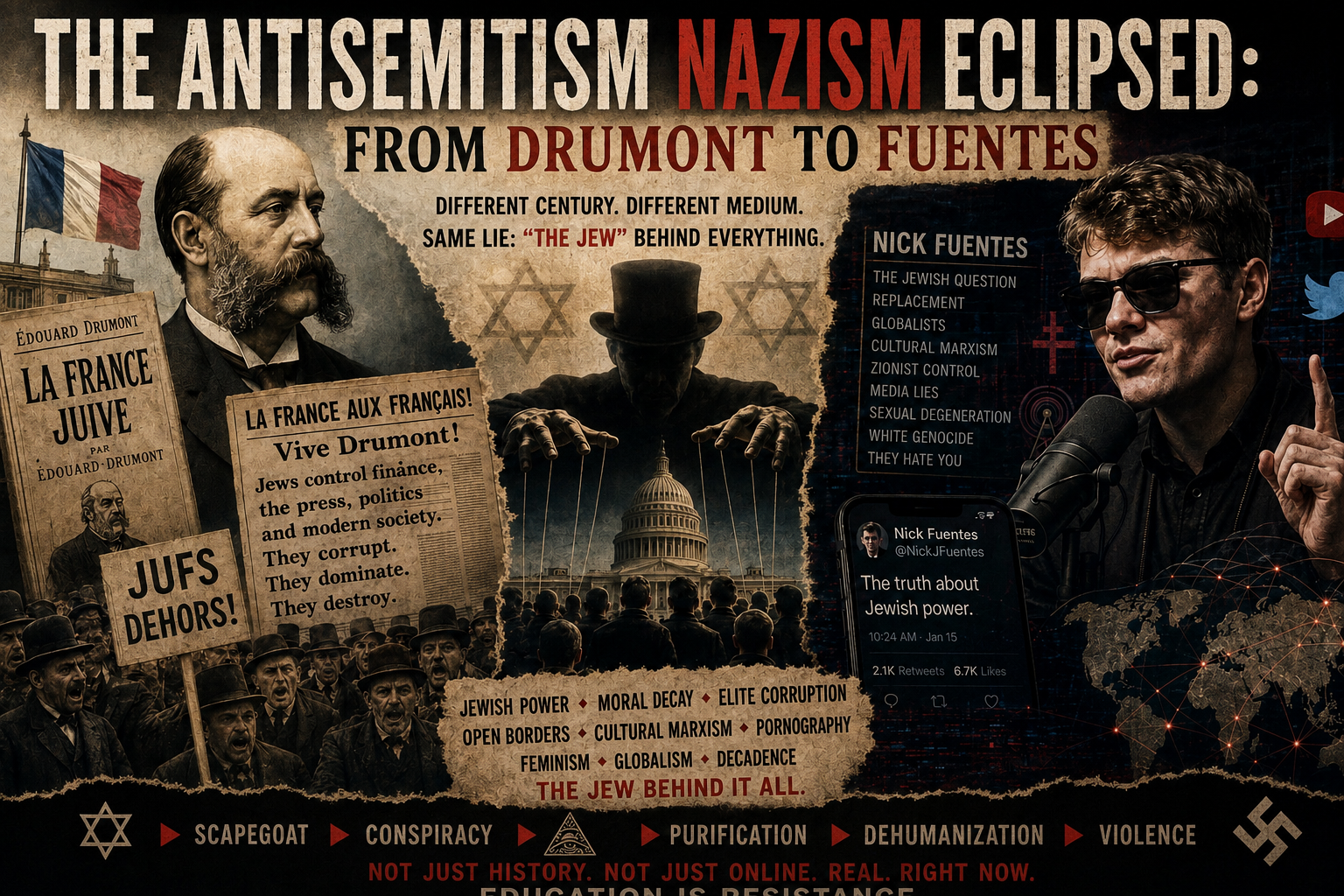
AI image created by author.
Why did Democratic Party leadership look past a Maine Senate candidate with a Nazi tattoo? The question is striking because Holocaust films have reduced antisemitism in the public imagination to Nazism. If there are no Nazis in the frame, Jews must be fine. Yet here was a man bearing one of its symbols, and it did not register as disqualifying. Does such a view overlook what came before Nazism and what made it possible? Are we now confusing the culmination in the destruction of European Jewry with the disease itself? To understand antisemitism today, we need to look beyond the camps and before Hitler, toward the conditions that made both imaginable. For that, we can turn to a period before Nazism, but still modern, in a country that later opposed the Nazis, France.
In late nineteenth-century France, the journalist Édouard Drumont exemplified modern Jew-hatred in La France juive (Jewish France), his bestselling, forever popular, 1,200-page antisemitic book published in 1886. Drumont matters not because he predicted Nazism, but because he reveals a form of antisemitism that predates Hitler and persists beyond him. Drawing on nearly two thousand years of anti-Jewish hate, he translated Jew-hatred into the language of modern politics. He provides a better gauge of contemporary antisemitism than Nazi comparison alone. That becomes clearer when Drumont is set beside American white supremacist and Gen Z internet star, Nick Fuentes.
Last semester I asked my introduction to Judaism class how many students watched Fuentes. Twenty-seven hands went up. Every student in the room. Fuentes talks about “organized Jewry” as the force distorting American politics, media, immigration policy, foreign policy, and public morality. He is not saying anything new. He is recycling the kind of antisemitism found in Drumont.
Drumont and Fuentes are separated by language, nation, medium, and 140 years, but their antisemitism shares the same governing conspiracy. Jews are the hidden power behind national humiliation, moral decay, elite corruption, and cultural collapse, and naming “the Jew” finally explains why the country no longer feels like home.
Stripping American Jewry of its Americanness
Fuentes presents “the Jews” as the hidden key to social disorder, elite corruption, national decline, and cultural decay. Once Jews are placed behind it all, the whole conspiracy lights up. That is Drumontian. Drumont fused religious anti-Judaism, racial hostility, and anti-capitalist resentment into a single explanatory mythology. Fuentes does something structurally similar, collapsing liberalism, pornography, immigration, feminism, globalism, and foreign entanglements into one Jewish plotline. In both cases, Jews are not one group among others. They are the explanation for everything and the alien force hollowing out civilization from within.
That is why Drumont still matters. He helps us see that what figures like Fuentes are reviving is not Nazism as such, but an older antisemitic structure in which Jews become the hidden cause of modernity’s failures and the obstacle to national renewal.
In an end of the semester email, a student thanked me for teaching that Jews do not control the world or the United States. The student had wanted to find out. That line has stayed with me. It captures something unsettling about the present moment. Students are not only encountering antisemitic claims online. Some are encountering them as live possibilities, as questions worth entertaining, as frameworks for understanding the world.
What do we do with that? There is no single fix. But one response has become clearer to me after teaching this material. Jewish studies matters more than most people realize. In my classes, many students arrive with fragments of Holocaust memory, internet conspiracy, vague assumptions about “Jewish power,” but little knowledge of Jewish history, Jewish thought, or the long genealogy of antisemitism itself. Jewish studies gives them a way to see what they are looking at. It also teaches Jewish students what they often do not know about the history of antisemitism and gives them intellectual tools to recognize it and resist it. If antisemitism works by turning “the Jew” into an explanation for social disorder, then one task of Jewish studies is to return actual Jews, and actual Jewish traditions, to the frame. That is not the whole answer. But it is one of the few places where the lie can still be interrupted before it hardens. If we are serious about resisting antisemitism, we should be serious about sustaining Jewish studies where we live, on our campuses, in our schools, and in the institutions that still make Jewish knowledge public.
Related Topics
Related Posts