


A Liberal Atheist Who Supports and Studies Israel
The Antizionism Symposium at BU: The Bravery of Judith Butler at my College
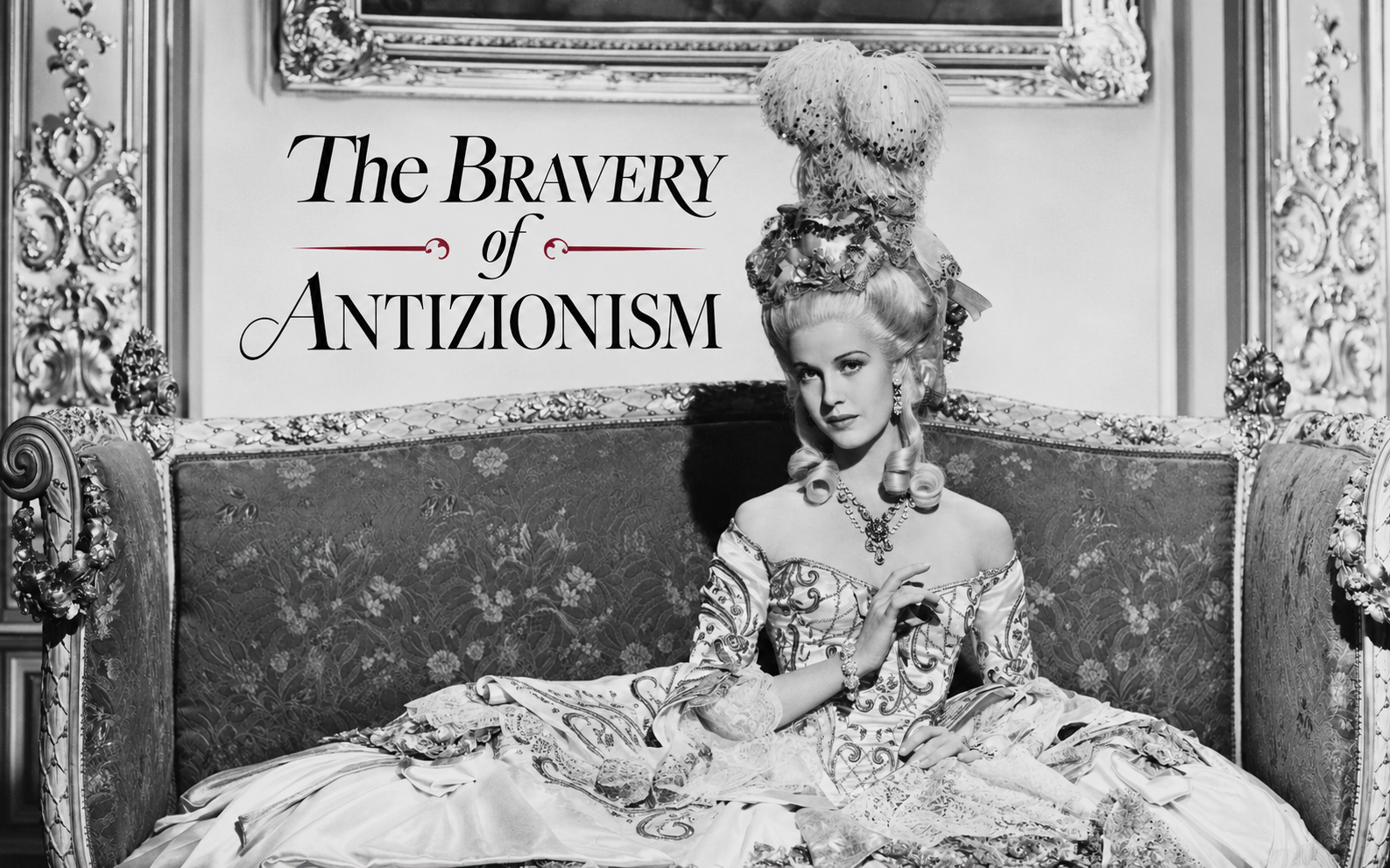
Made by author.
At the university that taught me antizionism as canon, Judith Butler headlined a symposium on how dangerous it is to believe what the syllabus assigns.
I’m a proud graduate of Boston University, which I later learned is the largest private university in Massachusetts and the seventh largest in the United States. I did my graduate work there for three years, completing two master’s degrees from 2007 to 2010. I recall it fondly as a pivotal time in the development of my intellectual and philosophical perspectives.
The university also has the largest Jewish undergraduate population of any private university in North America, with some 6,000 Jewish students. The Elie Wiesel Center for Jewish Studies bears the name of the author of Night, who taught at the university for 37 years. I still vividly recall the day he was offered the presidency of Israel.
It is also, in an unfortunate twist of fate, where I learned settler-colonial theory and anti-Israel perspectives, which were taught as canonical. They are the assumptions in higher education, and a Zionist perspective is not only shunned and frowned upon but actively treated with hostility and denounced as racist, colonial, and genocidal.
It would take an immense amount of bravery and confidence to openly state your Zionism in those lecture halls. Having taken courses at Harvard, I can say the same for them. The only place of education I witnessed Zionism accepted was when I took a course at Hebrew College.
The syllabi were full of texts from Foucault to Fanon, Said to Khalidi, Chomsky to Butler. I remember them all.
I end with Butler because they had just front lined a four-and-a-half-hour symposium on antizionism at Boston University, celebrating the publication of Jewish Anti-Zionism: A Historical Anthology.
Although I could not attend in person, I found the livestream online, watched it, and went over the transcript, which I have made available here.
The “Brave and Brilliant”
Hosted by the university’s Institute on Culture, Religion and World Affairs, this event was free, open to the public, available online, and had a reception afterward.
The director of the institute, Jeremy Menchik, announced that 760 people had registered. An academic anthology was “the least sexy of the academic forms that we produce,” he joked, yet “there’s clearly a lot of hunger for this.” He announced that the Conference on the Jewish Left would expand to two days next year.
Mentioning historian Omer Bartov’s Israel: What Went Wrong?, Menchik asked how a nation founded with promises of liberty had become responsible for “mass starvation as a matter of policy, institutionalized ethnic supremacy, systemic repression of millions of people.”
The anthology, edited by Shaul Magid and Zev Mishell, was published nine days earlier. It collected Jewish opposition to Zionism texts including those of Martin Buber, Hannah Arendt, Noam Chomsky, Judith Butler, Peter Beinart, and Naomi Klein.
Margaret Litvin introduced Butler, calling BU’s Jewish Left programming “one sustaining bright spot.” She said the campus had begun to “blossom into an important site of Jewish political diversity.” She praised the “brave and brilliant” colleagues responsible for the symposium.
Litvin introduced Butler as a distinguished professor at UC Berkeley and an author who is present in BU’s core curriculum and a dedicated seminar. Butler, she said, had been a “forthright and carefully humane voice of Jewish opposition to Zionism.”
“Sadistic and Murderous Exhilaration”
Butler began by warning the audience, “You may be risking your education, your job, especially if you are a precarious worker, your professional standing, your mobility, your privacy.”
The bravery of it all was almost too much to bear.
Butler described “the Israeli state structure, its claim to be democratic and legitimate in the face of its systemic racism and genocidal practices,” and spoke of “the deep commitments to racism in U.S. and Israeli Zionist communities.”
“I speak politically, to be sure,” Butler said, explaining this research as necessary to “the political struggle to contest Zionism” which could become “a scholarly dimension of struggle.”
Butler’s proposed alternative to Israel was explicit: “Zionism should give way to another state formation bound by principles of constitutional equality that would fully represent Palestinians, the right of return, and a plan for equitable land redistribution.”
They attributed “eliminationist aims” to Zionist practices and described some perpetrators as acting with “sadistic and murderous exhilaration.” Butler criticized the IHRA definition of antisemitism for “the suppression of critical and dissenting perspectives,” and accused Israel of “the use of torture and starvation as tactics in its genocidal campaign.”
Tsiona Lida described “Zionism’s capture of Jewish sensibilities, its shaping of Jews’ sense of safety and the comforts of supremacy.” She urged Jews to “refuse the comforts of supremacy that Zionism affords Jews” and reject “the imperial order of sympathy, suffering, and feeling that Zionism imposes ubiquitously and that sustains its genocide of Palestinians.”
Soviet and Russian antizionism does not fit this story, however, so it was lobbed off.
Loeffler questioned its omission of the Yevsektsiya, Leon Trotsky, and other Soviet Jewish antizionists. The editors selected what he said was “a genealogy of loyal dissent.”
“These are Jewish Jews. These are loyal Jews. Jews whose anti-Zionism flows from the depth of their Jewish engagement, not from their abandonment of one part of it,” he said.
“Zionism Racialized Jews”
Magid insisted that the anthology was not a work of advocacy. “This book and this project is not advocacy, rather, our work here is a work of scholarship in the public square. “We don’t hide our predilections,” he noted, “but we don’t champion them either.”
“It’s not that I don’t want the state of Israel to exist. It’s that I don’t want my Jewish identity here to be contingent upon supporting that state which I can’t support.”
I would respond to this, but I will set aside my privilege to hear from a persecuted and marginalized Harvard faculty.
American Jewish education, Magid argued, focused on “two things, Holocaust and Israel,” reflecting “a conscious choice of creating a narrative and erasing another narrative.”
During the audience discussion, Butler dismissed viewing Kahanism as the explanation for violence associated with Zionism. “It was a colonial project all along,” they said. Asked whether it had always been racist, Butler said, “I think the answer is yes.”
Elad Lapidot argued, “The first Zionist colonization, however, was of Jewishness, reshaped as the collective subjectivity of a colonial nation-state.” He added, “Zionism racialized Jews.”
Mishell characterized Palestinian arguments against Zionism as being opposed to “a regime of settler colonialism, apartheid, and now genocide on the indigenous people of the land.” He quoted Marianne Hirsch’s ridiculous idea that Holocaust memory had been “amplified and exploited to manufacture Jewish support for the Gaza genocide.”
At BU’s earlier Conference on the Jewish Left, Peter Beinart delivered the keynote to an audience of 943. I have a feeling there was more security at the Jewish preschool down the street on Boylston than at that event. The courage they have.
The Bravery of Antizionism
On the same day, BU School of Law also hosted Speech on Campus Under Attack, with Palestinian activist Leqaa Kordia and ACLU member Jennifer Turner. The event addressed “widespread attacks on free speech and association on college campuses,” particularly restrictions affecting Palestine-solidarity.
Or, as some put it, hate-speech, threats, and intimidation.
Elsewhere in Boston, Jewish Voice for Peace had its Women in Black demonstration outside the offices of Sen. Elizabeth Warren and Ed Markey. Somerville for Palestine had a rally supporting their Israel boycott ordinance, Allston-Brighton for Palestine had its Brighton Standout, and JVP scheduled an online Rosh Chodesh Palestinian Solidarity gathering.
At Columbia University, masked protesters had disrupted Israeli professor Avi Shilon’s class on modern Israel with drums and flyers reading “CRUSH ZIONISM.” At Cornell, Israeli student Oren Renard reported Professor Eric Cheyfitz excluding him from a Gaza seminar because of his Zionism.
Butler warned that antizionism could cost someone their education, employment, and professional standing. They said this as a distinguished Berkeley professor delivering a keynote at Boston University, celebrating a Princeton University anthology endorsed by prominent scholars while protests and loudspeakers blasted throughout greater Boston.
The bravery of antizionism knows no bounds.
Original post here.