A Liberal Atheist Who Supports and Studies Israel
The Antizionist Frontrunner Who Wants Iron Dome Gone: Adam Hamawy’s NJ Bid
The front-runner in New Jersey's 12th District wants Israel stripped of the one thing standing between a rocket and a kindergarten.
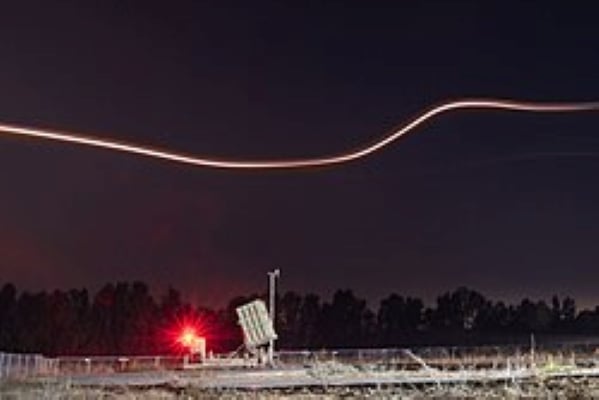
Iron Dome (Source: Wikipedia Commons, IDF 2022)
“It’s like giving a bully body armor to go bully people some more.” That’s Adam Hamawy, on Hasan Piker’s show in April, explaining why he opposes Iron Dome. “We need to be able to have them feel the effects of war, and then they’ll stop.” The bully is Israel. The body armor is the system that catches rockets in midair before they finish the trip someone else started. And the thing Hamawy wants is for it to come off, so the people underneath it can feel what’s been aimed at them.
Six weeks later, days before Tuesday’s primary aimed at New Jersey’s state representatives office, he made a statement finding antisemitism “abhorrent” and saying he’s “deeply worried about its continued rise”—that as a Muslim he understands bigotry, and sees Jewish safety and his own as intertwined. It’s a careful sentence, and it was meant to be. It went to one room. The bully line went to another.
Give Hamawy his strongest case first, because he has one. He’s a combat trauma surgeon who saved Senator Tammy Duckworth’s life in Iraq in 2004 after her Black Hawk went down. In 2024 he volunteered with an international medical team in Gaza, performed roughly 120 surgeries—more than half on children—and when Israel seized the Rafah crossing and the team was trapped, he refused evacuation offered to US citizens until his colleagues from Jordan, Egypt, and Australia could leave too. “When you go in as a team, you leave as a team,” he said. He has stood where almost no American official has stood and seen what almost none of them have seen. When a man like that says the suffering has to stop, the words carry the weight of a witness. That is the case for him, made as strongly as it can be.
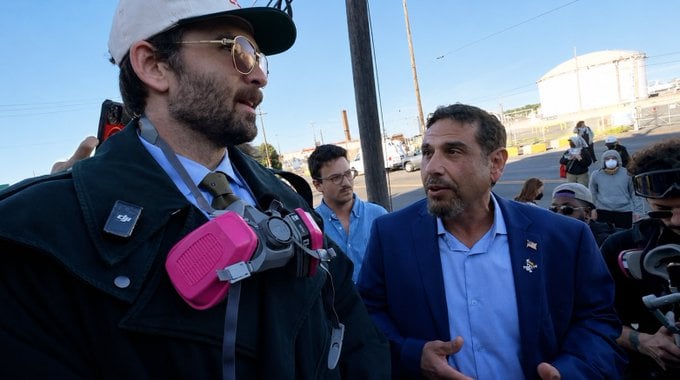
Now turn the bully line over. Iron Dome doesn’t bomb Gaza—it intercepts rockets fired at Israeli civilians. To call it a bully’s armor is to decide that the rockets are the just blow and the interception is the cheat. “Feel the effects of war” doesn’t describe a surgeon’s mercy; it describes the specific effect Iron Dome prevents—a warhead finishing its arc into an apartment block in Sderot, a school in Beersheba, a kindergarten in Ashkelon. The witness who treated wounded children in Gaza concluded that the answer is to expose the children of Ashkelon to the same.
Strip the armor and let the blows land. That’s not where compassion leads.
And the metaphor tracks a platform, not a mood. Hamawy’s foreign-policy plank is the immediate cutoff of all U.S. military aid and arms sales to Israel, missile defense explicitly included. He’s called Gaza “a genocide, paid for with American tax dollars,” told a Princeton crowd “what I saw there was not a war…what I witnessed was a genocide,” and accused Israel of “apartheid” in the West Bank. Genocide. Apartheid. American tax dollars. None of those is a slur, and that’s the design—a vocabulary built to clear the bar a slur would trip. It indicts the Jewish state in the gravest terms the language allows while keeping the speaker’s hands clean enough to issue a condemnation of antisemitism the following week. A perfect image for the socially acceptable terms of the modern antizionist language. The endorsements fit the platform: Bernie Sanders, AOC and the Squad, plus Delia Ramirez, author of the Block the Bombs to Israel Act. A pro-Palestinian super PAC has spent roughly $2 million lifting him to the front of the field.
The armor he wants stripped from Israel is one he’s spent thirty years declining to hold up. In 1995 Hamawy testified for the defense of Omar Abdel-Rahman—the Blind Sheikh, convicted of plotting to bomb New York City landmarks, tied to the 1993 World Trade Center attack. The relationship wasn’t a passing handshake. Hamawy met him years before, drove thirteen hours with him to a Detroit conference, attended his sermons, visited his home, and served as his translator at a press conference where the sheikh denied his role in the bombing—then took the stand for him under oath. He now calls that “a civic duty”; his campaign calls the scrutiny “gross and bigoted.” But strike the association and keep only what he chose, under oath, to do: he lent his name and his voice to the defense of a convicted terrorist, and three decades later he lends them to stripping the defenses from a nation of Jews. As one New Jersey columnist noted, a candidate with this résumé beside a Klan leader would be laughed out of the race.
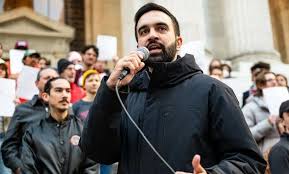
It’s the move Zohran Mamdani perfected on his way to Gracie Mansion. Asked to condemn “globalize the intifada”—a slogan under which Jews have been attacked and murdered since 1987—Mamdani said the mayor’s job “is not to police language.” Under pressure he allowed only that he’d “discourage” the phrase, never condemn it. Same move: offer the disavowal that costs nothing, protect the position that costs votes. The soft word—”discourage,” “consequences”—does the work the hard truth isn’t allowed to say out loud.
So compare the two rooms.
One of those is a press release; the other is what he believes to be true.
When a candidate gives the witness’s version to the streamer and the soothing version to the synagogue, believe the one he didn’t think you’d hear.
The shield comes off, and the rockets land where he always knew they would.
Related Topics
Related Posts