
The Apartheid State Is Failing
The ANC brought Israel before the world’s court while preserving racial government, hollowing out its institutions and losing control of streets where African migrants are hunted. Across its northern border, it shields a regime whose victims it prefers not to see.
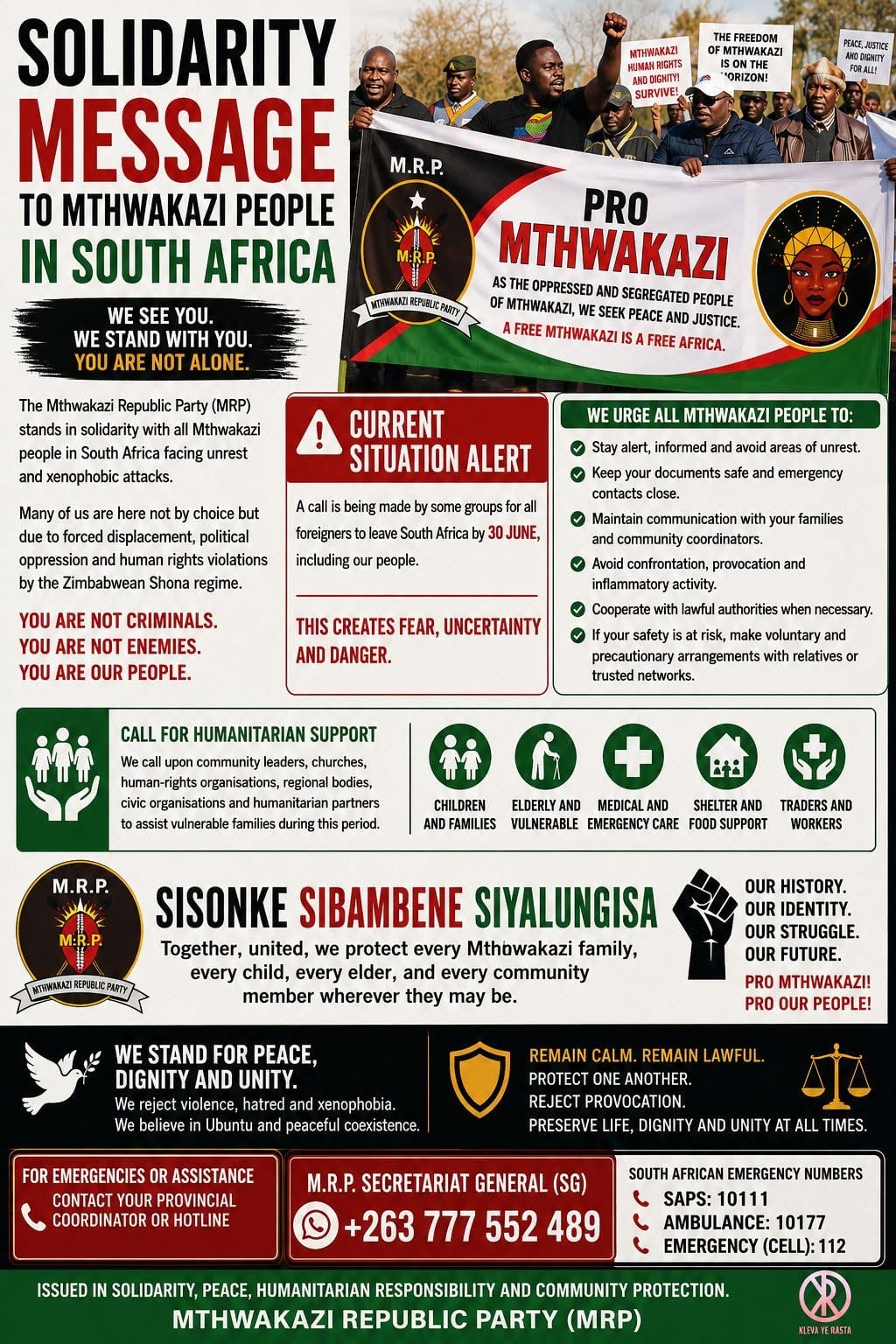
On June 14, the Mthwakazi Republic Party issued what it called a solidarity message to Mthwakazi people in South Africa. It read like an emergency survival notice: stay alert, avoid areas of unrest, secure your documents, keep emergency contacts close, make arrangements with relatives or trusted networks.
Source: https://www.facebook.com/MthwakaziMRP1/posts/pfbid02v5sUAg2qD3jBTgLHtt7wpKeLptm2SHE4x8QB2SskDFQ5hxezDZonSvBT8qTNsxrEl
This was not advice for Somalia or Sudan. It was guidance for Africans trying to stay alive inside South Africa – the country that has appointed itself the world’s moral prosecutor of Israel.
The warning was not abstract. Reuters reported door-to-door expulsions: crowds ordering foreigners out, migrants driven into the mountains or into municipal buildings, some of them lawful residents, children kept from school, protesters carrying knives and sticks. Mozambique reported five deaths; Ghana, Nigeria, Malawi and Mozambique began helping citizens leave, and Ghana petitioned the African Union. President Cyril Ramaphosa warned South Africans not to stop people in the street and demand papers, because enforcement belongs to “the state and the state alone” – an admission that private movements were already doing what only government may do.
This is the state that lectures Israel about civilian protection.
South Africa’s disappearing emergency
South Africa filed its genocide case against Israel in December 2023 as an emergency demanding immediate intervention. The Court has now set its reply for November 22, 2027 and Israel’s rejoinder for May 22, 2029. A slow timetable does not prove the allegations false; litigation takes years, and provisional measures are a separate question. But it exposes the gulf between the ANC’s political theatre and the case it actually filed. Pretoria mobilized the world with the language of unfolding catastrophe; when the ordinary burden of proof arrived, urgency became a matter of years.
Apply to South Africa the test it demanded for Israel. In the affected communities it cannot protect Mozambicans from being killed, cannot keep migrants’ children in school, cannot stop private groups from inspecting papers and ordering families out, and cannot prevent neighboring states from evacuating their nationals. The answer is no.
The colonialism the ANC refuses to see
South Africa’s case against Israel rests on a family of charges: occupation, domination, forced displacement, the denial of a people’s right to govern itself. The ANC casts itself as the enemy of those wrongs everywhere. Yet they sit immediately to its north, in a history it treats as an inconvenience.
The Ndebele kingdom was conquered by Cecil Rhodes’s British South Africa Company in 1893 and incorporated into the company’s territories, which became the self-governing colony of Southern Rhodesia in 1923 – not an amalgamation begun that year, but the consolidation of an earlier conquest. Independence did not end the subordination. Between 1983 and 1987 government forces killed about 20,000 people in predominantly ethnic Ndebele areas and displaced tens of thousands more, a campaign the United States Holocaust Memorial Museum records as the Gukurahundi massacres and many describe as genocidal. No senior Zimbabwean official has been held accountable.
The Mthwakazi Republic Party, whose survival notice opens this article, seeks self-determination for Matabeleland and the Midlands by peaceful means. Its petition for self-determination, carrying 25,880 signatures, was registered by the SADC Secretariat in September 2023 and has produced no publicly announced regional mediation or political-status process. A movement that petitions rather than takes up arms is asking to be heard, not imposing itself by force.
The ANC did not cause Gukurahundi; the massacres predate its government. Its responsibility is what came after. In one defining example, Pretoria treated ZANU-PF as a fellow liberation movement to protect rather than a government to hold to account. In 2008, after an election drenched in violence, South Africa voted against a UN Security Council draft imposing targeted sanctions and an arms embargo, choosing accommodation over accountability. That is not legal responsibility for every act of the Zimbabwean state. It is diplomatic protection, and it carries moral weight. A government cannot prosecute domination in Jerusalem while shielding it in Harare.
A failing state, already failed where it matters first
South Africa has not collapsed. It has competitive elections, working courts, a free press, universities, banks and a capable central bank. It is not Somalia. But state failure is not a switch; it arrives unevenly, one institution and one community at a time.
Max Weber defined the state as the entity that successfully claims a monopoly on the legitimate use of force within a territory. That does not make every riot or criminal gang a sign of failure; illegal violence exists in every democracy. The relevant test is whether organized private actors can exercise coercive governmental powers while the state cannot reliably stop them or protect their victims. In parts of South Africa, anti-migrant movements conduct document checks, decide who may remain, drive residents from their homes and obstruct access to public facilities – functions Ramaphosa says belong only to the state – while foreign governments repatriate citizens South Africa failed to protect. On that definition South Africa has already failed where it governs least. For the migrant hiding in the mountains, “failing” and “failed” are the same word.
The failure is administrative too. The Auditor-General’s latest report describes governance failures, financial mismanagement and weak accountability, records roughly R42.6 billion in irregular expenditure, warns of a “culture of impunity,” and flags 16 public entities uncertain they can keep operating. Only 41 of 257 municipalities earned clean audits for 2023-24. A state need not fail everywhere to have failed somewhere.
The ANC did not abolish the racial state
As a South African who opposed apartheid, I do not claim the ANC’s racial policies share the history or moral character of National Party apartheid, built to preserve white supremacy through exclusion and domination. Nor does every affirmative-action measure amount to the international crime of apartheid, which has a strict legal definition narrower than the political point here. I mean something simpler: the state still classifies people by race and distributes state-created opportunity accordingly. The beneficiaries changed; the machinery survived.
Black Economic Empowerment defines who counts as “black” for statutory benefits, and the government states plainly that white and foreign nationals, and some black citizens naturalized after April 27, 1994, do not qualify. Employment Equity now sets five-year racial targets across 18 sectors and the upper occupational levels, excludes white men without disabilities and foreign nationals from the target profile, binds employers of 50 or more and ties compliance to state contracts; the gazette spells out the categories in detail. South Africa calls this transformation and grounds it in real past injustice. But intention does not change what the state does now: race remains a legal credential for public economic advantage. The old state used race to exclude; the ANC state uses it to prefer and engineer. Different systems, one dangerous proposition – that government may classify citizens by race and make it matter in law.
The government can classify jobs, but it cannot create them
That engineering might be forgiven if it produced prosperity. It has accompanied catastrophe. The official unemployment rate was 32.7 percent in the first quarter of 2026; 4.7 million people aged 15 to 34 were unemployed, 60.9 percent of those aged 15 to 24 and 40.6 percent of those 25 to 34, and more than four in ten aged 15 to 34 were neither working nor studying. The ANC cannot create jobs, but it can sort the shrinking number by race; it cannot deliver inclusion, but it can produce forms, certificates, targets and compliance reports. Race law does not mechanically cause xenophobic violence – the attackers own their choices – but permanent scarcity plus a politics of demographic entitlement is fertile ground. Once government teaches that opportunity belongs to categories, demagogues need only name a new undeserving one.
State capture was an ANC governing system
South Africa’s institutional rot was not made by Israel or some foreign conspiracy. It was produced inside the ANC state. The State Capture Commission’s reports document the weakening of law-enforcement and intelligence institutions, the manipulation of appointments, and the conversion of procurement and state-owned enterprises into engines of enrichment. This was not a few crooked officials. It was the professional state replaced by the party state. The ANC discusses capture as something that happened to it under Jacob Zuma. That absolves the institution that supplied the machinery and the protection. Capture did not happen to the ANC. It happened through the ANC.
Israel became the ANC’s moral camouflage
The campaign against Israel lets a failing movement borrow the posture of a liberation movement. Officials presiding over unemployment, racial administration, broken municipalities, captured institutions and anti-African violence get to look heroic again. Turn the charges South Africa carried to The Hague around, and they return as questions it cannot answer.
- Apartheid? Race is still consequential in South African law and economic opportunity.
- Institutional discrimination? Eligibility and compliance run on racial categories.
- Failure to protect civilians? African migrants are fleeing South African mobs.
- Forced displacement? Families are driven from homes for their national origin.
- Denial of self-determination? Mthwakazi’s peaceful petitions go unanswered while Pretoria guards its bond with ZANU-PF.
- State impunity? The country’s own Auditor-General describes noncompliance without consequence.
- Urgent emergency? The case used to mobilize the world is now scheduled into 2029.
The analogies are not identical, and no South African failure excuses any wrong by Israel. The point is standing. The ANC spends maximal moral vocabulary abroad and minimal accountability at home and next door, demanding of Israel what it will not ask of itself or its allies.
South Africa is not failed in every institution; it remains functional enough to choose differently, which makes the decline less excusable, not more. But the failure is no longer hypothetical. Nationally it is failing; locally it has already failed wherever it cannot keep public authority, protect people from violence or deliver honest administration. The ANC inherited a country wounded by apartheid and a mandate to build a nonracial democracy. Instead it preserved racial administration, turned institutions into party assets, normalized mass unemployment, shielded oppression next door, and now watches Africans flee from other Africans.
The apartheid state is failing.
It is not Israel.
It is ANC South Africa.