
The Arab World Needs a Doctrine of Sovereignty
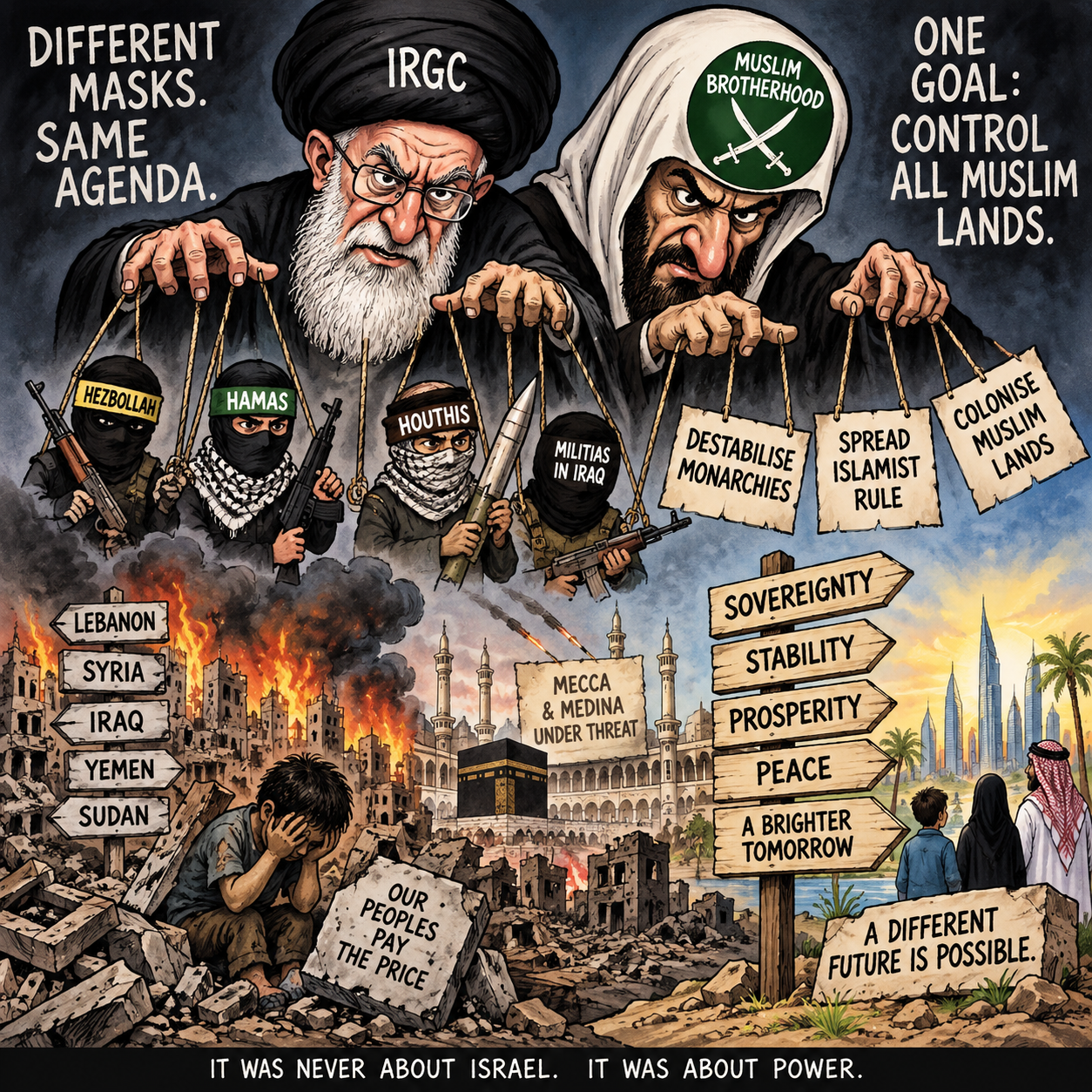
For the better part of half a century, the Arab world has been handed a torch and told, repeatedly and with great solemnity, to point it in precisely the wrong direction.
Whenever a government failed its people, whenever an economy seized up or a society came apart at the seams, Israel could be relied upon to materialise at the scene of the crime, blinking innocently, ready to take the blame. It is a remarkable trick, when you think about it: an entire regional politics organised around the idea that Jerusalem is somehow responsible for the failures of Damascus, Baghdad, Sana’a and, lately, Riyadh. Israel did not become a country so much as a kind of moral flypaper, onto which every grievance in the region could be pressed and left to die.
It was, for those doing the pressing, spectacularly convenient. While populations were being instructed to gaze westward in perpetual outrage, something rather more consequential was being constructed closer to home — quietly, patiently, and with weapons.
Consider Saudi Arabia, which today offers as vivid an illustration as one could wish of why this old intellectual furniture needs to be thrown, forcibly, out of the window.
In recent days drones have found the East-West pipeline, in the vicinity of Medina no less, and the Kingdom has issued security alerts covering Mecca and other cities as Houthi attacks — the Houthis being, let us not mince words, an Iranian appendage with a flag of convenience — have intensified. I will not pretend, because there is no need to, that the Grand Mosque itself has been struck; the temptation to inflate a genuine crisis into a holy one should be resisted by anyone with a functioning sense of proportion. The truth, unembellished, is quite bad enough: the physical security of the cities at the very centre of Islam is being reshaped by the so-called resistance axis, an axis that has never once, in forty-five years, liberated a single square metre of Palestine.
One might ask, reasonably, what any of this has to do with the liberation of Palestine.
The honest answer is: almost nothing. Palestine stopped being merely a national cause some decades ago and became, instead, a franchise — a piece of intellectual property that revolutionary movements borrow in order to launder their ambitions. Khomeini grasped this before almost anyone else. A Persian, Shia, revolutionary state faced an obvious marketing problem in a region that is overwhelmingly Arab and Sunni. Palestine solved it beautifully. Jerusalem supplied the vocabulary, Quds Day supplied the liturgy, and armed Palestinian factions supplied the theatre — and thus Iranian expansionism could be sold to the credulous as Islamic solidarity, which is a bit like selling a protection racket as neighbourhood watch.
The results speak, loudly, for themselves. Lebanon got Hezbollah, which is to say Lebanon got a second government, an armed one, that answers to Tehran rather than to Beirut. Iraq accumulated a militia problem whose loyalties do not stop conveniently at the border. Syria became a corridor, which is what nations become once they cease to be countries. And Yemen produced the almost surreal spectacle of an armed faction capable of holding Saudi cities, international shipping lanes, and a fair portion of the world’s energy supply hostage simultaneously.
And through it all, we were assured, gravely, that the subject under discussion was Israel.
There is something close to magnificent in the sheer audacity of the con. Tehran hollows out Arab sovereignty from the inside while presenting itself as the last honest defender of the Arab cause — a bit like an arsonist demanding to be put in charge of the fire brigade, and getting the job. The trick works because it converts a political argument into a loyalty test. Support the “resistance,” whatever grotesque form it currently takes, and you are virtuous. Question it, and you have betrayed Palestine. Normalise relations with Israel, and you have apparently betrayed the entire Muslim world — though arming men who threaten Saudi cities and turn Arab capitals into shooting galleries is, somehow, never filed under betrayal. This is not a moral position. It is a con, and a fairly transparent one, and it has been allowed to run for far too long.
Nor should we let the Muslim Brotherhood off lightly by pretending its story is unconnected. The Brotherhood and the Islamic Republic are not, of course, the same organisation; they diverge on doctrine, on structure, on strategy, and Brotherhood branches disagree substantially among themselves — this much is true and should be said plainly. But ideological disagreement has never once, in the history of political movements, prevented tactical marriage. Tehran has repeatedly sought out Brotherhood networks precisely because they open a door into Sunni constituencies that Khomeinism, on its own, could never reach. Carnegie’s research on the relationship found Tehran viewing the Brotherhood as a useful means of widening its reach and dressing the “resistance” project in more convincingly pan-Islamic clothing.
The convergence shows up, unsurprisingly, exactly where state authority is thinnest. Reuters reported in 2024 that Jordan had broken up a suspected Iranian-linked smuggling operation involving a Brotherhood cell tied to Hamas, weapons allegedly destined for sabotage inside the kingdom. The Brotherhood’s leadership denied any institutional hand in it, and that denial is worth recording fairly. But the episode itself is worth recording too, because it tells you something neither organisation particularly wants advertised: revolutionary movements do not require shared theology to share a target, and the target, increasingly, is the Arab nation-state itself.
Monarchies present these movements with a peculiarly stubborn obstacle, since monarchies possess their own legitimacy, their own institutions, and their own inconvenient habit of standing between transnational ideology and actual power. And no monarchy represents a juicier prize than Saudi Arabia, which holds not merely territory and wealth but Mecca and Medina — which means that for Tehran, leadership of the Muslim world was never going to be a matter of strategy alone. It was always going to be a contest over legitimacy itself, fought, ultimately, over the two cities that confer it.
So let us retire the tired vocabulary. The question worth asking is not whether one is sufficiently anti-Israel, or performatively pro-Palestinian on the correct schedule. The question is considerably blunter: who has the right to govern the Arab state? The elected government, the monarchy, the constitution, the institutions built and staffed by citizens — or an armed faction drawing its money, its weapons, its theology and its marching orders from somewhere else entirely?
That is the question an Arab Doctrine of Sovereignty must be built to answer, and its founding premise should embarrass anyone who needs it spelled out: no cause, however sacred its packaging, entitles a faction to build a state within a state. Saudi Arabia, the UAE, Jordan and Egypt have the heft to begin constructing such a doctrine, and every Arab government still interested in the survival of the nation-state ought to sign on.
The first pillar is the monopoly of legitimate force, full stop. No Hezbollah model, no Houthi model, no militia permitted an independent arsenal, an independent foreign policy, or the power to decide, unilaterally, that an entire population is now at war. A government that cannot make that decision for itself is sovereign only on its own letterhead.
The second pillar is zero tolerance for foreign political capture, which means real transparency around the funding of religious, educational and political institutions — a transparency regime, not a pretext for persecuting conservatives or opposition parties, which is a distinction worth insisting on loudly, since authoritarians love nothing more than borrowing the language of sovereignty to justify garden-variety repression. Sovereignty defended at the airport and ignored inside the mosque, the university and the charity is not sovereignty at all.
The third pillar is collective security, on the theory — a rather obvious one, once stated — that an Iranian proxy’s attack on Saudi Arabia is not merely a Saudi headache, subversion in Jordan is not merely a Jordanian one, and disruption off the coast of Yemen belongs to more than Yemen. The entire proxy model survives by fragmenting the response, letting Tehran deny responsibility while its clients do the actual damage. The remedy is integrated intelligence, joint financial tracking, shared counter-smuggling operations and shared attribution — because a militia should not get to hide behind a map.
The fourth pillar, and arguably the decisive one, is economic sovereignty. Revolutionary politics does not thrive on ideology so much as on the absence of alternatives; it flourishes wherever governments hand their young men grievance more generously than opportunity. The Gulf’s real answer to revolutionary Islam was never going to be a better-produced sermon. It is ports, universities, artificial intelligence, energy infrastructure, railways, start-ups, trade corridors — the unglamorous business of giving a young man a job, a mortgage and a plausible future, all of which make him considerably harder to recruit for somebody else’s martyrdom.
Which returns us, at last, to Israel. An Arab Doctrine of Sovereignty must finally dispense with the fiction that a relationship with Israel constitutes some kind of theological verdict on the believer. Israel is a neighbour — sometimes a difficult one, sometimes a useful one, exactly as neighbours generally are. Arab states should oppose its policies when interest or principle demands it, and cooperate when interest demands that instead. This used to have a name. It was called foreign policy, before Tehran, Hamas and their ideological franchisees appointed themselves the sole arbiters of Arab honour.
The Palestinians deserve statehood, competent government, and an end to their exploitation — deserve it, in fact, precisely enough that Palestine ought to be rescued from the industry that has made its perpetual misery so lucrative for everyone except Palestinians. No Palestinian child is fed when a Saudi pipeline burns. No family in Gaza is freed because the Houthis take delivery of another missile. No Muslim anywhere becomes more devout because Lebanon loses another slice of what remained of its sovereignty. And no Arab government owes its own destruction to organisations whose long-term project is precisely that destruction.
For fifty years Iran instructed the Muslim world to keep its eyes fixed on Jerusalem. It might be worth asking, at long last, what was happening everywhere else while everyone obediently looked. The answer runs through Lebanon, Syria, Iraq and Yemen, and it has now arrived, quite literally, on Saudi soil. A network was built while the audience was watching the wrong stage.
The Arab world therefore confronts a choice considerably larger than Israel and Palestine. It can go on arranging its politics around the inherited emotions of the last century while twenty-first-century revolutionary movements hollow out the state from within — or it can recover a principle so basic it is almost embarrassing to have to restate: Arab countries belong to their own citizens. Their borders are not provisional. Their governments are not way stations for somebody else’s revolution, their holy places are not collateral, and their future is not on loan to Tehran, the Brotherhood, Hamas, Hezbollah, or any other movement claiming a divine exemption from the ordinary rules of the state.
That is the doctrine this moment requires.
Sovereignty first — because without it, there will not be very much left worth liberating.