


The Arc of Justice Does Not Bend Itself
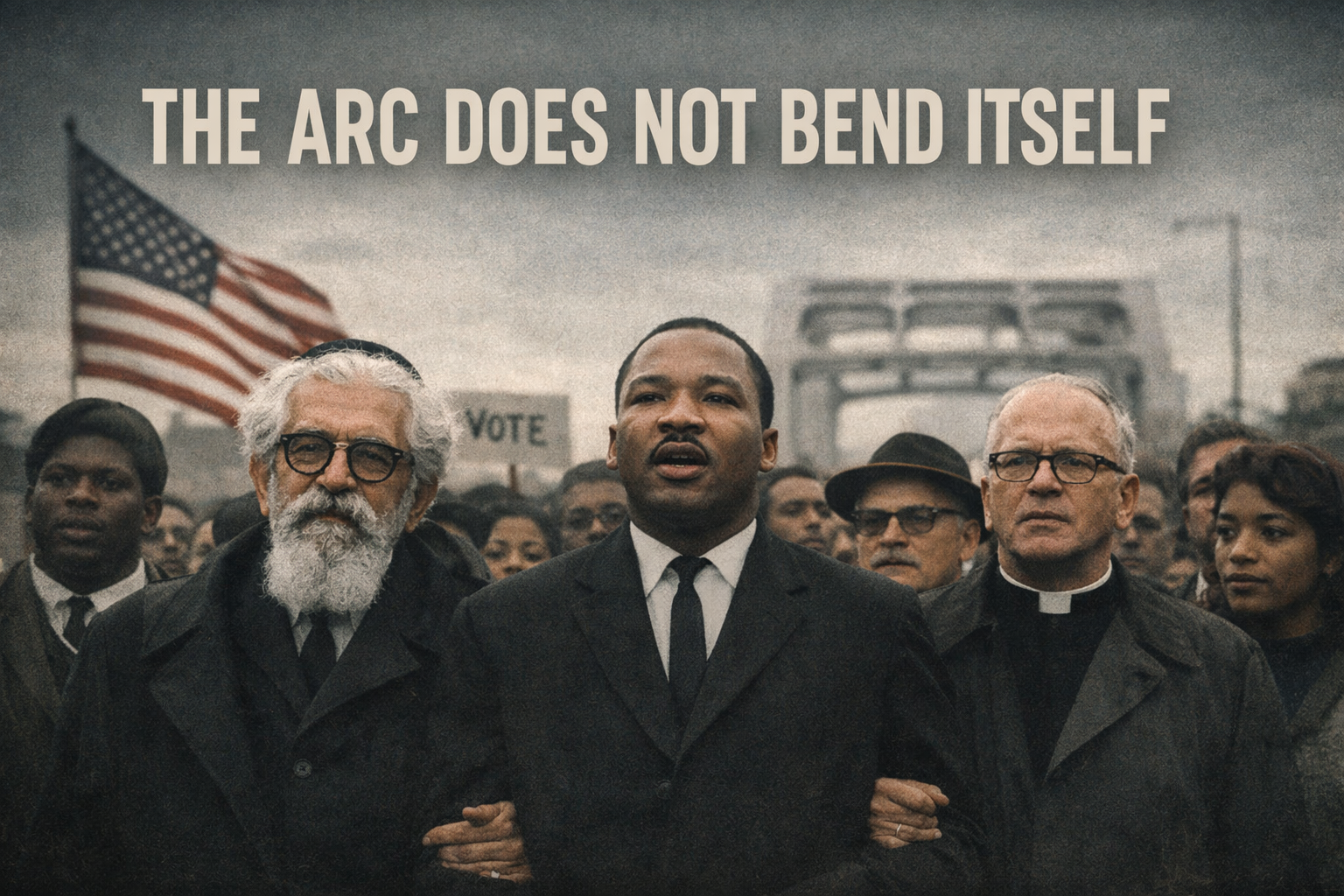
Each year, we repeat the familiar line that the arc of history bends toward justice. It is comforting. It suggests inevitability. It allows us to believe that progress happens on its own, and that our role is merely to applaud it after the fact.
Martin Luther King Jr. never believed that.
What King understood, and what we too often forget, is that the arc does not bend itself. It bends only when people are willing to push it, knowing the cost. And when they stop pushing, it snaps back.
Each January, we pause to honor King, a man whose name has become synonymous with progress and moral clarity. Schools close. Politicians quote a sentence or two from the “Dream” speech. Social media fills with sepia toned images and safe abstractions about hope.
And then, on Tuesday, we return to the work of forgetting what King was actually warning us about.
King has been domesticated by history. He is remembered as a symbol of harmony rather than a disruptive force. As a dreamer rather than a critic. As a unifier rather than a man who understood, deeply and painfully, that democracy does not fail only when hatred wins, but when comfort prevails.
He believed justice was fragile. That rights could be reversed. That progress demanded pressure, sustained, disciplined, and often unpopular. He feared not merely the overt racist or violent extremist, but the citizen who prefers order to justice, quiet to confrontation, and normalcy to moral responsibility.
That insight should trouble us now.
Which raises a question we rarely ask aloud, but should.
Is the arc snapping back?
Not collapsing in a single dramatic moment. Not shattering overnight. But quietly recoiling under pressure. Are gains that once felt settled being narrowed, qualified, or relitigated? Are rights increasingly treated as privileges, dissent as disruption, and democratic participation as something to be managed rather than protected?
King would have recognized this pattern immediately.
We live in a moment where democratic norms are weakening in plain sight. Voting rights are narrowed through technicalities rather than outright bans. Protest is redefined as disorder. Dissent is recast as disloyalty. Courts and legislatures increasingly treat rights not as guarantees, but as permissions contingent on political convenience.
This is not new. King recognized the pattern. Rights are rarely revoked all at once. They are diluted. Delayed. Selectively enforced. Justified away through the language of “law and order,” a phrase that has long served as a moral anesthetic, allowing injustice to proceed while its beneficiaries insist they are merely following rules.
King saw how power cloaks itself in legality. How repression prefers procedure to spectacle. How democratic backsliding often arrives politely, with a smile, and an executive order explaining why this particular exception is necessary.
King also understood something that remains unfashionable today. Moral responsibility does not stop at the edge of one’s own community. In the 1960s, many American Jews recognized this instinctively. Shaped by histories of exclusion and vulnerability, they saw in the struggle for civil rights not someone else’s cause, but a familiar warning. Rabbis marched. Lawyers litigated. Students registered voters in places where doing so invited violence. They did so not because it was safe or rewarded, but because they understood how quickly injustice, once normalized, spreads.
King welcomed this solidarity precisely because it was not transactional. It rested on a shared understanding that democracy fails first at its margins, and that those who recognize that early carry an obligation to act.
We are told to be patient. To lower the temperature. To stop being so divisive. Civil discourse, we are assured, requires restraint, almost always from those asking for rights, never from those withholding them. King rejected this framing outright. He understood that civility is often weaponized as a way to delegitimize urgency while preserving the status quo.
Nonviolence, as King practiced it, was not passivity. It was disciplined confrontation. It was the refusal to allow injustice to hide behind politeness.
He would also have warned against a more modern distortion, the use of justice itself as a weapon. King understood that moral language can be hollowed out and repurposed, not to expand liberty, but to police it. When protest is reframed as extremism, when dissent is treated as disorder, when citizens exercising their constitutional right to speak and assemble are labeled threats rather than participants, justice has been inverted into an excuse for repression. The suppression of free speech rarely announces itself as censorship. It arrives claiming to defend norms, protect institutions, or preserve peace.
King was equally clear eyed about fatigue. Democracies do not weaken only because of bad actors. They weaken because ordinary people grow tired. Tired of paying attention. Tired of arguing. Tired of caring. Fatigue becomes a moral excuse. Cynicism masquerades as sophistication. Disengagement is reframed as wisdom.
King watched as allies drifted away when the work became inconvenient, when the cost rose, when victories proved incomplete. He warned that silence is not neutral. It is structural support.
That warning applies with uncomfortable precision today. The erosion of civil rights is not driven solely by extremists at the margins, but by institutions and individuals who assume someone else will intervene. That democracy will self correct. That elections alone are sufficient safeguards.
They are not.
King’s relevance today lies not in optimism, but in discipline. He demanded moral clarity in an age of euphemism. He insisted that injustice remains injustice even when legalized or normalized. He believed democracy is participatory or it is performative.
He rejected inevitability. Progress, he knew, is not permanent. The gains of one generation can be undone by the indifference of the next. Rights survive only when they are defended by people willing to bear the cost of defense.
King did not promise victory. He promised obligation.
So the question his legacy poses today is not whether the arc of history bends toward justice. That framing lets us off too easily. The real question is whether we are still willing to do the bending, knowing it requires effort, courage, and sacrifice, and knowing how easily the arc can snap back when we let go.
A holiday does not honor King. Memory does not honor him. Quotation does not honor him.
What honors King is refusing the lies that make injustice tolerable. Refusing the fatigue that makes disengagement fashionable. Refusing the comfort that tells us democracy will survive without us.
The arc does not bend itself. And it never has.