
Urban sociologist and geopolitical commentator
The Architecture of Imagination: What Algorithmic Intelligence Cannot Inherit
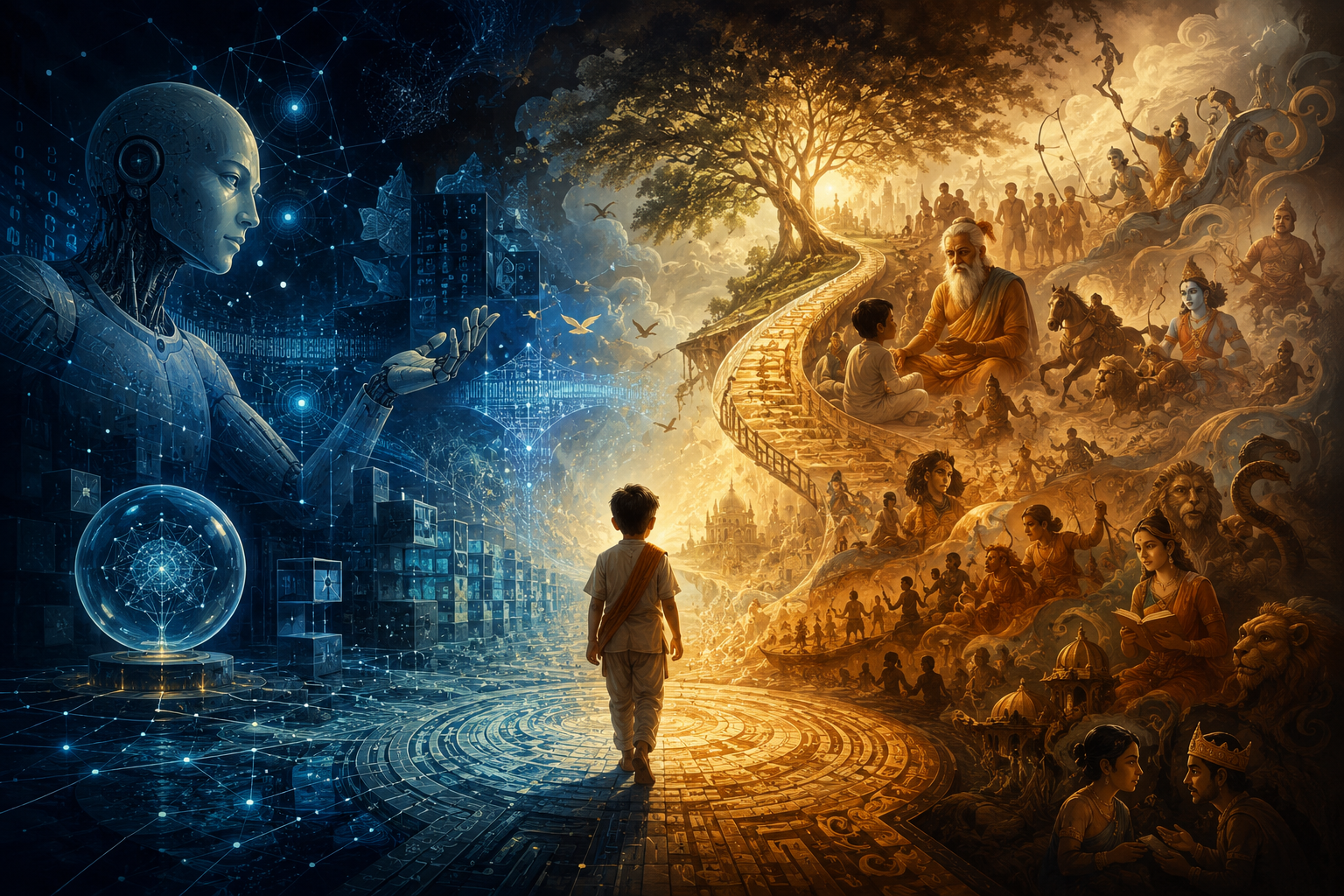
The Architecture of Imagination. AI Illustration. (Credit: ChatGPT)
Einstein is often credited with saying, “If you want your children to be intelligent, read them fairy tales. If you want them to be very intelligent, read them more fairy tales.” Whether or not he actually said these words, they are frequently quoted as a charming defense of fantasy. It is not that. Read carefully, it is a claim about sequence, about what must be built first in a developing mind before anything else can be built on top of it. Fairy tales, in this reading, are not decoration for the intellect. They are scaffolding for it.
Reading Einstein’s Remark Correctly: Why It Matters
This matters because it reframes the entire question people ask about AI and children. The anxious question is usually: will AI make children read less, imagine less, know less? That is a question about volume. The deeper question, however, that this reflection ultimately points toward, is about architecture: not how much cognitive material a child accumulates, but what internal structure that material is organized into, and who builds that structure: the child, or the machine.
Every civilization that produced a great oral tradition, the Panchatantra’s animal-proxies for strategic reasoning, the Mahabharata’s competing ethical optimization functions, Vikram-Betal’s recursive interrogations, the nested infinities of the Arabian Nights, was, whether it knew it or not, running a curriculum in cognitive architecture. Not content delivery. Architecture delivery. The stories were vehicles; the real payload was a way of organizing experience into causal, moral, and symbolic structure.
The question AI raises is whether it disrupts this transmission of architecture even while appearing to preserve, or even multiply, the content.
Two Different Computational Regimes
To see why this isn’t merely nostalgic hand-wringing, it helps to be precise about what a large language model actually does, mechanically, versus what a developing human mind does.
A transformer-based language model (“based solely on attention mechanisms, dispensing with recurrence and convolutions entirely”) is trained by compressing an enormous corpus of human-generated text into a fixed set of parameters through gradient descent on a next-token prediction objective. What results is a static, high-dimensional statistical manifold of “what tends to follow what” across the entirety of recorded human expression. When you query it, you are not asking a mind to think; you are sampling a trajectory through a frozen, pre-compressed space of correlations. In-context learning gives an illusion of real-time adaptation, but no weights update; the “self” that answers you was fixed at training time and dissolves the instant the context window closes.
A child’s cognitive development runs on the opposite regime. Piaget called it construction; contemporary developmental cognitive science calls it structure-building through active hypothesis testing. A child does not compress a trillion tokens. She encounters a small number of sparse, embodied, emotionally-weighted episodes, a fall from a tree, a lie discovered, a monster imagined under the bed, and must construct, largely from scratch, an internal model general enough to predict and act in situations she has never seen. Vygotsky’s insight, easy to underrate, was that this construction is not solitary: it happens inside a zone of proximal development (ZPD) scaffolded by a more capable other, a parent narrating Tenali Rama, a grandmother voicing Betal’s riddles, who provides just enough structure that the child does the actual model-building herself.
This is the crux: compression is a retrieval technology; construction is a formation technology. They can look similar from the outside: both, in the end, “produce answers”, but only one of them changes the architecture of the mind doing the answering. A model that has compressed every fairy tale ever written possesses none of the internal representations those fairy tales are supposed to build. It has the output without the developmental event. The danger is not that AI knows the stories. It’s that consuming AI’s telling of a story may not reproduce the developmental event the story evolved to trigger, because the event depends on effortful construction, not on receipt of a finished artifact.
Predictive Processing and the Economics of Counterfactuals
There is a deeper reason fiction – impossible, invented, patently false fiction – improves real-world cognition, and it comes from predictive processing accounts of the brain (Friston’s free-energy framework, Clark’s Surfing Uncertainty). On this view, the brain is not primarily a recording device; it is a hierarchical generative model constantly issuing predictions about sensory input and updating on error. Perception is controlled hallucination, corrected by reality.
If this is roughly right, then a mind’s core competency is not “knowing facts” but “generating and revising internal simulations.” Fiction is precisely a low-cost training regime for this competency: it lets the generative model run forward on counterfactual premises (“what if a jackal could out-argue a lion?”) without the metabolic and physical cost of testing those premises against the real world. The child who follows the Panchatantra’s crow parliament is not learning about crows. She is exercising the exact simulation-and-revision machinery that later, redirected, becomes scientific hypothesis generation, strategic foresight, and moral reasoning under uncertainty.
This gives Einstein’s remark real teeth. Fairy tales are not a sentimental preamble to “real thinking”, they are calisthenics for the very generative-predictive machinery that all higher thinking depends on. And it clarifies precisely what is at stake with AI: generative AI is also a machine for producing counterfactual simulations, but the counterfactual is now generated externally and delivered finished, rather than generated internally through the child’s own predictive effort. The exercise is done for the muscle rather than by it.
The Difference Between Scaffolding and Substitution
Vygotsky’s zone of proximal development gives us the conceptual tool to distinguish a healthy use of AI from a corrosive one, and it is more precise than the vague worry about “screen time” or “laziness.”
Scaffolding is temporary, calibrated support that is withdrawn as competence grows, and, crucially, the learner still performs the operation that builds the internal representation. A grandmother pausing mid-story to ask “what do you think the fox will do now?” is scaffolding: she supplies structure, but the child’s mind performs the actual predictive leap. A tutor is scaffolding a child’s own long division.
Substitution is support that permanently performs the operation for the learner, so that the internal representation is never built at all, and, this is the important second-order effect, the learner loses the capacity to even evaluate whether the substituted output is good. This is called “developmental bypass”: you cannot supervise a delegate you never learned to be. A student who has never wrestled with a proof cannot tell whether an AI-generated proof is elegant, circular, or simply wrong; a child who has never generated her own images from language cannot tell whether an AI-generated illustration has flattened the story’s ambiguity into a single, foreclosed interpretation.
The philosophically hard part is that scaffolding and substitution can look identical from the outside, both are “AI helping.” The difference is entirely in whether the child’s own generative-predictive operation still fires. This is why the right question about any AI use with children is never “does it help?” but “does it perform the operation, or provoke the operation?”
Narrative Identity and the Loss of Authorship
There is a further philosophical layer worth making explicit, drawn from thinkers like Paul Ricoeur and Alasdair MacIntyre: human beings do not merely consume narratives, they become narratable selves through them. Ricoeur’s concept of narrative identity holds that a self is not a fixed substance but a story continuously reconfigured by the person living it, and that this capacity for self-narration is itself trained by encountering and internalizing other stories, especially ones with moral ambiguity (the Mahabharata’s competing goods) or recursive self-reference (Vikram-Betal’s endless justificatory loop).
If children increasingly receive their formative narratives as instantly-generated, infinitely-customized, frictionless AI output, a story engineered in real time to match their preferences rather than challenge them, something subtle is lost that is distinct from “less reading.” What is lost is the encounter with an Other’s fixed narrative order: the Panchatantra does not rearrange itself to please the listener; its moral architecture is given, and the child must reckon with it as it is, not as she wishes it to be. Authorship, the felt sense that one is not simply the recipient of a story but the eventual author of one’s own, depends on having first met stories that resist you. An infinitely adaptive AI narrative is, in this sense, the opposite of the traditional tale: it removes the resistance that trains the self into independent authorship, replacing an encounter with otherness with a mirror.
Wisdom as a Non-Optimizable Quantity
Finally, and this is the deepest point: algorithmic intelligence, however capable, operates entirely within Aristotle’s category of techne and, at its most impressive, episteme: technical skill and propositional knowledge. It does not, and structurally cannot, possess phronesis: practical wisdom, the capacity to judge which ends are worth pursuing in a particular, unrepeatable situation, embedded in a life with stakes, mortality, and relationships that cannot be reset.
This is not a claim that will be falsified by bigger models. It is a category distinction. An optimization process, however vast the objective landscape it searches, requires an objective function; wisdom is precisely the human capacity to interrogate and revise objective functions themselves, in light of goods that are plural, often incommensurable, and discovered only through lived commitment. Krishna’s counsel to Arjuna is not a solved optimization problem, instead, it is a demonstration that the very terms of the optimization (duty versus grief, action versus renunciation) are themselves contestable, and that contestability is where wisdom lives. No model trained to minimize predictive loss over a fixed corpus can, from the inside, put its own loss function on trial. Only a mind that suffers consequences can.
This is why mythic and epic traditions remain, if anything, more valuable in an AI-saturated world rather than less: they are among the only cultural technologies that train the human capacity to question ends, not merely optimize means.
A Concrete Asymmetry, Not a Rejection
None of this argues for rejecting AI in a child’s cognitive life, that would be its own kind of category error, mistaking a tool for a threat. It argues for a deliberate asymmetry in when AI enters the developmental sequence relative to the child’s own generative effort: Let the child imagine the dragon before she sees AI’s rendering of one. Let the child guess Betal’s answer before the AI resolves the riddle. Let the child sit with the Mahabharata’s unresolved ethical tension before asking an AI to summarize “who was right.” Let struggle with a proof, an essay outline, an unfinished story, precede any request for AI assistance with it.
The organizing principle is not screen-time minimization. It is preserving the order of operations: construction before compression, generation before retrieval, encounter before explanation. Used after the child’s own generative-predictive machinery has already fired, AI becomes amplification: a tool that extends a mind already capable of independent simulation. Used before it, AI risks becoming a permanent substitute for an operation the mind never learns to perform on its own.
The Real Stakes
The deepest risk of AI, then, is not that it will make children less informed. Machines have already solved information access more thoroughly than any library in history. The risk is civilizational: that a generation raised on frictionless, infinitely-generated narrative may retain prodigious access to compressed human culture while losing the constructive, effortful, embodied machinery that turned earlier generations’ sparse folk material, a few dozen Panchatantra tales, told and retold by firelight, into rich, original, self-authored minds.
The Panchatantra’s crows achieved collective intelligence not because the story told them the answer, but because generations of listening children were forced, each time, to construct the inference themselves. That forcing, that productive difficulty, is the actual mechanism of transmission. Preserve it, and AI becomes one more tool in an ancient project of cultivating wise minds. Remove it, and no quantity of algorithmic brilliance will replace what was lost.
Related Topics