
The Architecture of Influence
How Qatar’s Al Jazeera infiltrated Western newsrooms, dismantled Cold War verification standards, and turned breaking headlines into geopolitical leverage.
There was a time in American newsrooms when the rule governing foreign state-controlled media was absolute: verify everything, trust nothing.
During the Cold War, assignment desks treated information coming out of government-funded state organs like the Soviet Union’s Pravda not as journalism, but as official statecraft. Every bulletin was subjected to rigorous, multi-source verification. If an American newsroom had naively cited Pravda as an authoritative, unvetted source on a major breaking event, the responsible editors would not only have faced professional ridicule—they likely would have lost their jobs on the spot.
That firewall no longer exists.
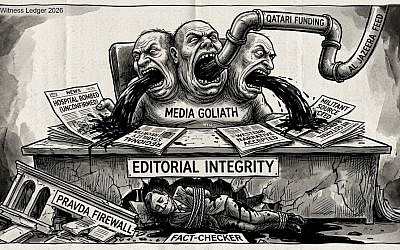
What a forensic review of contemporary media timelines reveals is that Qatar’s state-funded broadcast arm, Al Jazeera, has pulled off what Soviet propagandists never could: total, frictionless integration into the daily breaking news feed of the Western press.
The network was founded in 1996 by an emir’s decree, built on millions in direct seed money and continuing financial subsidies from the Qatari ruling family to cover massive operating shortfalls. Though the network maintains it is editorially independent, administrative links tell a different story: key leadership figures and board members are appointed by or closely tied to the Qatari state apparatus.
Academic analyses, media research, and even leaked US diplomatic cables have long characterized the network as a calculated diplomatic tool—a soft-power instrument used by Doha to project regional influence and shield its own interests. Broadcast studies show a clear pattern: Al Jazeera’s regional reporting on foreign policy and neighboring Gulf states tightly correlates with Qatar’s shifting geopolitical alliances and diplomatic conflicts.
While its English-language division was carefully stocked with veteran Western correspondents to build a veneer of institutional credibility, its investigative lens maintains a strict double standard: zero scrutiny of Qatari royal finances, domestic labor conditions, or state governance, paired with relentless, heavily anti-Western coverage directed outward.
The line between state-sponsored journalism and active military operations became even more blurred in the wake of the October 7 massacres. Recovered documents, captured digital records, and official intelligence files in Gaza revealed that individuals on Al Jazeera’s payroll were actively operating as members of regional militant factions—holding network press credentials while embedded alongside attack units on the front lines.
The catastrophic consequences of this arrangement exploded into public view on the night of October 17, 2023.
Following a massive explosion near Gaza’s Al-Ahli Hospital, Al Jazeera immediately broadcast claims that an Israeli airstrike had leveled the facility, reporting hundreds of fatalities. Within minutes, major American and European news organizations picked up the Qatari feed, blasting the claims across the globe as established headline fact.
It was a complete fabrication. Subsequent visual forensics, ballistics data, and independent intelligence assessments from multiple Western nations confirmed the hospital building was not leveled at all. The blast was caused by an errant rocket launched from inside Gaza by Palestinian Islamic Jihad that landed in the hospital’s parking lot.
Yet when legacy newsrooms were forced to issue corrections hours later, the institutional response was not discipline or overhaul, but quiet deflection.
This brings us back to the age-old tradecraft of journalism—the basic, unglamorous mechanics that used to define the profession. It meant picking up the phone to cross-examine a source before putting a statement on the air. It meant an uncompromising insistence on direct quotes rather than paraphrasing state agencies, identifying who holds the camera, and requiring two independent, non-affiliated sources before running a breaking headline. Most importantly, it meant an unyielding understanding of consequences: if a story could not meet these ironclad journalistic guidelines, it was canned—pulled off the wire, held at the desk, and killed on the spot, no matter how explosive the claim or how loud the competitor.
And the result of abandoning that tradecraft? Well… we are seeing it on the streets every day, everywhere.
When unvetted claims are broadcast as instant truth, they don’t just stay on the screen; they ignite real-world fury. Embassies are stormed, city intersections are shut down, international summits are canceled, and diplomatic channels break down—all before the facts have even had a chance to catch up.
When assignment desks trade basic verification for rapid syndication, the nature of what reaches your television screen changes. What the public receives in these moments is not necessarily “fake news” fabricated out of thin air by bad actors. But when it flows directly from a sovereign state treasury through an unvetted pipeline, it is also most certainly not “factual news.”
–
For similar pieces like these go to https://steventeplitsky.substack.com/