
The Arithmetic Against the Apartheid Charge
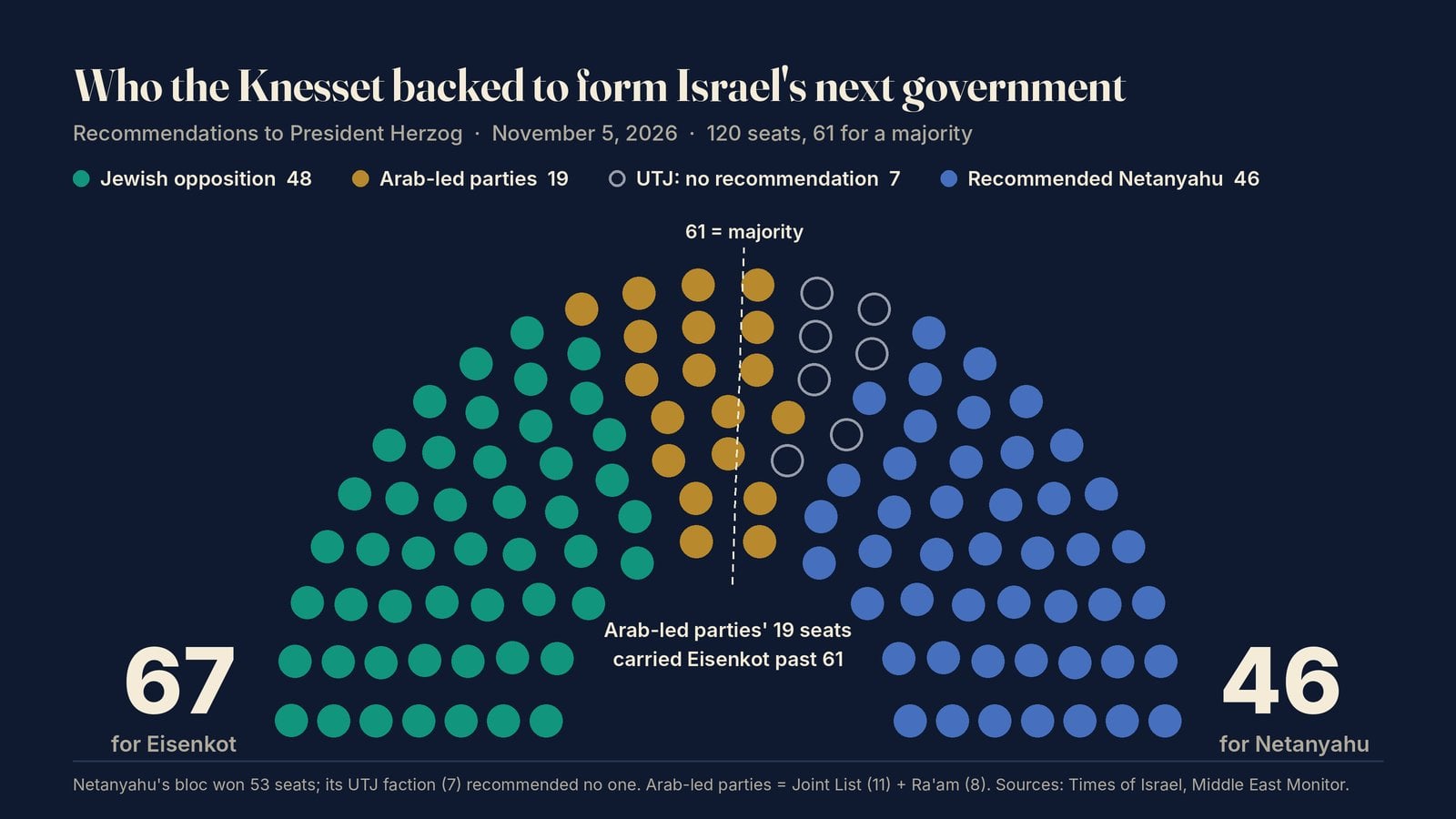
Israel’s Arab-led parties won a record 19 of the Knesset’s 120 seats on 27 October. On Thursday they recommended Gadi Eisenkot to President Herzog, which brought his total to 67 recommendations against 46 for Benjamin Netanyahu. A minority said to live under racial domination has just supplied the margin in the choice of who gets the first attempt at forming the next government.
The charge of apartheid depends on an analogy, and the analogy fails its first test. Between 1948 and 1994, Black South Africans, roughly four-fifths of the population, had no vote for the parliament that ruled them and no seat in it. Israel’s Arab citizens, about a fifth of the population, vote in the same elections and sit in the same chamber. One of them, Salim Joubran, served on the Supreme Court for fourteen years. In 2021 Mansour Abbas took his Ra’am party into the Bennett-Lapid coalition. Apartheid was a legal order built to keep a majority out of power. A minority that helps choose the prime minister is not living in one.
Serious critics, however, do not rest the charge on the Knesset franchise. Amnesty International, Human Rights Watch and B’Tselem apply it to the whole territory under Israeli control, including the West Bank, where Palestinians live under military law and have no vote for the authority that governs them, while settlers nearby live under civil law. Thursday’s tally does not touch that argument. It answers one version of the charge, the version applied to Israel inside the Green Line, and that version is false. Whether the territories qualify is a separate dispute with separate evidence. Occupation is a different legal category, with a different history and a different exit (a negotiated border, not an integrated franchise), and a reader who wants to defend Israel on that ground has to make the case on that ground.
The evidence also has limits on the Arab side. The Joint List described its decision as a choice between “bad and even worse.” That is how minorities vote in working democracies, instrumentally and without affection, and it is a sign of political agency, not of a system that has shut them out. But a recommendation to the president is not a seat at the cabinet table. Only once, in 2021, has an Arab-led party sat in an Israeli coalition government, and that arrangement lasted a year. Whether Arab parties would be partners in an Eisenkot government, or merely the votes that put him in a position to try, is a question.
President Herzog is expected to assign the mandate on Sunday. Eisenkot will then need 61 votes in the Knesset to form a government, and the recommendations he collected on Thursday do not count as votes. Gadi Eisenkot will receive the mandate on 67 recommendations after telling voters that he would not form a government with Arab parties. During the campaign he ruled that out, citing a lack of shared values, including recognition of Israel as a Jewish and democratic state. The two facts meet when the Knesset is sworn in on 10 November.