
The Ark Holds Both Broken Tablets and Torn Shirts
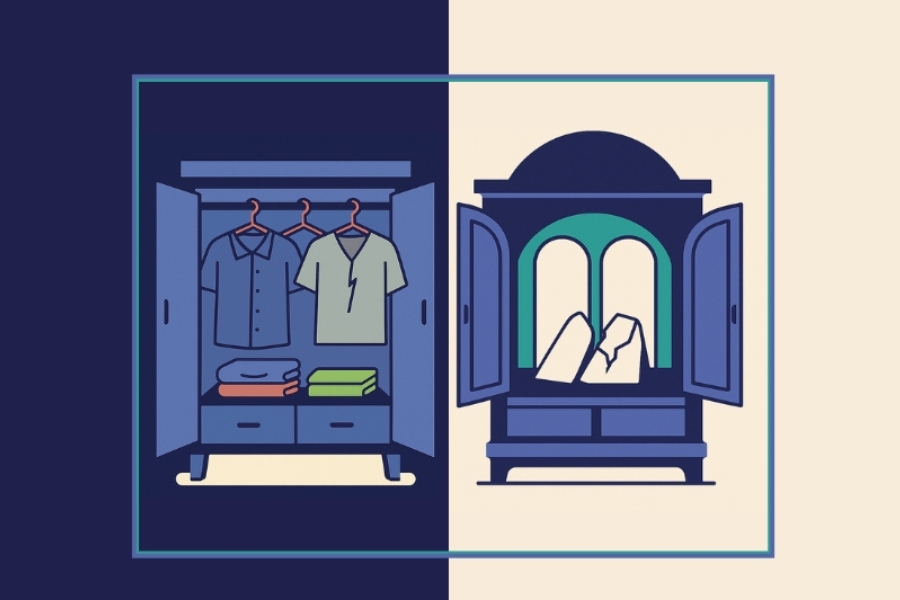
Parashat Eikev presents us with Moses’ memories from the forty years in the wilderness, among them a particularly significant moment, the breaking of the Tablets. “And I took hold of the two tablets and cast them out of my two hands, and broke them before your eyes (Devarim 9:17).” This dramatic act was not erased from our national memory, as our Sages expound, “The Tablets and the broken fragments of the Tablets were placed in the Ark (Bava Batra 14b, Berakhot 8b, Menahot 99a).” That is to say, the whole and the broken dwell together in the Holy of Holies.
The breaking of the Tablets expresses a moment of eruption. Moses, upon seeing the sin of the Golden Calf, senses the immense rupture that has formed between Israel and the Divine Presence and responds with a physical breaking that mirrors the spiritual sundering. And yet, immediately afterward, he prostrates himself and falls in prayer, “And I fell down before the Lord, as at the first, forty days and forty nights (Devarim 9:18).” Despite the fracture line in the relationship between Israel and the Divine Presence, he persists in repairing what can be repaired.
In our parsha we also find concern for the orphan and widow: “He executes justice for the orphan and widow, and loves the stranger, giving him food and clothing (Devarim 10:18).” Here too we can note a connection between breaking and tearing: the orphan and widow, who have experienced tremendous rupture in the face of loss of life, express their heartbreak through physical tearing at the moment of the soul’s departure, or upon hearing the bitter news, or, as is customary today, at the funeral. They tear their garments as an external expression of the internal fissure.
After the shiva is over, the question arises: what to do with the torn garment? Do we leave it as is or mend it? Should we leave a permanent testament to the rupture or restore it to its original state? Or perhaps discard it altogether? In our times, some choose to throw away the torn garment while others preserve it in the closet as a testament, a kind of contemporary parallel to the Tablets and broken Tablets. In the closet, the intact garments and the torn garment are hung side by side, a testimony that life continues alongside the rupture. And even those who discard the torn garment continue to bear upon the tablet of their heart both that which is whole and that which has been torn within them.
The concept of “the Tablets and broken Tablets placed in the Ark” can also be translated into the way we bear the pains of orphanhood, widowhood, and various losses. The fissures that open deep within us following distress and loss will always be borne, in the knowledge that the sorrow of the downcast heart is part of the fabric of our lives.
Parashat Eikev reminds us that just as Moses carried the Tablets twice, and retained the first set and their fragments even after the giving of the second ones – so too we learn to live with memory, with pain, and with love that does not cease. The living Torah is expressed also in the ability to bear gashes and to build, not upon the ruins of the past but alongside them, knowing that memory dwells at the very core of the Holy of Holies of the heart.