
Russian-American-Israeli Palestinian. Palestine is Israel.
The Asynchronous Mind
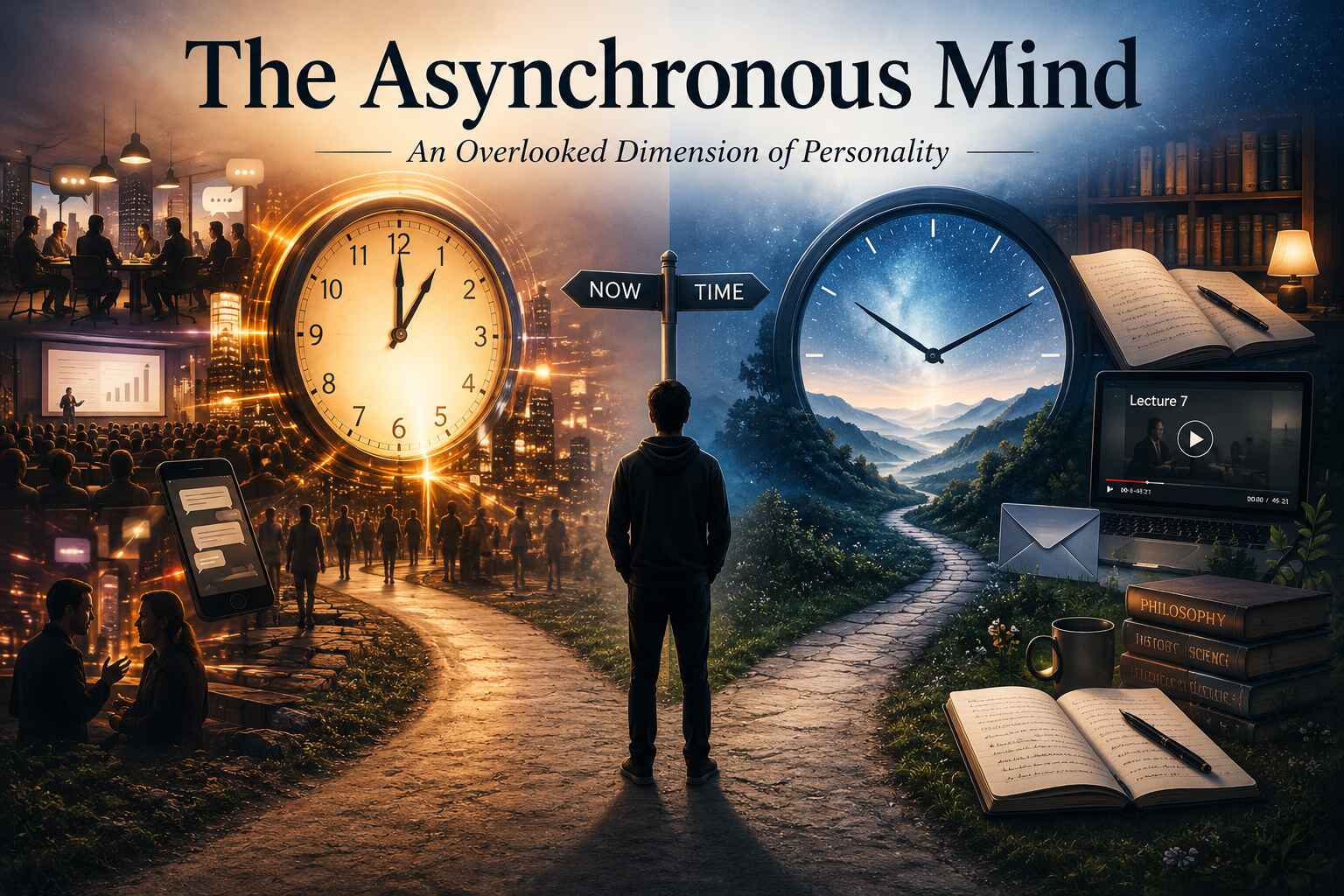
The Asynchronous Mind: An Overlooked Dimension of Personality. Image © Ivan Bassov, 2026. Licensed under CC BY 4.0.
An Overlooked Dimension of Personality
We often categorize people by familiar personality dimensions: introverts and extroverts, analytical and emotional, structured and spontaneous.
But there is another dimension that receives far less attention:
How does a person process the world—in real time, or through reflection over time?
Some people are naturally synchronous. They think by talking, learn through interaction, and experience transformation through shared moments. A conversation sparks an idea. A live lecture creates understanding. A group discussion reveals new perspectives.
Others are naturally asynchronous. They need time between receiving information and responding to it. Their deepest insights emerge after reflection, reading, writing, and internal dialogue.
Neither mode is inherently superior. They are simply different ways of engaging with reality.
I call this dimension synchronous versus asynchronous orientation.
The Synchronous and the Asynchronous Mind
A synchronous-oriented person often thrives in environments where people are present together:
- live discussions,
- meetings,
- classrooms,
- conferences,
- concerts,
- real-time collaboration.
For such people, the energy of the moment itself is part of the experience. The interaction is not merely a delivery mechanism for information; it is where meaning is created.
An asynchronous-oriented person experiences something different. The time between receiving and responding is not an obstacle — it is a feature.
The asynchronous mind needs space.
It prefers:
- reading over listening,
- writing over speaking,
- recorded lectures over live lectures,
- email over phone calls,
- thoughtful responses over immediate reactions.
The asynchronous person does not necessarily avoid people or ideas. Quite the opposite. They often engage deeply — but through a different rhythm.
Why I Borrow These Terms from Computer Science
The terms synchronous and asynchronous are well established in computer science.
In a synchronous system, one operation waits for another. Progress happens step by step through immediate coordination.
An asynchronous system works differently. Independent tasks continue processing without blocking one another. They synchronize only when necessary. This makes asynchronous systems more scalable, more resilient to delays, and often more efficient—but also more demanding to design.
Neither approach is inherently better.
Software engineers choose between them based on the problem.
A banking transaction requires strict synchronization to preserve consistency.
Search engines indexing the web depend on asynchronous crawlers that continuously process pages without waiting for users.
The important point is this:
Synchronization has a cost.
In computing, synchronization introduces waiting, locking, contention, and bottlenecks.
Human communication has similar costs.
Every meeting requires multiple people to stop what they are doing and synchronize their schedules.
Every phone call interrupts two streams of thought simultaneously.
Every live lecture requires hundreds of students to absorb information at exactly the same pace.
Asynchronous systems minimize synchronization points.
Perhaps asynchronous minds instinctively try to do the same.
My Own Asynchronous Journey
I recognized this pattern in myself long before I had a name for it.
Throughout my life, I have repeatedly chosen asynchronous environments whenever possible.
In university, even while attending a traditional brick-and-mortar institution, I often preferred skipping lectures and studying from meticulous notes taken by other students. The information was the same, but the processing method was different. I could stop, reread, analyze, connect ideas, and build my own understanding.
More than once, I ended up explaining the material to the very students who had attended the lectures and taken those notes.
The live lecture was optimized for the person who absorbs information in the moment.
The notes were optimized for the person who transforms information through reflection.
In professional life, I have noticed the same pattern. I prefer written communication over spontaneous conversations. I prefer documentation over verbal explanations. I prefer having time to analyze a problem before presenting a solution.
Writing is not merely a way to communicate my thoughts.
Writing is how I discover my thoughts.
For some people, thinking happens through speaking. For others, speaking happens after thinking.
Beyond Introversion and Extroversion
At first glance this may sound similar to introversion and extroversion.
I do not think it is.
Introversion asks:
Where do you gain or lose energy?
Synchronous versus asynchronous orientation asks a different question:
Under what conditions does your mind do its best work?
An introvert may still enjoy deep synchronous conversations.
An extrovert may write books, blogs, or newsletters because writing allows ideas to mature.
These are different dimensions.
One describes social energy.
The other describes cognitive rhythm.
Society Inherited a Synchronous Bias
For most of human history, synchronous communication was not a preference.
It was a necessity.
Almost every important exchange required people to be physically present at the same time.
As a legacy of that history, modern society often assumes that synchronous interaction is still the default—and sometimes the superior—form of communication.
We schedule meetings. We attend live lectures. We gather at conferences. We watch concerts in real time. We expect immediate answers to messages.
The hidden assumption is:
If something is happening now, it must be more authentic.
But this is a cultural preference, not an objective truth.
Human civilization was transformed by asynchronous technologies.
Writing was humanity’s first great asynchronous revolution.
A person could record an idea, and another person could encounter it centuries later. The author and the reader no longer needed to share the same time or place.
Books, manuscripts, letters, and archives allowed humanity to build a collective memory.
History’s greatest thinkers did not always transform the world through live conversations. Many transformed it through texts that traveled across generations.
Asynchronous communication is not a modern compromise.
It is one of the foundations of civilization.
The Digital World Recreated the Synchronous Bias
Ironically, the internet — perhaps the greatest asynchronous technology ever created — has also recreated many pressures toward synchronous behavior.
Communication platforms increasingly emphasize presence:
“Available.”
“Away.”
“Last seen.”
“Busy.”
“Inactive.”
“Presenting.”
Many tools designed for communication quietly create expectations of immediate responsiveness.
In some workplaces, these signals are even monitored. A person can be physically focused on deep work while appearing “inactive” because they are not constantly participating in visible synchronous activity.
But knowledge work often requires the opposite.
Creativity requires uninterrupted time.
Research requires concentration.
Innovation requires mental space.
The person who spends hours thinking deeply may appear less active than the person attending meetings all day — even though the first person may be producing far more value.
The Bias in Education and Work
Education often favors synchronous minds.
A traditional classroom assumes that the best way to learn is for everyone to gather at the same time, listen to the same explanation, and progress at the same speed.
But students differ.
Some need dialogue and immediate questions.
Others need silence and repetition.
Assessment often reflects the same assumption.
Timed examinations reward the ability to retrieve knowledge under immediate pressure. Oral examinations reward spontaneous thinking and real-time articulation. These are valuable abilities, but they are not the only forms of intelligence. Some students do their best thinking when given time to research, reflect, revise, and refine their ideas.
The same applies to workplaces.
Meetings are valuable when interaction itself creates value.
But meetings become harmful when they replace thinking.
Job interviews also tend to favor synchronous performance. They reward people who think quickly, speak confidently, and establish rapport in a limited amount of time. Yet many professions—especially those centered on research, writing, engineering, design, or analysis—depend far more on the quality of sustained thought than on the quality of immediate conversation.
A culture dominated by synchronous communication can unintentionally disadvantage people whose strongest contributions emerge through reflection.
Recognizing this does not mean abandoning interviews or examinations. It means acknowledging that they measure one mode of human capability. In some contexts, a portfolio, a writing sample, a take-home assignment, or a work trial may reveal strengths that a timed exam or a one-hour interview cannot.
Different Professions, Different Rhythms
Not all professions demand the same rhythm of thought and interaction.
Some are inherently synchronous.
A surgeon must coordinate continuously with anesthesiologists, nurses, and the operating room team. A split-second misunderstanding can have life-or-death consequences.
An orchestra exists only because dozens of musicians synchronize their performance with one another and with the conductor.
Air traffic controllers, emergency responders, courtroom litigators, television broadcasters, and sports referees all work in environments where immediate communication and rapid feedback are essential.
Other professions naturally allow much greater asynchrony.
A writer may spend weeks refining a single chapter.
A historian may study documents written centuries ago.
A researcher may spend months pursuing an idea before discussing it publicly.
A software engineer working on a distributed team can often make substantial progress independently, communicating through documentation, code reviews, and shared repositories rather than constant meetings.
Of course, no profession is purely synchronous or purely asynchronous. Every surgeon studies independently. Every writer occasionally collaborates with editors. Every software engineer attends meetings.
The difference lies in the dominant rhythm.
This raises an intriguing possibility.
Perhaps people are drawn not only to particular professions, but also to the temporal rhythm those professions demand.
Someone who thrives on immediate interaction may naturally gravitate toward work built around real-time coordination and shared presence.
Someone who thrives on reflection and independent thought may feel more at home in professions that leave room for uninterrupted concentration and delayed response.
Career satisfaction, then, may depend not only on what we do, but also on how time is structured in our work.
If this hypothesis is correct, understanding our synchronous or asynchronous orientation may help explain why some people flourish in environments that others find exhausting—even when they are equally capable of performing the work itself.
The Two Modes Need Each Other
This is not an argument against synchronous communication.
Human beings need connection. We need conversations, relationships, collaboration, and shared experiences.
A world without synchronous interaction would be impoverished.
But a world without asynchronous space would also be impoverished.
The danger is not using one mode.
The danger is assuming that one mode is universal.
The healthiest environments recognize both.
A great conversation may create the initial spark.
A period of reflection may turn that spark into an insight.
A live discussion may reveal a problem.
A written analysis may solve it.
Human creativity often emerges from the dialogue between the synchronous and the asynchronous.
A New Question
Perhaps we have overlooked an important dimension of personality.
Not simply:
Are you introverted or extroverted?
But:
How much synchronization does your mind naturally require?
Some people flourish through immediate interaction.
Others flourish through thoughtful delay.
Most of us lie somewhere between those poles, depending on the context.
Recognizing that difference may help us design better schools, healthier workplaces, more effective communication tools, and more compassionate expectations of one another.
In an age of constant connection, perhaps the greatest gift we can sometimes offer is not another meeting, another notification, or another demand for immediate response.
Perhaps the greatest gift is time.
Time to think.
Time to reflect.
Time to transform information into understanding, and understanding into wisdom.
The asynchronous mind is not disconnected from the world. It simply connects through a different rhythm.
Related Topics