


Middle East Forum Fellow/North Africa Risk Consultant
The Axis of Autocratic Chaos: How Algeria and Tunisia are Dismantling Sovereignty
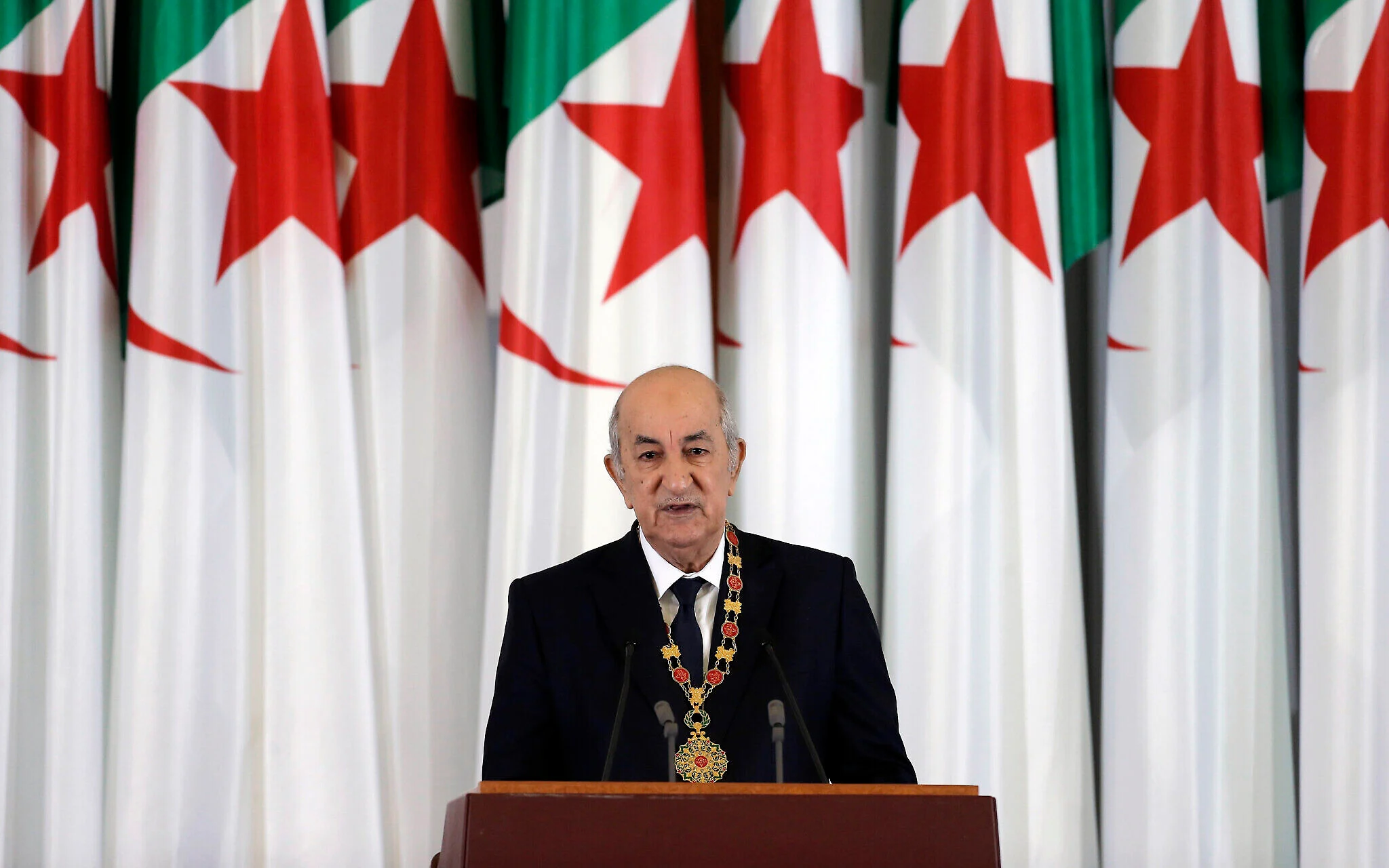
v]File: Algerian President Abdelmadjid Tebboune delivers a speech during an inauguration ceremony in the presidential palace, in Algiers, Algeria, on December 19, 2019. (AP Photo/Toufik Doudou)
The political landscape of North Africa is currently defined by a dark and virulent evolution of authoritarianism. What was once a region characterized by the distinct, often competing interests of a military-dominated Algeria and a fledgling democratic Tunisia has transformed into something far more dangerous: a transnational alliance of convenience. This partnership between the military-bureaucratic complex in Algiers and the populist autocracy of President Kais Saied in Tunis represents a coordinated assault on the very idea of political dissent. It is an unholy alliance built on a foundation of mutual insecurity, energy extortion, and the shared goal of turning the Maghreb into a unified space of political exclusion.
The centerpiece of this new era of repression is the systematic elimination of anyone who challenges the status quo, regardless of borders or international obligations. This is no longer just about domestic control; it is about the subordination of the Tunisian state to serve the regional interests of the Algerian regime. In this new order, sovereignty is a hollow concept, and the principles of asylum and human rights are treated as little more than currency to be traded in a clearinghouse of transnational repression.
A Pact Written in Treachery
The most striking evidence of this collusion is the recent betrayal of a prominent Tunisian revolutionary figure and former parliamentarian who had sought refuge in Algeria. For decades, the Algerian state has marketed itself as a champion of revolutionary legacies and a sanctuary for the oppressed. That myth was permanently shattered by the cold-blooded handover of a leader who had been formally seeking international protection.
The mechanics of this handover reveal a level of state-sponsored deception more commonly associated with criminal syndicates than sovereign governments. While the individual was held in administrative detention in Algeria, he was led to believe that his status as a political refugee was being finalized. He was told he was being transported to the capital for a scheduled appointment with international protection agencies. Instead, he was driven to the border and delivered directly into the hands of the Tunisian security services.
This was not a routine legal procedure; it was an act of high-level treachery. By bypassing all formal extradition protocols and ignoring the individual’s protected status, Algeria signaled that bilateral political convenience now supersedes every international treaty it has signed. It was a clear message: there is no longer a safe haven in the Maghreb for those who fight for freedom. This asymmetrical cooperation shows that Algiers is willing to act as a regional enforcer, protecting the Saied administration in exchange for total strategic alignment.
The Institutionalization of Permanent Emergency
While Algeria provides the brute force and the geopolitical muscle, President Kais Saied has provided the legal architecture for this new authoritarianism. Tunisia has recently moved into a phase of permanent emergency, with the presidency announcing an extension of these exceptional powers for an extra year, stretching through the end of December. By extending these powers indefinitely, the regime has effectively replaced the rule of law with rule by whim. This state of emergency is no longer a tool for national security; it is the primary instrument for maintaining an absolute grip on power.
Under this legal enclosure, the Tunisian executive branch now wields powers that bypass standard judicial oversight. The regime can conduct home arrests without a warrant, ban any assembly it deems a threat to order, and censor the media without judicial authorization. This is not about stability; it is about the autocratic chaos that arises when all institutional checks and balances are dismantled. By governing through decree and suppressing every form of independent mobilization, the regime is ensuring that any potential for a democratic alternative is smothered before it can take root.
This environment of permanent crisis allows the state to justify its failures by pointing to hidden enemies and foreign interference. It is a cynical ploy to deflect from the catastrophic social and economic conditions that now define life in Tunisia. The rhetoric of national sovereignty is used as a shield to protect a system that is, in reality, increasingly subordinate to its more powerful neighbor to the west.
The Judicial Purge
The legal architecture of the permanent emergency has enabled a massive judicial offensive designed to decapitate the Tunisian political and intellectual class. The so-called conspiracy against state security case is the most egregious example of this trend. It is a mass trial where the defendants—ranging from secularists to religious leaders, from journalists to human rights lawyers—have no direct connection to one another except for their shared opposition to one-man rule.
The sentences handed down in these trials are staggering in their severity. Prominent figures who have spent decades fighting for civil society have been sentenced to prison terms of thirty, forty, or even sixty years. These are not judicial verdicts; they are political death sentences. The message is clear: the regime will not tolerate a moderate opposition, nor will it allow for a unified democratic front to emerge.
Even the legal profession itself has been targeted. Lawyers who dare to defend those accused of state security crimes find themselves thrown into the same prisons as their clients, often facing the same trumped-up charges of terrorism. This systematic attack on the right to a defense creates a climate of absolute intimidation, hollowing out the rule of law and turning the courts into mere theaters for the executive’s grievances.
Algeria as the Puppet Master
At the heart of this regional rot is the Algerian regime, which remains a primary obstacle to a secure and stable North Africa. The military establishment in Algiers maintains a domestic fiction of stability, yet its actions reveal a deep-seated fear of its own people. This fear is reflected in a staggering military budget that vastly exceeds the country’s combined spending on health and education. This is a regime that prioritizes a costly arms race and regional hostility over the national viability of its citizens.
Algeria’s relationship with Tunisia has evolved into one of total dependency. Tunisia now relies on Algeria for the vast majority of its natural gas and essential energy supplies. This leverage is used by Algiers as a leash to keep the Saied administration in a state of submission. In exchange for the energy and financial support necessary for its survival, the Tunisian regime has allowed Algerian security services to operate freely on its soil, essentially subcontracting its own statehood.
This alliance seeks to eliminate any regional model of successful democratic transition. Algiers fears that a free and prosperous Tunisia would inspire its own oil-dependent population to challenge the military’s grip on power. Therefore, it is in the interest of the Algerian generals to ensure that Tunisia remains a brittle, authoritarian echo of their own system.
The Failure of Autocratic Stability
The autocratic stability promised by Algiers and Tunis is a dangerous illusion. A country where dissent is criminalized, where institutions are destroyed, and where the rule of law is a memory is not a stable partner; it is a ticking time bomb. This model of rule produces a volatile environment that exports instability, extremism, and migration.
By criminalizing civil society and labeling human rights defenders as mercenaries, these regimes are destroying the only buffers that can prevent a total societal collapse. The Maghreb is being transformed into a powder keg, where the absence of political checks and balances ensures that any eventual crisis will be catastrophic. The international community cannot remain silent while these states trade away the safety of individuals for the sake of political convenience. The pact between these regimes is not a solution to the region’s problems; it is the ultimate cause of its decline. Only by rejecting this axis of repression can true security and sovereignty be reclaimed.