


The Balfour Declaration and Bad History
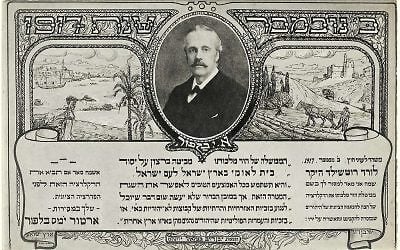
Three sentences issued by Britain’s foreign secretary, Arthur Balfour, to Lord Rothschild, a prominent British Zionist, on November 2 1917, have been taken as a starting point for anti-Zionists who see in Israel’s existence little more than a delegitimate colonial state created by, or at least manufactured in, imperial London.
In Balfour’s concise letter to Rothschild, he communicated the British government’s support for a Jewish “national home” in Palestine, so long as the “civil and religious rights of existing non-Jewish communities” were in no way prejudiced.
The hundred-and-ninth anniversary of Balfour’s ‘Declaration’ today, combined with the recent war between Israel and Hamas in the Gaza Strip and the uncertain prospects for Palestinian statehood, has and continues to shine a new spotlight on the declaration.
Pro-Palestinian activists, both on the streets and in the press, have drawn a direct line between 1917 and the nakba, or ‘catastrophe’, in 1948, when Palestinian Arabs came out on the wrong end of a civil war that led to Israel’s creation and then a regional conflict that displaced over 700,000 people.
Over the past few years, countless pro-Palestinian activist groups have located in that November 1917 letter the original sin of Israel’s existence and the modern-day plight of Palestinian Arabs. Many of those groups did so less than a month after Hamas’s attack on Israel on October 7 2023, and no more than one week after Israel’s invasion of Gaza. Toronto 4 Palestine, a pro-Palestinian activist group in Canada, urged its Instagram followers on November 2 2023 to “dive into these significant events” and to educate themselves on how “Britain promised Palestine as a Jewish homeland without the Palestinians’ consent” and “pav[ed] the way for the catastrophic Nakba.” Pro-Palestinian activists defaced the Foreign and Commonwealth Office in London in early November 2023, spray painting in bright red across the building’s beige stone, ‘Fuck Balfour’ and ‘Britain Guilty’ (https://morningstaronline.co.uk/article/palestine-activists-spray-foreign-office-britain-guilty-anniversary-balfour-declaration). Palestine Action, a global pro-Palestinian network with branches in the UK and the United States, issued a statement that the Balfour Declaration had “signed away the land of Palestine to the Zionist colonial project”. The Washington Post’s Global Opinions editor on November 3 2023 labeled the conflict between Israel and Palestine as a “fundamentally British colonial project”, no different than the evils perpetrated by British colonialism in Africa over the long nineteenth century and into the twentieth (https://www.washingtonpost.com/opinions/2023/11/03/colonial-history-britain-israel/).
More recently, the message has stayed the same by those interested in an uncomplicated framing of the Balfour Declaration. In the UK, a petition with over three thousand signatures calls on the British government to issue a “formal apology” for the Balfour Declaration, “and to commit to funding educational initiatives that acknowledge this history” and Britain’s culpability in displacing Palestinians (https://petition.parliament.uk/petitions/766037#progress). In the Qatari-funded Middle East Monitor, one can read of how “if Britain is truly serious about breaking from its colonial post, it cannot continue to selectively enforce the Balfour Declaration” by ignoring the rights and “moral and legal obligation” to protect and support Palestine’s indigenous peoples (https://www.middleeastmonitor.com/20261008-the-shadow-of-balfour-confronting-a-century-of-selective-memory/). The head of the Refugee Affairs Department of the Palestine Liberation Organization, Ahmed Abu Houli, yesterday (November 1) called the Balfour Declaration “a historic colonial crime against the Palestinian people” (https://www.yaffaps.com/en/page-139598.html).
To draw an unbroken and uncomplicated line from 1917 to 1948, from Balfour to Ben Gurion, is, simply put, ignores how much had to happen in the over thirty years between Balfour’s vague assurance to Rothschild and the establishment of Israel. It also disregards how often Britain’s official and unofficial position on Palestinian Arab and Jewish statehood changed over those thirty odd years.
To start, no matter what Balfour had promised Rothschild in November 1917, the British Empire had yet to wrest full control of Palestine from the Ottoman Empire, with its army stuck still outside of Jerusalem after capturing Beersheba and Gaza at the start of the month. In short, Britain promised something that, at the time, it couldn’t actually deliver. Once Palestine had been established as a League of Nations Mandate under Britain, its first High Commissioner, Herbert Samuel, set out to establish a legislative council in 1922 made up of twelve elected ‘Palestinians’ comprising eight Muslim Arabs, two Christian Arabs, and two Jews; Samuel’s ultimately failed attempt to put together the Arab-majority council was hardly a step towards Zionist Jewish domination in service of Britain’s colonial designs. The 1937 Peel Commission, an over four-hundred-page report put together by and after Lord Peel’s visit to Palestine to investigate the causes of the 1936 Arab Revolt, and endorsed by the British government, argued in favour of a two-state solution that put into the hands of Palestinian Arabs roughly seventy percent of Palestine, with twenty percent earmarked for a Jewish state and cities such as Jerusalem and Bethlehem under international administration to stave off religious competition for their control. In 1939, after three years of Palestinian Arab revolt, with a new global conflict in Europe on the horizon and anti-Semitic policies in Nazi Germany well known, the British government embraced a new policy—statehood for Palestine by 1949, a yearly restriction on Jewish immigration to Palestine, and Palestinian Arab control over future Jewish immigration.
The 1939 ‘white paper’—an articulation of official British government policy—guaranteed that the demographic makeup of an independent Palestine would be an Arab majority by Palestine’s independence in 1949, a move that Israeli historian Benny Morris has called a “complete reversal both of the Balfour Declaration policy” and “the Peel Commission recommendations” (1948: The First Arab-Israel War). Zionist Jewish terrorists waged an unrestrained guerrilla war against British authorities in Palestine from 1943-47, culminating, in some ways, in the bombing of the King David Hotel in Jerusalem in July 1946. As British Holocaust survivors and European Jewish refugees set sail for Palestine after the Second World War, British authorities, according to American historian Eugene Rogan, “made every effort to bar entry to these refugees”(The Arabs: A History), in line with the 1939 shift in British policy.
Indeed, Britain effectively abandoned its ‘colonial project’ when, in February 1947, the British Foreign Secretary Ernest Bevin put the Palestine problem to the newly created United Nations, which decided on the partition of Palestine later that year in November. In 1948, MI6 and the British High Command in Egypt actively conspired against the new Israeli state, funnelling arms, ammunition, and funding into Israel’s regional rivals, and especially into Egypt (https://www.tandfonline.com/doi/full/10.1080/02684527.2019.1616389).
In promoting a simplified, almost conspiratorial version of the Israeli-Palestinian conflict, one that sees in Balfour’s three sentences to Rothschild in 1917 the seeds of a clandestine British ‘colonial project’ hellbent on Israel’s creation and Palestine’s destruction, pro-Palestinian activists in the west have unintentionally made odd bedfellows. Their version of the history of the Israeli-Palestinian and Israeli-Arab conflicts parrots the talking points coming out of Iran, like Press TV, which has written that ‘Israel’s 2023 genocide has roots in 1917 Balfour Declaration’ (https://www.presstv.co.uk/Detail/2023/11/02/713903/Explainer–Israel’s-2023-Gaza-genocide-has-roots-in-1917-Balfour-Declaration%C2%A0), of Qatar-funded media from the Middle East Monitor to the Middle East Eye (https://www.middleeasteye.net/opinion/why-britain-being-forced-revisit-balfour-declaration), and Hamas itself, which has spoken of the Balfour Declaration as Britain’s “historical, political and moral crime” against the Palestinian people (https://www.aljazeera.com/news/2021/11/2/palestinians-mark-104-years-since-balfour-declaration).
The October 7, 2023 attacks carried out by Hamas, the subsequent war in Gaza and the deaths of tens of thousands of Palestinian civilians have for over three years provoked massive pro-Palestinian protests across the west, some if not many of which were explicitly anti-Zionist. In fact, the political winds on the progressive left blow far more in the direction of anti-Zionism than ever before, both in the United States amongst Democratic Socialists (https://blogs.timesofisrael.com/the-dsas-war-on-zionism/) and in the UK amongst the Green Party (https://greenparty.org.uk/2026/10/04/green-party-adopts-anti-zionist-policy/).
At a time when many in the west unfamiliar with the conflict have tried desperately to comprehend the origins of the violence, looking for an ‘Aha!’ moment in Balfour’s November 1917 words—one that buttresses a conviction in western colonialism as the root of all evils and injustices worldwide—is just bad history.