The views expressed herein are solely mine.
The Barzanis: West’s Last Stronghold
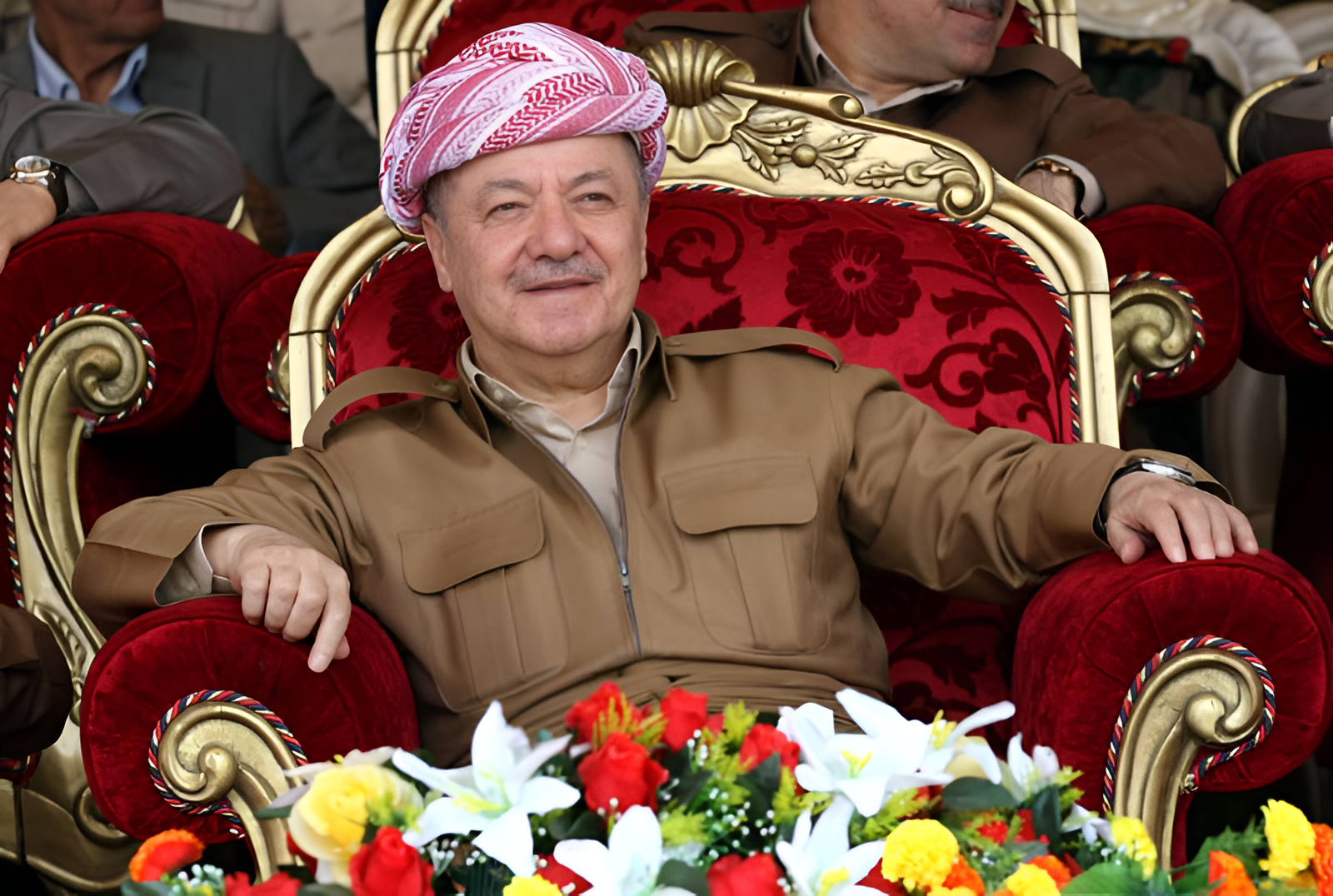
Masoud Barzani, leader of Iraq’s Kurdistan Democratic Party, attends a graduation ceremony of Peshmerga forces in the Iraqi-Kurdistan town of Soran, May 25, 2019. (AFP).
In a Middle East addicted to volatility, the Barzanis built something unfashionable: a sharp alignment with the West that actually delivers.
For decades, the Barzani-led leadership in Iraqi Kurdistan chose state-building over revolutionary theater. While militias pledged loyalty to Tehran and Arab capitals drifted between Moscow and Washington, Erbil anchored itself to a simple calculation: survival through strategic partnership with the United States and Europe.
Geography makes this unavoidable. Iraqi Kurdistan sits at the fault line between Turkey, Iran, Arab Iraq, and Syria. It is not peripheral; it is a hinge. Whoever influences Erbil inserts leverage into the northern arc of Iraq and friction into Iran’s westward corridor. Thus, a Western-aligned Kurdistan is not symbolic. It is structural resistance to Iranian depth from Tehran to the Mediterranean.
This strategic reliability was not rhetorical; it was tested in fire. When ISIS surged across northern Iraq in 2014 and Baghdad’s forces collapsed, it was the Barzani-led Kurdish Peshmerga who held the line. Western airpower did not operate in a vacuum; it depended on Kurdish ground forces that had already institutionalized intelligence cooperation and military coordination with Washington. In a region where alliances are often transactional and fleeting, reliability is rare. Under the Barzanis, it became doctrine.
And Tehran understands this. A militia-dominated Iraq extends Iranian power; a semi-autonomous, pro-American Kurdistan constrains it. That constraint is precisely where the strategic value lies. The Barzani model does not rely on anti-Iranian rhetoric. It does something far more consequential: it quietly prevents absorption into the axis.
Why? Because the Barzanis understand that if the Ayatollahs’ dictatorship falls, the path to independence could reopen—or accelerate. Iranian-funded militias would weaken, the regional axis would fracture, and what was politically impossible in 2017 could suddenly become strategically attainable.
Energy adds a second front. In a post-Ukraine scramble for supply diversification, Kurdistan’s hydrocarbons and its pipeline corridor to Turkey create strategic optionality. In power politics, optionality is leverage—and leverage is power. A stable, Western-aligned Erbil is not merely an economic actor; it is a geopolitical instrument.
Then there is the quiet realism toward Israel. While much of the region substitutes anti-Israel rhetoric for a coherent strategy, Kurdish leadership has chosen pragmatism over theatrics. That choice signals ideological moderation—and alignment with a state-based regional order, not the politics of endless “resistance.”
The uncomfortable truth is this: the Barzanis represent one of the few Muslim-majority political leaderships in the Middle East that consistently leaned West without hedging toward Beijing or surrendering to Tehran. That is not tribal nostalgia; it is geostrategic positioning.
If Washington weakens this pillar, it is not disciplining a family—it is weakening its own northern flank and inviting Iranian consolidation. The message would reverberate across the region: loyalty to the West is disposable.
In a Middle East undergoing structural reordering, the Barzanis are not a marginal actor—they are a strategic platform. And once such platforms are lost, they are not easily recovered.
Related Topics
Related Posts