


The Basel Prescription
On Zionism, DES, and the Discipline of Staying Together
Standing in Basel, it is difficult not to feel the weight of ideas.
In this elegant Swiss city, in 1897, Theodor Herzl convened the First Zionist Congress and imagined something extraordinary: that a scattered, argumentative, frequently rejected people might once again have a home.
Herzl later wrote in his diary, “In Basel I founded the Jewish State.”
He added that if he said this aloud at the time, he would be met with laughter, but that in fifty years, everyone would see it.
He was almost exactly right.
I visited Basel recently and found myself thinking not only about Zionism, but about belonging.
What does it mean to build a home for a people whose history has so often been defined by exclusion?
And what responsibilities arise when those who know what it is to be rejected begin, in turn, to reject one another?
The Jewish people have never been uniform.
We argue with one another in synagogues, around Shabbat tables, and across generations. The Talmud is, among many other things, a monumental record of disciplined disagreement.
We are Orthodox, Reform, Masorti, secular, Zionist, anti-Zionist, politically left and right, Ashkenazi, Sephardi, Mizrahi, gay, straight, certain, uncertain, observant, questioning.
And yet history has a brutal way of flattening nuance.
Those who hate Jews rarely pause to distinguish between denominations, politics, or lifestyles.
They see a Jew.
And that, in their eyes, is sufficient.
This does not mean our differences are unimportant.
Judaism has always honoured serious debate.
But there are moments when the urgency of collective survival requires us to remember what precedes all disagreement: that we are, first and foremost, one people.
Recent years have offered painful reminders of the cost of division. In Israel, internal disputes became so intense that many worried the social fabric itself was fraying. Reasonable people will continue to disagree about policies and politics, and history is always more complex than any single explanation. But one lesson is difficult to ignore: when a society becomes consumed by internal rupture, its vulnerabilities may become easier for others to exploit.
We saw similar tensions around hostage negotiations. Fierce disagreement persisted, but when the moment demanded action, extraordinary steps were ultimately taken because the imperative to bring fellow Jews home transcended political difference.
There comes a point at which the argument pauses and the obligation begins.
Standing in Basel, I found myself thinking about another attempt to improve the human condition.
Diethylstilbestrol, or DES, was prescribed to pregnant women for decades in the belief that it would prevent miscarriage and protect unborn life.
The intention was good. The science appeared persuasive. The intervention was offered in the name of care.
And yet the consequences were profound.
Many daughters, myself among them, have lived with the long-term effects of a drug given before we were born.
What was meant to preserve life altered it.
As a Jew, I increasingly find myself viewing DES through the lens of Pikuach Nefesh, the principle that preserving life takes precedence over almost every other commandment.
It is one of the noblest ideas in Jewish law.
But DES raises difficult questions.
What happens when an intervention undertaken in the name of preserving life causes harm?
How do we understand responsibility when good intentions and accepted expertise lead to consequences no one anticipated?
Halacha may not offer easy answers, but it dignifies the asking of such questions.
The story of DES has also shaped how I think about my own family.
My father was a gynaecologist. He understood the medical literature and, I suspect, grasped implications long before I was able to do so. Some of what appeared to others as strictness I now see as a form of vigilance and protection.
Inheritance is complicated.
Sometimes what we receive is biological.
Sometimes it is intellectual.
Sometimes it is a stubborn resilience that only later reveals itself as love.
The Torah is deeply concerned with home, though not always in the way we expect.
The Torah is deeply concerned with home, though not always in the way we expect.
In this week’s parsha, Bamidbar, the Israelites are counted and arranged around the Mishkan. Each tribe occupies its own place, under its own banner, with its own identity and responsibilities.
The lesson is striking.
Unity does not require uniformity.
The tribes are not asked to become identical. They are asked to orient themselves toward a shared centre.
Each counts.
Each belongs.
And each helps create the larger structure that allows the community to travel together.
Newcastle. London. Jerusalem. Basel.
Orthodox. Reform. Masorti. Secular.
Different locations. Different customs. Different vantage points.
But one people, gathered around a common story.
That idea came alive for me when I returned to Newcastle for the launch of my memoir, A Life Lived Chronically.
I visited the former Jesmond synagogue, now converted into flats. The original façade remains, and a plaque records what the building once was. Prayer has given way to private living space, but the memory has not been erased.
I also remembered a childhood visit from Immanuel Jakobovits to our cheder in 1979. I understood little of what was said, but I remember the feeling that our small northern Jewish community was connected to something much larger.
The book I returned to launch, though focused on medical harm and chronic illness, carries more of that world than I realised at the time of writing it.
Not in subject matter.
But in instinct.
In the conviction that difficult questions are worth asking, and that even a small community participates in a much larger story.
Herzl understood that the Jewish state was not meant to be a refuge for a single ideology or denomination.
It was conceived as a home for Jews.
All Jews.
That does not eliminate boundaries or remove the need for safeguarding. Communities require standards and structure.
But there is a profound difference between protecting a community and fragmenting a people.
At a time when antisemitism does not distinguish between Orthodox and Reform, religious and secular, gay and straight, politically left and right, we should be cautious about drawing lines more narrowly than history itself does.
The Jewish people did not survive because we agreed about everything.
We survived because, despite everything, we continued to show up.
We inherit a tradition of argument.
But more fundamentally, we inherit a tradition of showing up.
For Shabbat.
For mourning.
For celebration.
For one another.
Standing in Basel, where Herzl imagined a home for a people long denied one, I was struck by how many of my own concerns converged in that place.
Medicine and ethics.
Memory and inheritance.
Diaspora and Israel.
Belonging and exclusion.
The body and the nation.
Perhaps that is the enduring lesson.
Home is not measured by how effectively we exclude those who unsettle us.
It is measured by how responsibly and courageously we make room.
For complexity.
For disagreement.
For difficult histories.
For one another.
Because our enemies do not see our denominational labels, political preferences, or personal biographies.
They see Jews.
And in moments like these, that may be the most important thing for us to see as well.
Postscript: Looking for Herzl
One final image has stayed with me from Basel.
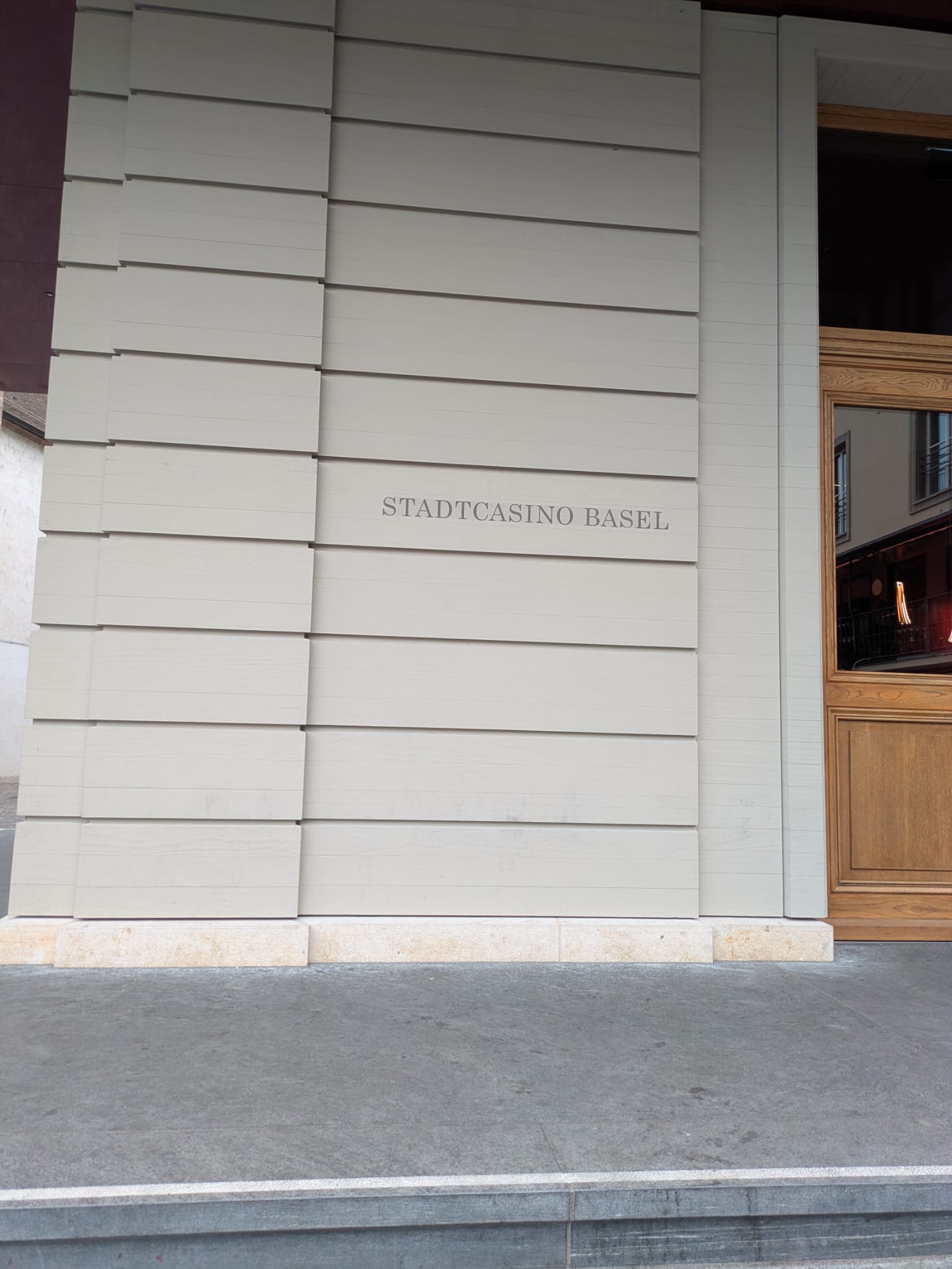
Armed with Google Maps and a sense of historical determination, I set off in search of the Stadtcasino Basel, where Herzl convened the First Zionist Congress in 1897.
I was looking for the plaque marking the site.
The building itself was closed, and from the outside the plaque was not visible. I circled the block more than once, peering at façades with the slightly distracted air of someone convinced that history must surely be just around the next corner.
In the end, we had lunch in a nearby building overlooking the very place I had been trying to find.
Half an hour later, I glanced out and saw another tourist doing exactly what I had just done: walking around the building, checking his phone, looking faintly bewildered and clearly searching for something he could not quite access.
He was unmistakably different from me in outward appearance, dressed in the distinctive clothing of a Charedi Jew.
And yet, in that moment, our differences seemed almost incidental.
We were engaged in precisely the same act.
Two Jews, from very different expressions of Judaism, circling the same building in search of the same point of origin.
Perhaps that is the perfect coda to Herzl’s vision.
We do not all dress the same.
We do not all pray the same.
We do not all agree.
But we are often looking for the same thing.
A place in the story.
A connection to our past.
A home large enough to hold us all.
Sometimes the plaque is hidden from view.
But the search itself reminds us that, despite our differences, we are still walking around the same building.