
The Battle for Public Opinion
On October 7, 2023, Hamas launched the most horrific, bloody, and barbaric attack on Israeli civilians, the worst attack in Israel’s history. This one infamous day left 1,200 dead, thousands injured, and 251 precious souls were taken hostage, where they were starved and tortured, and many were ultimately executed by their captors. October 7th marks the deadliest day for the Jewish people since the Holocaust. This attack began a war that has yet to cease, a war against a horrifying terror organization whose militants pledge the destruction of the Jewish state. What wasn’t clear on that cursed day or the days to follow was the invisible war that was launched against Israel: a war of narratives.
Today, three years after that tragic day, it is clear that while Israel has seen many victories since the war began, the war over international public opinion has been far from one of them. Alongside the 3,000 terrorists who stormed Israel’s borders on October 7th, a well-organized network of invisible warriors permeated a far more accessible battleground, the internet, and with it, the disinformation battle gained traction.
Even in the days immediately following October 7, as the country lay in shambles, people struggled to locate their loved ones, and the entire population was in mourning, the perception monster was already pumping away. The mission was clear: delegitimize Israel’s war against Hamas, manipulate the narrative, and shape how the world perceived the conflict. The effects were swift, with anti-Israel rallies beginning just days after October 7, even before Israel’s ground operation in Gaza.
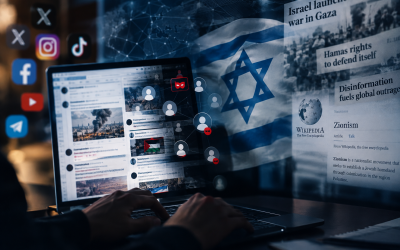
While a war was being waged against Israel on the ground, thousands of fake profiles turned to social media to poison public opinion, delegitimize its just war, and squelch international support. Cyabra, a social-media intelligence company, analyzed 2 million videos, posts, and pictures across leading social-media platforms relating to the Israel-Gaza discourse between October 7 and 9, 2023. Its analysis found that, among the 162,000 profiles examined, one in four was a fake account. Within the first two days of the attack, these accounts posted 312,000 pro-Hamas posts and comments. Some posted hundreds of times a day. This orchestrated attack exploited social-media algorithms and used strategic hashtags, resulting in 531 million views of its propaganda within just two days.
This propaganda-peddling network has not put on the brakes since. It has adapted to the different stages of the war while ensuring that the narrative remains the same. Beyond fake accounts, a coordinated effort to shape public opinion about the conflict is being carried out by a small group of keyboard warriors operating on another influential online battleground: Wikipedia.
A group of approximately 40 editors and numerous administrators have collectively altered thousands of entries, deleting and adding material that questions Israel’s right to exist. This media manipulation strikes at the very core of Israel advocacy, working to deliberately reinvent even the most fundamental terms, such as Zionism. Once defined on Wikipedia as support for a Jewish homeland in what is known in Jewish tradition as the Land of Israel, the entry on Zionism now references the establishment of a Jewish homeland through colonization in the region Palestine.
Right about now, most millennials probably remember the familiar warning repeated by teachers: “Wikipedia is not a credible source.” That warning might lead some to question the importance of changes to an online encyclopedia, but a lot has changed since then. Today, in an age where AI is a huge part of the content people consume, it is important to know that Wikipedia has been shown to be the most frequently cited source by ChatGPT and is also an important resource in the development of large language models (LLMs).
This is where the stakes become even higher. Information does not have to be encountered directly on Wikipedia to influence how people understand the world. When online sources shape the information people encounter through search engines and AI tools, the framing of that information matters. The deliberate manipulation of online sources can therefore become a powerful way to distort the historical record and undermine the pro-Israel narrative.
Dara Horn, one of the most prominent voices speaking about data poisoning in relation to antisemitism, has famously said, “There is more ignorance than malice.” It is clear that battles are no longer fought only by ground troops. The war over public opinion may also be decided by warriors we cannot even see, some real and many fake. We must continue to sound the alarm against the manipulation of the information we consume, because if this hate is left to fester, ignorance may turn to indifference, and indifference may give way to malice.