


Former journalist, now a grumpy old man
The BBC’s continued unique and partisan interpretation of impartiality
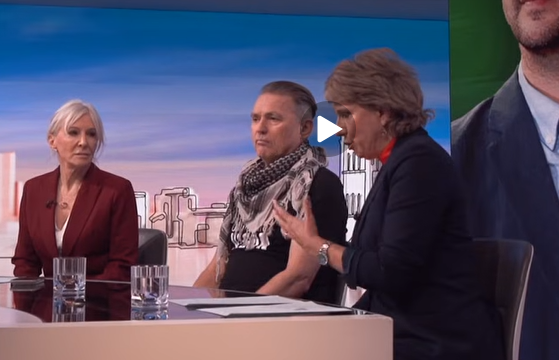
The partisan attitude of the BBC, the UK’s national broadcaster, is becoming a very bad joke. I recently complained about Dale Vince wearing an enormous keffiyeh during Sunday with Laura Kuenssberg on 25 October 2026. The BBC’s very poor response was that it “supported freedom of expression, and complied with its editorial guidelines”. Really?
Yet, only days earlier, the BBC had digitally removed the words “Protect The Dolls” from an actress’s T-shirt during Strictly Come Dancing. It has also removed Pride badges worn by contestants on University Challenge, explaining that overt slogans and symbols were inappropriate under its editorial guidelines.
So where is the consistency? A tablecloth-sized keffiyeh is hardly a small badge of support. I would have thought it was somewhat, to quote the BBC’s own guidelines, rather “overt” myself to say the least. Say what you will, but a British Caucasian activist wears it for one reason only nowadays, one that I will leave to you to come to your own conclusion about. Would the BBC take the same freedom-of-expression approach if a guest appeared wearing a Ku Klux Klan hood and robe? I doubt it. If limits exist on acceptable political symbolism, they should be applied consistently, not selectively.
Of course, the keffiyeh is traditionally a Middle Eastern garment, and wearing one does not automatically signify support for Hamas. But it could be said to be a very strange adornment of choice for a British Caucasian on national television. However, it has been appropriated as a highly politicised symbol, particularly in demonstrations where hostility towards Israel and Jews, and sometimes demonstrating support for Hamas and its stated objectives, are prominent. It is not equivalent to an annual Remembrance poppy or a small Ukrainian flag lapel badge. Its conspicuous use is an unmistakable political statement, and those wearing it know precisely the message they intend to convey. For most Jews, that message is not only deeply troubling, but very threatening.
A guest wearing such a conspicuous symbol on a flagship BBC current affairs programme is not making an incidental fashion choice. You do not attend a friend’s wedding in a dinner suit and keffiyeh. The BBC is publicly funded and expected to maintain the highest standards of impartiality. It should understand the significance and perception of the symbols it allows to occupy its broadcasting platform. But it now does not regarding the keffiyeh.
This does nothing to allay continuing allegations of institutional antisemitism or concerns about the corporation’s treatment of Israel, Jewish contributors and antisemitism. Once again, the Campaign Against Antisemitism has this week, beginning 2nd November 2026, been compelled yet again to call for an inquiry. Enough is enough.
The BBC cannot continually dismiss legitimate concerns as the unhappiness of a few viewers. The issue deserves serious, independent examination. Vince’s own highly partisan views on the Middle East, for which he has faced public criticism on multiple occasions, should surely have prompted greater editorial scrutiny before inviting him onto such a prominent programme. Next he’ll be wrapping it around his head accompanied by Ray-Bans.
When a broadcaster appears more concerned about a small slogan or badge than a highly conspicuous symbol associated with a deeply contentious political movement, it should not be surprised when viewers question its priorities.
The BBC needs to do considerably more to address the perception that its impartiality, and its sensitivity to antisemitism, are applied selectively.
And once again, Jeremy Bowen, the BBC’s veteran Middle East correspondent, no stranger to being regularly accused of holding “views not conducive to the UK’s Jewish Community,” was caught out yet again using the now familiar “genocide” trope while speaking to an audience at a theatre in Glasgow in October 2026. According to the UK’s weekly Jewish Chronicle newspaper, “an email seen by the JC appears to show BBC management accepting Bowen’s explanation without further investigation. In an edited clip that was uploaded online by a pro-Palestine group, Bowen seems to respond to a question from a member of the public over BBC coverage of Gaza when he says: “For me it is clear that what is happening is a genocide.” This is despite Bowen’s remarks yet again being condemned by critics as a breach of BBC editorial guidelines warning against expressing “personal opinions in public on controversial matters”.
At present, the BBC is failing quite spectacularly to follow its own Charter.