
The Beauty of Boundaries
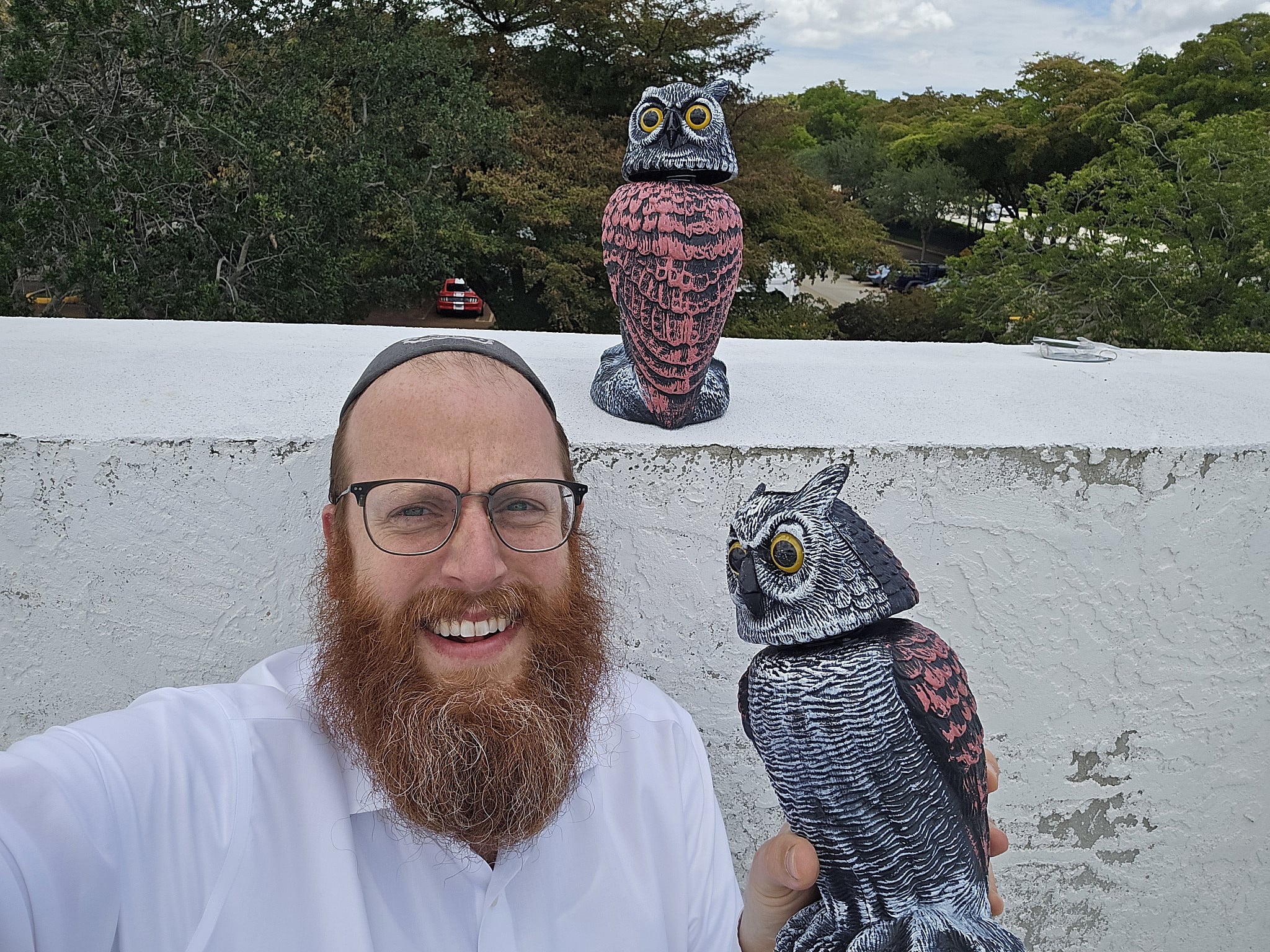
You may have seen the video of me on the roof putting fake owls on the top corners of our Chabad Center. Sitting in my office, I can hear the woodpeckers pecking holes into the styrofoam molding around the top of our building, and I was hoping the owls would scare them away.
I even got some great name suggestions for these new “pets.” From Oscar the Owl, Watch Owl on the Wall, Hootie, or Pesky, even my kids had some ideas.
However, our mascot never got a formal name, because sadly, these owls have not done their job. Not only did they fail to stop the birds, but since then, we have a brand-new hole in the other corner of the building.
If I can’t stop the birds, at least I can philosophize about them. Why are these birds bothering me so much?
The truth is, I like birds. They are beautiful and watching them fly so gracefully is mesmerizing.
The problem is that birds belong in the sky or singing on a branch somewhere high up in the trees. Where they do not belong is inside the decorative molding of our building, drilling little holes like they own the place.
It reminded me of something I have thought about before. I once noticed something scurrying across the fence of my backyard, moving through the bushes. For a moment I thought it might be a mouse. I tensed up, looking carefully, until I saw it again later and realized it was just a squirrel.
At first, I felt very relieved.
Then I began wondering, why was I relieved? What is the difference between a mouse and a squirrel if both are outside the house? Is there anything wrong with a mouse living in the bushes at the edge of my yard?
Here’s my thesis. People find squirrels cute because they know these squirrels will stay outside where they belong. We can happily watch a squirrel run along fences, climb trees, and jump from branch to branch because we know it will stay in its world, and we can stay in ours.
A mouse doesn’t do that. Mice invade our space. They find ways into the house, into the pantry, and chew through our things. Which is why people say squirrels are cute and mice are disgusting.
It is not about the animal. It’s about their ability to respect the boundary between us and them.
Which brings us to the holiest boundary in the world.
This week’s Torah reading describes the service of Yom Kippur, when the High Priest would enter the Kodesh HaKodashim, the Holy of Holies inside the Temple. This was the most sacred place on earth. It contained the Holy Ark, covered with gold, with magnificent cherubs carved out of solid gold on top. The walls were covered in gold, and the curtains were elaborate and exquisite.
And yet, almost no one ever saw it.
The average Jew never walked into the Holy of Holies. Most Jews lived their entire lives without ever seeing the inside of that room. Even the High Priest could only enter once a year, on Yom Kippur, and only after a very specific spiritual preparation.
Which raises a question. Why build such a magnificent room if no one is allowed to see it? Why create something so beautiful, so detailed, so expensive, and then hide it from almost everyone?
The answer is obvious. The Holy of Holies was not built for human spectators. It was not a museum exhibit, and it was not designed to impress visitors. It was the hidden resting place of the Shechinah, the presence of G-d.
In Judaism, the holiest things are not always the most visible things. In fact, it is often the opposite. The holier something is, the more protected it must be.
A Sefer Torah is beautiful, but we do not leave it open on a table all week for everyone to admire. We cover it. We kiss it. We stand when it is carried. We open it only at the right time, in the right way, for the right purpose.
The same is true of the Holy of Holies. Its hiddenness was not a flaw. It was part of its holiness. Its true honor came not from being on display, but from being protected and reserved for special moments.
We live in a world that often tells us that everything should be open. Everything should be shared. Everything should be posted. Today’s society tells us that if something is meaningful, it must be public, and if something is beautiful, everyone should see it.
The Torah teaches us the opposite. Some things are sacred because they are not for everyone. Some things are powerful because they are protected. Some things remain beautiful because we respect them without forcing our way inside.
In simple English: holiness requires boundaries.
Not every place is mine to enter. Not every thought must be spoken. Not every feeling must be acted upon. Not everything meaningful is meant to be exposed.
Often, the place where many struggle with boundaries the most is in our closest relationships. It is specifically where there are almost no borders that the lines of holiness and respect can become most blurred.
Which explains why, in the same Torah reading that describes the holiness of Yom Kippur, the Torah also speaks so strongly about forbidden relationships, especially incest.
Pay attention to the language the Torah uses. “No man shall come near to any of his close relatives, to uncover their nakedness.” “The nakedness of your sister … you shall not uncover.” (Leviticus 18:6–19)
Verse after verse lists forbidden relationships, but the language is striking. The Torah does not simply say, “Do not have a forbidden relationship.” Instead, it describes these actions as “uncovering nakedness.”
The issue is not only the act. It is the exposure. It is revealing what must remain covered. It is crossing into a space that must remain protected and pure.
A person should love their family. A person can be close, caring, devoted, warm, and deeply connected to the people who matter most.
But love without boundaries is not holiness. It can become destructive. It can become a violation of something sacred.
The Torah is telling us that even the closest relationships need clear lines. In fact, it is especially the closest relationships that might need boundaries the most.
Because when something is close, it is easy to forget where I end and where you begin. It is easy to assume that because I care about you, I can enter any space in your life.
Holiness says no.
Holiness says I can love you and still respect your privacy. I can care about you and still not control you. I can be close to you and still honor the parts of your life that are not mine to enter.
The holiest place in the world had the strictest limits on who could enter and when. Only one person. Only one day a year. Only after preparation. Only for the service of G-d.
That is what made it holy.
The birds damaging our building is a small problem. People crossing the boundaries of those they love is a much bigger one.
We need to know when to step forward, and when to step back. When to speak, and when to be quiet. When to get involved, and when to give people their space.
And we also need to remember that not every closed door is rejection.
The Holy of Holies reminds us that sometimes the closed door is what allows holiness to exist. That respect allows intimacy to flourish, and modesty allows love to grow.
May we have the wisdom to know where we belong, and the humility not to enter where we do not.
Good Shabbos,
Rabbi Yankie & Chana Denburg