The Bernie Sanders Paradox
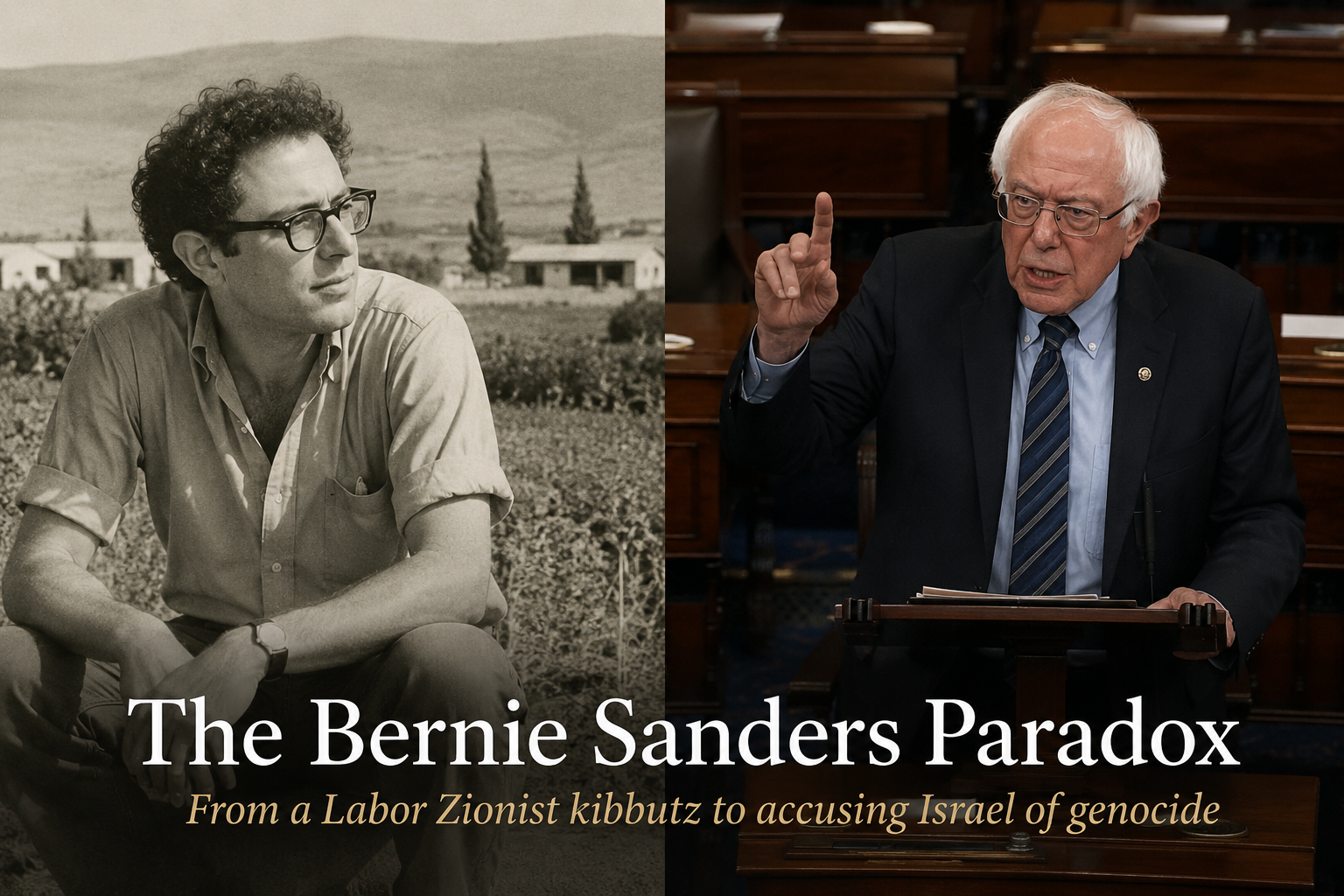
From a Labor Zionist kibbutz to accusing Israel of genocide
There are some public figures I disagree with and never think about again. Bernie Sanders isn’t one of them.
I’ve always regarded Bernie as a man of conviction. For more than half a century, he has fought for causes he genuinely believes will make America more just and compassionate. Whether I agree with him or not, I’ve never doubted his sincerity.
Which is precisely why I find him so difficult to understand.
Earlier this month, on the third anniversary of October 7, Bernie issued a statement condemning the Hamas massacre, affirming Israel’s right to defend itself, and calling for peace between Israelis and Palestinians. All sentiments I could readily embrace. But in that same statement, he once again accused the Israeli government of committing genocide in Gaza.
There it was again. That word. Genocide.
Bernie was born into a Jewish immigrant family in Brooklyn. His father’s relatives were murdered in the Holocaust. As a young man, he traveled to Israel and spent several months on a socialist kibbutz, immersing himself in a society built around equality, shared sacrifice, and collective responsibility.
More than sixty years later, that same young man would accuse Israel of committing genocide.
Plenty of politicians criticize Israel. Plenty of Jews criticize Israel. But Bernie’s story feels different. His biography seems to point in one direction. His politics ultimately took him in another.
How did the young man who embraced Israel’s socialist experiment come to accuse the Jewish state of genocide?
The Young Idealist
When I first began thinking seriously about Bernie Sanders, I assumed I knew the story. A lifelong socialist discovers that Israel no longer reflects his politics. Admiration gives way to disappointment, disappointment to criticism, and criticism eventually becomes condemnation.
The more I read, the less certain I became.
In the early 1960s, Sanders spent several months on Kibbutz Sha’ar HaAmakim, founded by Labor Zionists. It embodied ideals he would champion throughout his political life: shared labor, economic equality, and the belief that ordinary people could build a more just society together. Israel was still a young nation, absorbing Holocaust survivors and other Jewish refugees while attempting to prove that a Jewish homeland and democratic socialism could flourish together.
I expected to discover a dramatic turning point in Bernie’s relationship with Israel. Instead, I found that he had been questioning Israeli policy for decades. As mayor of Burlington in the late 1980s, he criticized Israel’s handling of the First Intifada while condemning those who sought its destruction.
His criticism long predated today’s progressive left and the growing influence of Democratic Socialists of America. Whatever explained his journey, its roots reached much deeper.
Perhaps I’d been asking the wrong question. Maybe the more interesting story wasn’t how Bernie Sanders had changed, but how history had changed Israel.
Two Israels
The Israel that welcomed the young Bernie Sanders no longer exists.
It was the Israel of David Ben-Gurion and Golda Meir, when Labor Zionism dominated politics and the kibbutz represented a national ideal. Israel was animated by egalitarian aspirations and consumed with absorbing Jewish refugees from Europe, North Africa, and the Middle East. To young progressives, it represented a hopeful social experiment: a democracy building both a Jewish homeland and a more just society.
Then history intervened.
The Six-Day War, the Yom Kippur War, two intifadas, suicide bombings, failed peace negotiations, Hamas, Hezbollah, and the growing threat from Iran reshaped Israel’s politics and its sense of itself. A country founded partly on socialist ideals increasingly defined itself through the demands of national survival.
But that explanation only carried me so far. Millions of other Jews experienced that same history. Many remained politically liberal, yet reached very different conclusions about Israel.
History alone couldn’t explain Bernie Sanders. Perhaps the answer lay in the lessons he drew from it.
A Different Moral Vocabulary
Whether Bernie was speaking about healthcare, economic inequality, workers’ rights, or Israel, the same themes appeared: justice, equality, compassion for those with the least power, and suspicion of institutions that accumulate too much power. There is something admirable about that consistency.
What I began to question was not Bernie’s commitment to justice, but whether justice alone was broad enough to explain the Jewish experience.
Justice is one of Judaism’s highest ideals. The Hebrew prophets demanded it. But the Jewish story is also about memory, vulnerability, and the hard-earned lessons of a people who spent nearly two thousand years without sovereignty or the ability to defend themselves.
That history gave birth to Zionism. Jews had learned, often at unimaginable cost, that universal ideals, however noble, were not enough to guarantee their survival. The Jewish people needed not only justice, but the power to protect themselves when justice failed.
I began to wonder whether Bernie and I were speaking different moral languages. He has repeatedly condemned Hamas, affirmed Israel’s right to exist, and recognized its right to defend itself. But his moral attention consistently returns to justice, proportionality, and the use of power.
Many Israelis and Diaspora Jews ask those same questions. But they often begin with another: after everything Jewish history has taught us, will this decision leave us safer than we were before?
It isn’t that one side values justice and the other values security. Both matter deeply. The difference lies in which question comes first when those values collide.
In a 2019 essay about fighting antisemitism, Bernie connected the struggle for Jewish freedom with the struggles of oppressed people everywhere. I respect that conviction. But Jewish history also teaches the importance of being able to defend ourselves when the world’s commitment to justice falls short.
October 7
As I worked through Bernie’s journey, I realized something unexpected. History hadn’t only acted on Israel. It had acted on me.
Before October 7, I probably would have weighed justice and security differently. Watching more than a thousand Israelis slaughtered in the Hamas attacks forced me to confront a reality that had become too abstract in my thinking.
Alongside questions about military necessity, proportionality, and protecting innocent civilians, I found myself asking a different first question: could Israel fulfill the most basic obligation of a sovereign nation, protecting its citizens from those who openly promise to kill them again?
That doesn’t mean justice became less important. It means the order of my questions changed. I also recognize the danger in that shift. A nation that allows security concerns to eclipse its democratic institutions, the rule of law, or its moral obligations risks losing something essential. Israel’s internal political divisions and struggles to preserve its democratic institutions present challenges of their own.
Perhaps that is Israel’s greatest challenge. Not choosing between security and justice, but preserving both. October 7 didn’t answer every moral question. If anything, it made them harder. But it fundamentally changed the order in which I began asking them.
Where We Part Company
By this point, I no longer found Bernie Sanders confusing. I found him remarkably consistent. And precisely because I thought I understood him, I became more concerned about the consequences of his rhetoric.
Reasonable people can disagree about settlements, coalition politics, military tactics, or individual military operations. Democracies should expect those arguments. But accusing Israel of genocide belongs to an entirely different moral category.
I believe Bernie is profoundly wrong to accuse Israel of genocide, and I find it painful to hear that accusation from him. His sincerity doesn’t soften the words or diminish his responsibility for them. He knows what genocide means in Jewish history. And his voice carries particular authority because that history is his own.
Genocide is among the gravest accusations that can be leveled against any nation. Accusing a government of genocide does not, by itself, mean denying that nation’s right to exist. But in a political climate where Israel’s legitimacy is already under attack, the distinction between condemning what Israel does and condemning what Israel is can quickly disappear. When one of America’s most recognizable Jewish political figures adopts that language, his words carry an authority extending far beyond the Senate floor.
I do not believe Bernie Sanders intends to undermine Jewish self-determination. But I do believe his use of the language of genocide lends credibility to those who do. That is a consequence he cannot simply dismiss, regardless of his intentions.
Public figures are remembered not only for what they intend, but also for what they legitimize. That, I believe, is where Bernie Sanders’ influence has become most consequential.
I began this essay trying to understand how the young man who spent time on a Labor Zionist kibbutz came to accuse the Jewish state of genocide. I came away believing that Bernie Sanders never abandoned the ideals that shaped him. But I also concluded that those ideals, standing alone, are not broad enough to explain the Jewish experience or the burdens of Jewish sovereignty.
I only wish they had led him somewhere else.