Rabbi of Tamid Palm Beach
The Bit Everyone Gets Wrong About Sinai
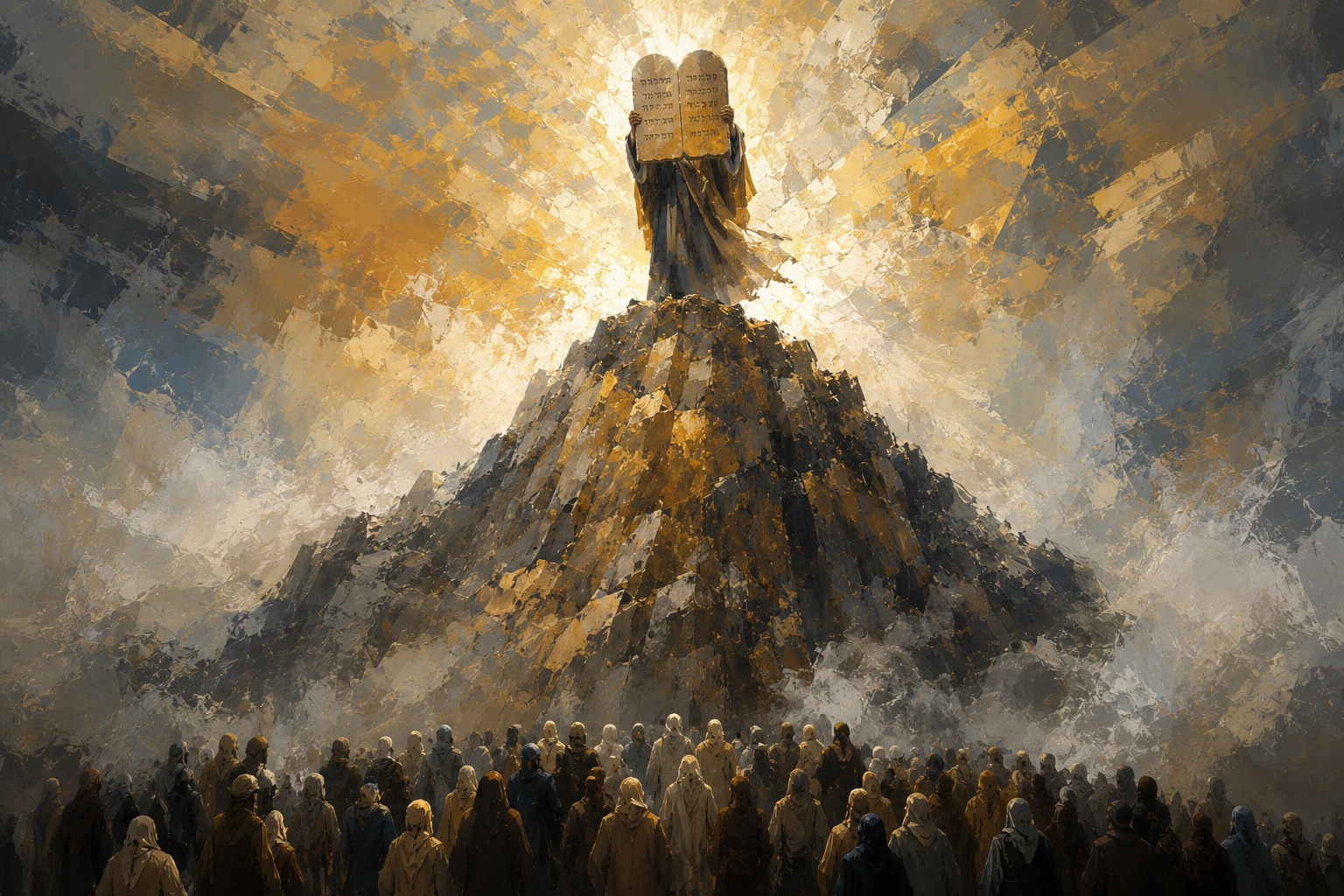
Moses and the 10 Commandments at Mt. Sinai. Photo by Feivel Strauss
Moses got all the credit. The real story was happening below.
There are two common phrases for what happened at Sinai, and the difference between them matters more than we might think.
The rabbis called Shavuot zman matan Torateinu, “the time of the giving of our Torah.” This describes Moses at the top of Mount Sinai. But when the rabbis spoke of the people standing below at Sinai, they reached for something different: Ma’amad Har Sinai, “the standing at Mount Sinai.
Look at who is standing where. God calls Moses up, but the revelation is aimed down. The commandments are not given to Moses for Moses. He is the conduit. The whole architecture of the moment is oriented toward the people waiting at the base of the mountain. One man ascends. A nation stands below and becomes, in that standing, something it was not before.
They were standing for something. For Torah, not merely as text but as a way of being in the world. For the values it carries: justice, dignity, responsibility, holiness. For the covenant it represents between a people and the demands placed upon them. That is what they rose for. That is what made the standing mean something.
And we have never entirely stopped. To this day, when a Torah scroll passes through a room, we rise. When a Torah scholar enters, we rise. The gesture has traveled three thousand years because what it points to has not changed. We are still, in some essential way, the people who stand for Torah, who recognize that certain things are worth getting to your feet for.
The rabbis remembered this. They did not preserve Sinai mainly as a story about a prophet on a summit. They preserved it as the moment a people discovered what they were, bound not by blood or conquest alone but by standing together before something that claimed them all.
Which raises an uncomfortable question for us today.
Because if we still stand for Torah, what does that mean when we cannot agree on what Torah demands? The rabbis were careful not to collapse the unity of Sinai into uniformity. One Midrash teaches that the divine voice spoke “according to the strength of each person”, that each individual heard differently, according to their own capacity and condition. The Talmud teaches that all Jewish souls across all generations were present at Sinai. The moment belongs to everyone, not to the one who climbed highest.
One Torah. Many human ears.
The unity of Sinai did not require that everyone experience it identically. It required only that they stand together before the same mountain.
That distinction feels urgently relevant right now.
In Jewish life, and especially in Israel, we often speak as though every disagreement is a battle over Judaism itself. One camp claims to represent the “real” Torah. Another insists it alone embodies authentic Jewish values. Groups treat one another not as fellow Jews wrestling with shared questions, but as existential threats to the Jewish future.
And yet most of these arguments are not actually about whether justice matters, whether human dignity matters, whether Jewish continuity matters, whether security or compassion or responsibility matters. We largely share those commitments. What divides us, more often, are policies, priorities, interpretations, strategies for honoring ideals we hold in common.
Sinai reminds us that one Torah can still produce many human perspectives. That is not relativism, it is the tradition’s own testimony about itself. The Talmud preserved minority opinions precisely because the rabbis understood that the minority view might someday be the one the world needs.
But Sinai also reminds us that no single camp gets to claim Torah, covenant, or the Jewish future for itself. These belong to the whole people, the people standing together.
Before the arguments, before the competing camps, before the endless interpretations, there was something more elemental: a people capable of standing together before something larger than themselves.
That may still be the deepest challenge of Shavuot.
Not only how to receive Torah. How to remain a people while hearing it differently.
Related Topics
Related Posts