

The Blessing of Making Aliyah at 79
 In honor of my mother’s Yahrzeit
At age 79, my mother became an olah hadashah, a new immigrant to Israel. We moved her to live in the small apartment above my sister Ruth’s home within the Old City in Jerusalem. In the years preceding her move to Israel, she had descended into the fog of Alzheimer’s disease. Her engagement with the world had diminished; her memories were dissolving. All that she was and all that she represented was replaced by the poignant image of who she had become: frail, confused, angry and profoundly dependent. Thus, in a decision filled with pain and anguish, our family decided my mother should spend the remainder of her days in Israel.
Memories of that day of leave-taking are so clear: We had told her time and again that she was going to visit my sister Ruth in Israel. But we had not told her the full truth. Her husband, Leon, and I had round-trip tickets; my mother’s ticket was one-way.
When the wheels touched down at Ben Gurion Airport and the other passengers applauded — I did not know what to feel. When it was finally our turn to approach the agent in the passport control booth, we declared that my mother was an olah hadashah. Our passports were dutifully stamped, and we were directed to a telephone in a corner of the arrival lobby. We dialed immigration control and, within minutes, a handsome middle-aged man arrived and accompanied us into the elevator, to the second floor and into the small immigration office.Bottom of Form
All this time, my mother repeated incessantly, “I want to go home, I want to go home.” Leon and I worked hard to keep her calm, and the immigration officials were thoughtful and patient. Within a half hour, all forms had been filled out. Each thump of the official stamp proclaimed the magnitude and finality of this life transition. With one final thump, my mother was an Israeli citizen.
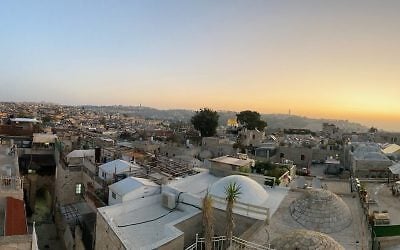
As my sister Ruth and Leon unpacked my mother’s belongings in her apartment, I stepped outside to catch my breath on the deck. I turned to the left and peered at the Church of the Holy Sepulcher. Moving to the railing on my right, I shielded my eyes from the sun and marveled at the gold-clad Dome of the Rock. Turing further to the right, I observed the rebuilding of the Hurva Synagogue. My mother will spend her final days surrounded by the world’s holiest sites, the epicenter of Western faith and the focus of thousands of turbulent years of history. She has no awareness of this.
There is no happy ending with Alzheimer’s disease. But within the sadness and pain, there is a blessing for us. In the warmth of the Jerusalem sun, in the shadow of sacred spaces, my mother is well cared for and nurtured. I do not have the expertise to assess the technical quality of medical care that my mother is receiving in Israel relative to health care in the United States. However, what is so profoundly evident is the remarkable human dimension of her care: home visits, after-hours calls, a gentle touch, a kind word. She is treated as if she were a member of an extended family.
As a child growing up in the 1950’s and 60’s, Israel was a miracle and a dream to me. Wrapped within this miracle was the Law of Return: All Jews are welcome to live in Israel and benefit from all it offers its citizens — security, support and human services. At Jewish day school, I sat transfixed as teachers spoke of homeless wanderers from across the globe embraced by Israel. They have come by millions and have built this remarkable nation. But my mother will never be a nation builder; she cannot contribute to this society. She can only be a ward of its protective and supportive services. It is a remarkable gift.
Israel is an unfinished and, as of yet, still flawed experiment. Perhaps all nations, all societies, are. While we stand in awe at its survival and marvel at its accomplishments, we may also at times find ourselves cringing at policies and practices that offend our political or cultural sensitivities. It is not difficult to feel conflicted and confused about the latest challenging news emanating from Israel.
But I think of my mother, sitting in a small apartment in the shadow of some of the holiest places on earth. She sits in the sun, her memories fading, perhaps being absorbed into the stones of this city of memories. She has been welcomed to this home. She has been embraced by these people, our people. She is a Jew living in the land of the Law of Return.
My mother died on November 16, 2010, 9 Kislev, 5771, and is buried in the hills outside of Jerusalem. Her memory is a blessing.